
Home / Hayati Pro Max Plus Pods / Rocky Candy Orange Hayati Pro Max Plus Pods
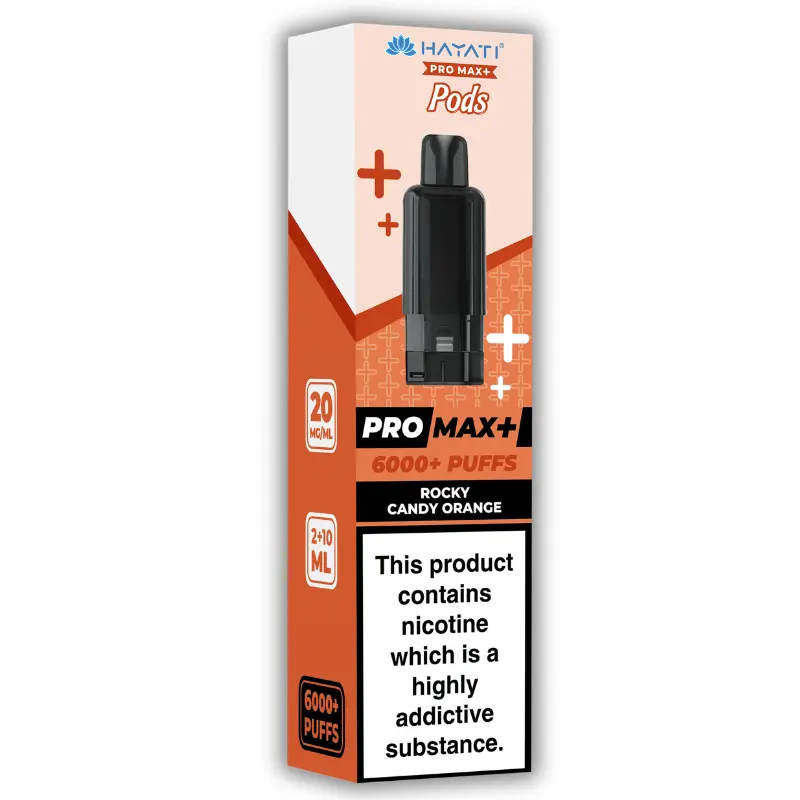
Hayati · Pro Max Plus
Rocky Candy Orange Hayati Pro Max Plus Pods
£5.49
✔ In stock — ready to ship
Genuine Hayati
Free over £20
Same-day dispatch
Secure checkout
Rocky Candy Orange is a single prefilled pod at £5.49, supplied on its own with no device in the packet. Twelve millilitres of 20mg nicotine salt liquid, sealed in a pod that carries its own coil, sold to somebody who already has a Hayati Pro Max Plus body and is topping the drawer up rather than choosing hardware. The commercial shape of the listing is that simple, and it is the least interesting thing about it.
The interesting thing is the name. Three words, and only one of them names something a person can taste. Orange is a fruit. Rocky and Candy are not flavours in any sense at all. They are statements about physical form. Rock is hard. Candy, in the register this label is reaching for, is sugar boiled to a solid and set until it fractures rather than yields. Both words describe what a substance does against teeth, and an aerosol has nothing for teeth to do. There is no solid phase in vapour. There is nothing to bite, nothing to crack, nothing to wear down over ten minutes against the roof of the mouth. Whatever else this pod delivers, it cannot deliver the one property its first two words announce.
That is not a complaint about Hayati and it is not a trick. It is a question about what a texture word is actually doing when somebody prints it on a bottle of liquid, and the question has a real answer. The answer is that the word is not describing a sensation at all. It is naming a class of confectionery in order to point at a flavour profile, and boiled sweet orange is a genuinely distinct and recognisable profile that differs from fresh orange, from orange juice and from orange squash in ways you can set out precisely. Doing that work is the useful part of this page, because it is the part that tells you what will actually be in your mouth.
So there are two ways to read the label, and they lead to two different purchases. Read as a promise about mouthfeel, it will disappoint you, because the promise is not physically available. Read as a pointer to a register, it is unusually informative and it narrows the field faster than most three-word names on this shelf do. The rest of this page works out which reading the evidence supports, and what follows from it for the liquid you will be drawing on.
Three words, and two of them describe a solid
Start by counting, because a claim about naming is worth nothing unless it survives the catalogue. Hayati's full range across every format runs to 492 listings carrying roughly 190 distinct flavour names once you strip the hardware suffix off each title. Search those names for anything that reports a physical state rather than an ingredient and you get about fourteen: Rocky Candy Orange, Fizzy Cherry, Ice Pop, Gummy Bear, Blue Razz Gummy Bear, Strawberry Jelly Beans, Smooth Strawberry Ice, Smooth Tobacco, and a bubblegum family of six that spans Bubblegum, Bubblegum Ice, Blueberry B'Gum, Strawberry Watermelon Bubblegum, and two dual listings that pair a B'Gum side with something else. Fourteen out of roughly 190 is not rare, but it is a small minority, and the great majority of Hayati's names hand you a fruit or two and stop.
Narrow to the shelf this pod actually sits on and the picture sharpens. The Hayati Pro Max Plus Pods shelf carries 89 listings with 89 distinct names, and exactly seven of those names contain a word about physical form: Blue Frozen, Blueberry B'Gum, Fizzy Cherry, Ice Pop, Rocky Candy Orange, Smooth Strawberry Ice and Smooth Tobacco. Seven of 89. And within that seven, the words are not doing the same job. Frozen and Ice are about temperature, which vapour can carry, because chemical coolants act on the same nerve endings cold does. Smooth is a mouthfeel adjective vague enough to survive almost anything. B'Gum names a chew. Fizzy names effervescence. Rocky is the only one on the shelf that names hardness, which is the single property of a solid that has no analogue whatsoever in a gas.
That is the narrow, countable version of the claim, and it is the one worth making. Not that texture words are unheard of here. Not that Hayati are unusual for using one. Only that on this particular shelf, Rocky Candy Orange is the one listing whose name leads with a property the medium cannot transmit under any circumstances, and that it doubles down by following it with a second word from the same category.
Two other pages in this catalogue have taken apart a name that fails to deliver what it appears to offer, and it is worth saying what they found, because this page is arguing something different from both. The Dragon Berries pod kit page examined a title where a named ingredient turns out to contribute almost nothing, because dragon fruit is celebrated for looking remarkable and tasting of very little, so the word on the box points at a real fruit that cannot supply much of a flavour. The Fruit Bomb / Straw' Watermelon B'Gum page examined a name that promises magnitude rather than identity, where the word tells you how loud something is meant to be without telling you what it is. Neither of those is this. A missing ingredient is a shortfall of degree: dragon fruit gives you a little and you wanted more. A magnitude word is an unanchored comparison: loud against what? Rocky is a different failure entirely, and a cleaner one. It is not that the property arrives weakly or arrives unmeasured. It is that the property has no route into an aerosol at all, and would not arrive if the recipe were perfect and the coil were new.
Which forces the question this page exists to answer. If the word cannot be describing the sensation, and Hayati are not in the habit of printing words at random, what is it describing?
What vapour carries, and the one channel it has no access to
Work out the limit properly and the rest of the page follows from it. What people loosely call flavour is assembled from several separate streams of information, and they do not arrive by the same route.
The first is aroma: volatile molecules light enough to travel as a gas, picked up by the olfactory epithelium either through the nostrils or, more importantly here, from the back of the throat on the exhale. Retronasal aroma is where nearly all flavour identity lives. It is the reason a blocked nose flattens food to sweet and sour, and it is the reason the fruit in a pod tends to declare itself on the way out rather than on the way in. Vapour carries this stream well. Aroma compounds are exactly the sort of thing a warm coil can lift into an aerosol.
The second is taste proper: sweet, sour, salt, bitter and savoury, read by receptors on the tongue from compounds that have dissolved in saliva. Vapour carries this stream partially. Condensate from the aerosol does deposit on the tongue, so a sweetener and an acid in the liquid do register, but at a fraction of the concentration a mouthful of food or drink delivers. Sweetness in vapour is a quieter, more suggestive thing than sweetness in a sweet, and a lot of what reads as sweet is actually aroma doing the work rather than the sweet receptor.
The third is chemesthesis, which is the trigeminal nerve reporting temperature, chemical cooling, warmth and irritation. This is the stream that menthol and the synthetic coolants use, and it is why a cooled liquid genuinely feels cold rather than merely tasting of mint. Vapour carries this stream very well, and it is the reason cooling words on labels are the honest ones: an Ice listing can actually produce the sensation it names.
The fourth stream is texture, and it works completely differently from the other three. Texture is mechanoreception. Receptors in the tongue, the palate, the gums and the jaw report force, resistance, fracture, particle size and the way a thing changes shape under pressure, and some of it is not even felt so much as heard, conducted up through the jawbone as the sound of something breaking. None of that is chemical. It is a mechanical reading of a solid or a liquid that has mass and occupies space.
An aerosol has no solid phase. It applies no meaningful mechanical load to anything in the mouth. Nothing in it can fracture, because there is nothing solid to fracture. Nothing in it can abrade, dissolve slowly, stick to a molar, or take ten minutes to disappear. The sound is absent, the resistance is absent, and the slow arc of a hard sweet getting smaller and sharper-edged as it goes is absent. This is not a limitation of Hayati's recipe or of this particular coil. It is a property of the format, and no amount of formulation skill changes it, in the same way no amount of skill makes a photograph smell of anything.
There is one honest qualification and it should be made rather than glossed over, because a page that overstates its own argument is no better than a label that overstates a product. Vapour is not entirely without physical presence in the mouth. Vegetable glycerine raises the density of the aerosol, so a glycerine-heavy liquid produces a thicker, more coating cloud that genuinely feels different from a thin one, and most people will describe that difference in texture words. There is also throat feel, which is partly the nicotine and partly the propylene glycol. So the mouth is not receiving nothing. What it is receiving is a property of the base liquid and the power going through the coil, not a property of the flavour. It is the same for every pod on the shelf regardless of what the label says, which means it cannot be what Rocky is pointing at. No flavouring decision produces hardness, and hardness is what the word means.
One further consequence is worth drawing out, because it is the part people notice without being able to name. A hard sweet has a shape in time. The flavour is locked in a matrix that dissolves slowly, so intensity climbs for the first minute, plateaus, and then fades as the sweet gets small. That arc is half of what makes the experience recognisable. A pod has no arc of that kind. Each draw is a fixed dose delivered over two or three seconds and then gone, and the next draw starts from nothing again. So the confectionery frame misleads about pacing as well as about hardness. Even if every aroma molecule matched a real orange sweet exactly, the shape of the experience would be wrong, because one is a slow release and the other is a series of discrete events.
Boiled sweet orange is a real flavour, and it is not fresh orange
Having established what the word cannot mean, here is what it does mean, and this is the section that should decide the purchase.
Confectionery flavours are a category in their own right, and orange is one of the clearest examples of the gap between a fruit and the sweet named after it. Anyone who has eaten both knows they are not the same thing, but the reasons are specific and they explain what a liquid built on the second one will actually taste like.
Take fresh orange first. Peel the fruit and the first thing that reaches you is not the flesh at all, it is the oil from the skin, a fine spray of it released as the peel tears. That oil is mostly d-limonene, which on its own smells of generic citrus rather than of orange specifically, plus small quantities of aldehydes and other minor components that do the actual identification work. The flesh underneath is mildly acidic, watery, faintly bitter where the membrane is, and the juice vesicles burst individually so the sweetness and acid arrive in irregular pulses rather than evenly. It is a low-intensity, high-complexity flavour, and it is unstable: the delicate components oxidise quickly, which is why a cut orange smells duller after an hour. Reproducing that in vapour is one of the harder problems in citrus, because the minor compounds that make it read as orange rather than as lemon or generic citrus are exactly the ones that thin out under heat.
Orange juice is a different animal again, particularly anything that has been pasteurised or reconstituted. Heat treatment adds cooked notes and takes away top notes, so the result is rounder, heavier, and less bright than the fruit it came from. There is pulp body, a slightly savoury edge in some from-concentrate juice, and the sugar and acid are in fixed proportion rather than arriving in pulses. A liquid aiming at the juice register reads thick and slightly dull, and it works best with something sharp alongside it. This is the register Blackcurrant Juice is pointing at with its own name, and it is a useful comparison precisely because Hayati named that one after the drink rather than the fruit.
Orange squash or cordial is a third thing. Dilute a concentrate and what you have is a lot of water, a fair amount of sweetener, a considerable load of citric acid and a very small quantity of orange oil. The acid is the loudest component, the aroma is thin, and the sweetness in cheaper squash has a slightly flat, wide quality that comes from intense sweeteners rather than sugar. A squash register in an e-liquid reads watery and sharp, with the acid arriving before the fruit does.
Marmalade is worth a mention as the fourth point of comparison, because it is the one orange profile that keeps the bitterness. Cooked peel, caramelised sugar, and pith bitterness deliberately retained. Nothing in this pod's name points there, and it would be a strange thing to build a 12ml pod around, but naming it helps fix the boundaries of what a confectionery orange is not.
Now the boiled sweet, which is what Rocky Candy is pointing at. Sugar confectionery of this kind is made by cooking a sugar syrup to the hard crack stage, well above the boiling point of water, then cooling it fast so it sets as an amorphous glass rather than crystallising. That process is brutal on flavour. Delicate aromatics simply do not survive it, so the flavouring has to be robust, heat stable and added as late in the process as the manufacturer can manage. The practical result is that confectionery orange is not built from cold-pressed peel oil doing subtle work. It is a compounded flavour, assembled from a narrow set of durable components chosen because they are instantly identifiable and because they last.
That gives the boiled sweet orange four properties that separate it cleanly from the fruit.
- It is simplified. Fewer components than the fruit, each of them louder. The blurry, half-noticed parts of a real orange are gone, and what is left is a small number of markers turned up.
- It is symmetrical. A real orange develops: peel oil first, then juice, then a slight bitterness at the end. A boiled sweet does not develop at all, because the flavour is distributed evenly through the glass. The last minute tastes like the first.
- It has no bitterness. No pith, no membrane, no rind. The whole bitter register that anchors a fresh orange is absent by design, and its absence is a large part of why the sweet reads as a sweet rather than a fruit.
- Its sweetness is round rather than sharp. Sucrose has a heavy, full quality that reads as body as much as sweetness, and it sits underneath the citrus rather than competing with it. The acid load is much lower than in juice or squash, so the orange sits on a broad sweet base with only a small lift of sourness on top.
Here is why that matters for a pod rather than for a confectioner, and it is the single most useful observation on this page. The confectionery version of orange is already a simplified, robust, high-amplitude construct, designed from the start to survive heat and to be recognised without complexity. That is precisely the kind of flavour a coil can deliver faithfully. The fresh fruit version is the hardest citrus target in vapour, because its identity lives in fragile minor components. So the words Rocky Candy are not decoration bolted onto the front of an orange liquid. They are a signal that the recipe is not attempting the difficult version, and that is genuine information. A buyer who wanted a chilled glass of fresh orange should read those two words as a warning, and a buyer who wanted the loud, sugary, single-note orange should read them as a match.
The tasting description Hayati themselves put on the listing is consistent with all of this. Their own wording characterises it as a concentrated, sweet citrus modelled on rock rather than on the fruit, bright, with a sugary quality and a little zest at the finish. Take that as the maker's account rather than as an independent verdict, because that is what it is, but note that it matches the register the name predicts. If Hayati had described a pulpy, juicy, acidic orange, the name and the description would be pulling in opposite directions and that would be worth flagging. They are not.
What that should sound like from front to back
Turning a register into an expectation of the actual draw is the last piece, and it needs to be done with the confidence level marked, because nobody should take a flavour-by-flavour account from a retail page as a tasting note.
Reasonably confident. The inhale will be the quieter half. Citrus aroma is light and volatile, and in a mouth-to-lung pod most of the identity arrives retronasally, so the front of the draw is likely to be sweetness and a general brightness rather than a fully formed orange. The exhale is where the fruit should resolve and where the confectionery quality should be obvious. Sweetness will be high. Every element of the naming points at the top of the sweetness range, and a confectionery register with no sour word attached to it has nothing pulling in the other direction.
Reasonably confident. There will be little or no bitterness. That is the structural consequence of aiming at a sweet rather than at a fruit, and it is also the difference a buyer will notice fastest if they have been running a pod with any pith or rind character in it.
Probable. The acid load is modest. Hayati label sourness when it is present: seven distinct names in the catalogue carry the word Sour, including Cherry Sour Raspberry and Blue Sour Raspberry, so its absence here is weak evidence rather than no evidence. Expect a lift of zest at the back of the exhale rather than a sour spine running through the whole draw. This is an inference from naming practice, not a published figure.
Probable. Little or no cooling. Hayati mark cooled liquids in the title with Ice, Frozen or Cooler, and this name carries none of those words. Hayati publish no coolant declaration on any listing, so the naming convention is the only evidence available, and a convention is not a specification. If a small amount of coolant is present to sharpen the citrus, which is a common formulation choice, the name would not necessarily record it.
Unknown. Where this sits on a sweetness scale against the other 88 listings on the shelf. It will be sweet. Whether it is sweeter than Berry Lemonade or less sweet than Ice Pop is not published by anybody, and anyone who tells you otherwise is guessing.
Unknown, and it matters. The intensity. This is the axis most likely to decide whether you keep rebuying, and there is nothing on the record about it. A confectionery register can be executed at a level that is pleasant across 12ml or at a level that is exhausting after two days. The name predicts the shape of the flavour and says nothing at all about the volume it is played at.
What this pod is not, stated flatly, because ruling things out is more useful than piling adjectives up. It is not a fresh orange. It is not an orange juice profile. It is not a citrus blend, because there is no second citrus in it, which distinguishes it from every other orange listing Hayati sell. It is not sour. It is not, on the naming evidence, a cooled liquid. And it will not feel like anything hard in the mouth, because nothing can.
The two readings, and which one to buy on
Set the two readings side by side and the verdict is not close.
The mouthfeel reading says: this liquid will give me some impression of crunch, hardness, or the physical business of a boiled sweet. That reading is wrong, and it is wrong for a reason that no product improvement could address. It fails on the medium, not on the recipe. A buyer holding that expectation will be disappointed on the first draw and will probably not be able to say why, because the disappointment is about an absence rather than a fault. Nothing tastes wrong. Something that was implied simply is not there.
The register reading says: this liquid is aiming at the flavour profile associated with a hard orange sweet, meaning simplified, loud, sweet, symmetrical, and free of the bitterness and the irregularity of the fruit. That reading is supported by everything available. It is supported by the confectionery word appearing at all, by Hayati's own description of the liquid as modelled on rock rather than fruit, by the absence of a sour word in a range that uses sour words, and by the technical fact that the confectionery version of orange is the version most likely to survive a coil intact.
So the name is a poor promise and a good pointer. As a pointer it is more informative than most, which is the part worth being fair about. Compare it with the listings on this shelf whose names supply nothing at all: Black Mamba, Blue Fusion and Midnight Dream, the last of which has its own page devoted to the problem of a title made of two words that name nothing tastable. Rocky Candy Orange names a fruit and a category of confectionery, and those two facts together narrow the field substantially. The texture word is doing real work. It is just not doing the work it appears to be doing.
One more consequence follows, and it is practical rather than philosophical. If the word is a register pointer, then the right comparison set for this pod is not other oranges, because there is only one other orange family in the whole catalogue. It is other confectionery-register listings, regardless of fruit. That changes which alternatives are worth looking at, and the comparison section below is organised on that basis.
The pod itself, kept short
What arrives is one sealed pod holding 12ml of liquid at 20mg, with the coil and wick built into it. No body, no cable, no spare. The Rocky Candy Orange Hayati Pro Max Plus 6000 Pod Kit at £7.99 is the same flavour with a rechargeable body included, so the £2.50 difference between the two listings is the price of the hardware and nothing else. Buy the pod if the body is already on your desk. Buy the kit if it is not, or if a second body is genuinely useful to you.
Check the range name printed on the device you own against the range name in the listing title before ordering, because Hayati run several pod families and a compatibility decision from a retail page is not a substitute for the hardware in your hand.
The one specification that actually matters for this particular liquid is the volume. Twelve millilitres is a long run for a single flavour, and a confectionery register is a more demanding thing to commit that much liquid to than a middle-of-the-road fruit is, because loud and sweet is exactly the sort of profile a palate adapts to. That is a flavour argument rather than a hardware argument, which is the point: the device is the same device it is under the other 88 listings on the shelf, and the rest of what there is to say about it lives on the Pro Max Plus pods shelf rather than here. The coil is sealed inside the pod and is not replaceable, so the pod is spent when the coil is, whichever comes first.
The listing, relabelled and read
| Flavour register | Confectionery citrus, modelled on a hard orange sweet |
| Fruit named | Orange, and no second fruit |
| Words in the name that describe form | Two of three |
| Cooling in the title | None declared |
| Sour treatment in the title | None declared |
| Nicotine | 20mg, nicotine salt, the only strength on this listing |
| Liquid volume | 12ml, already in the pod |
| Price | £5.49 |
| Supplied as | One pod, no device, no cable |
| Body required | Hayati Pro Max Plus, bought separately |
| Coil | Built into the pod, replaced only by replacing the pod |
| Manufacturer puff figure | Rated by Hayati at up to 6,000, a laboratory estimate |
| Maker | Hayati |
| Reference | rocky-candy-orange-hayati-pro-max-plus-pods |
Two of those lines need reading rather than glancing at. The 20mg figure is the ceiling permitted for nicotine in the United Kingdom, so it is not a choice Hayati made about this flavour in particular, it is the top of the legal range and most prefilled pods sit there. Nicotine is addictive and the strength is worth knowing for that reason rather than as a performance number. If a lower figure suits the way you use a pod, the same platform is sold as Hayati Pro Max Plus Prefilled Pods 5mg and as Hayati Pro Max Plus Prefilled Pods Zero Nicotine, though those are the range's own flavour defaults and not this orange.
The puff figure is the other one. Six thousand is a rating produced by test equipment drawing at a fixed length and a fixed interval, which no person does, so it is a comparison number between listings rather than a forecast of your week. On a sweet, sweetener-forward liquid it is also likely to be the less binding of the two limits, because the coil on a heavily sweetened pod usually reaches the end of its useful life before the liquid does.
Everything else in the table is a plain fact from the listing. What is absent from it is also worth naming: no ingredient list, no coolant declaration, no sweetener named, no coil resistance, no flavour-house attribution. Hayati publish none of those on this product and neither will this page.
What to weigh it against, and who should take which
Orange first, because it is the shortest list in the catalogue. Across all 492 listings, only seven titles contain the word orange, and four of them are the Orange Lemon Lime family. That leaves the three Rocky Candy Orange listings, which means this is the only place in Hayati's entire range where orange is the sole fruit named. Everywhere else it is a partner to lemon and lime. If you want orange without other citrus alongside it, there is no alternative to consider, which is an unusual position for a listing on a shelf this size to be in.
If you want the citrus spread across three fruits instead of concentrated on one, Orange Lemon Lime Hayati Mini Ultra Pods at £3.49 is the nearest thing, and it is genuinely a different proposition rather than a substitute. Three citrus fruits sharing one profile means the orange is a component rather than the subject, the lime brings an acid edge that a confectionery orange will not have, and it is a different pod family on different hardware, so check what you own before ordering. The Orange Vapes shelf collects the orange-adjacent listings in one place, and it is worth knowing that it holds nine products of which only seven actually name orange in the title. Two of them, Blue Fusion and Blue Razz Fruit Twist, are shelved there without orange appearing in their names at all, which is a reminder that a category page is a merchandising decision rather than an ingredient list.
Now the comparison that actually matters, which is by register rather than by fruit. If what appeals is the confectionery treatment rather than orange specifically, the shelf has a small cluster of listings pointing at drinks and sweets instead of at fruit, and they are the real neighbours here.
Ice Pop is the closest structural relative, because it is the other listing on the shelf named after a confectionery item rather than an ingredient, and it has the same problem in a milder form: an ice pop is defined partly by being frozen solid, and vapour cannot be frozen solid either. The difference is that an ice pop's flavour register is thin, bright and syrupy in a way a coil can approach, and the cooling half of the name can genuinely be delivered by a coolant. Take Ice Pop if you want sweet and cold. Take this if you want sweet and warm-toned.
Berry Lemonade, Blackcurrant Lemonade and Blue Razz Lemonade are the soft-drink register on this shelf, and they solve a different problem. A lemonade profile carries its own acid and a suggestion of carbonation, so it stays lively across a long pod in a way a pure sugar register does not. If you have found sweet liquids go flat on you by the third day, a lemonade is the more dependable bet of the two structures, and this pod is the one that asks more of your tolerance for sweetness.
For the fruit-drink register rather than the confectionery one, Blackcurrant Juice is the shelf's clearest example, and it is the direct opposite of the choice this pod makes. Juice means pulp, body and a little tartness. Rock means glass, amplitude and no tartness at all. Somebody who reads the word juice as appetising and the word candy as excessive should buy the blackcurrant and not this.
If the sweetness is the worry, the acid-forward listings are the corrective. Cherry Sour Raspberry and Blue Sour Raspberry both declare a sour treatment in the title, which on the evidence of Hayati's naming habits means it is a deliberate part of the recipe rather than an accident of the fruit. Running one of those alongside this one is a reasonable way to keep a sweet pod from wearing its welcome out, because the palate resets faster against something sharp than against something neutral.
If the missing cold is the worry, the cooled listings are where to go. Banana Ice, Blackberry Ice and Blue Frozen all put a temperature word in the title, and the useful point is the one this page has been making from the start: those words are honest in a way Rocky is not, because chemical coolants act on the same nerve that reports actual cold, so the label names something the format can deliver. A cooling word predicts a sensation. A hardness word cannot.
Among the berry listings that make up most of this shelf, Blueberry Cherry Cranberry, Blue Razz Cherry and Mad Blue represent the crowded middle that this orange is a deliberate break from. That is the honest case for buying it: not that it is better, but that it is different from the run of dark fruit, and a rotation built entirely out of berries flattens after a while because the fruits share so much of their aroma profile. A citrus in the set gives the rest of it something to be distinct from.
Juicy Peach is worth naming for a different reason. Its page sets out the argument about single-flavour pods having no in-session escape route, which applies here too and will not be repeated: a 12ml pod of one loud liquid is a commitment, and the only exits are a second device, an early bin, or waiting it out. If that argument worries you about a sweet citrus specifically, it should, because loud sweet profiles are the ones adaptation acts on fastest.
Finally, the practical restocking note. This listing sits on Hayati Pods and on Hayati Prefilled Pods and Refills as well as its own shelf, and the whole range is on the full Hayati listing. Ordering one pod first rather than three is the sensible move on a flavour whose intensity is not published, and the £5.49 price makes a single-pod trial cheap enough that there is no case for buying in bulk before you know.
Living with 12ml of a sugar-forward citrus
The handling advice that matters here is not the generic sort, it is the sort that follows from this liquid being both sweet and citrus, which is a combination with two specific consequences.
The first is residue. Sweetness in an e-liquid does not come from sugar, because sugar does not behave usefully on a coil. It comes from a combination of sweet-smelling aroma materials and, in most sweet liquids, an intense sweetener. Hayati publish no ingredient list, so what is in this one is not on the record, but the general behaviour of sweetened liquids is well established: the sweetener does not fully vaporise, it accumulates on the coil and darkens with heat, and the coating it forms dulls flavour delivery before it affects anything else. On a pod with a sealed coil there is no cleaning it, so the practical consequence is that a sweet pod tends to fade rather than to fail, and the fade is gradual enough that you adapt to it without noticing.
The second consequence is what fades first, and this is the part specific to a citrus. The bright, volatile top of a citrus profile is the most fragile thing in the liquid and the first casualty of a coil that has started to coat. Sweetness holds up longest, because sweetness is carried by heavier components. So the failure mode of this particular pod is predictable: the orange thins out and the sugar stays, and what was a bright sweet citrus becomes a vague sweet. If you notice the flavour turning generic rather than turning nasty, that is the coil rather than the liquid, and it is the signal that the pod is near the end of its useful life even if there is liquid visibly left in it. That is a real cost and it is worth factoring into the price per pod.
Chain drawing makes both of these arrive sooner. Back-to-back draws leave the wick short of liquid and the coil running hotter than it should, and hot running is what turns a slow coating into a fast one. Leaving a few seconds between draws is not a rule about etiquette, it is the single cheapest thing you can do to keep a sweet pod tasting the way it did on day one.
On storage, keep spare pods out of direct sunlight and away from anything warm, because heat and light degrade citrus aromatics faster than they degrade almost anything else in a flavour library. A pod left on a car dashboard for a summer afternoon will not be the pod you bought. A drawer at room temperature is entirely adequate, and there is no benefit to refrigerating anything.
If you set a pod aside part used and come back to it weeks later, expect the first few draws to be muted and slightly off-key, then to recover. The wick has been sitting saturated in warm liquid, and the material immediately around the coil oxidises a little. It is not spoilage, it is a stale saturation layer, and drawing through it clears it. Give it three or four slow pulls before judging whether the pod is finished.
On disposal, a spent pod is not ordinary rubbish. It holds an electrical component in the form of the coil, plus a small residue of liquid, so it belongs in the electrical waste stream. Most vape retailers operate a return arrangement for exactly this, and household recycling centres accept small electrical items. Dropping it in a bin is the one handling decision on this list with no upside at all.
One last point on pacing rather than maintenance. The confectionery frame this page has spent so long on has a practical edge to it. A hard sweet is self-limiting: you have one, it lasts ten minutes, it ends, and the ending is built into the object. Twelve millilitres of a liquid built on the same flavour register has no such stopping point. If you find intensely sweet things pleasant in small doses and tiring in large ones, that is a real reason to treat this as a rotation pod rather than an only pod, and to have something sharp or cold in the drawer beside it.
Questions that come up before ordering this one
Will this actually taste like a hard orange sweet?
It should taste like the flavour of one, which is simplified, loud, sweet and free of bitterness. It cannot feel like one, because hardness is reported by pressure receptors reading a solid and vapour contains no solid. The flavour half of the reference is deliverable and the physical half is not, and the name does not distinguish between them.
Is there any cooling in it?
Nothing in the title says so, and Hayati use Ice, Frozen or Cooler when a liquid is cooled. That is a naming convention rather than a published specification, so it is good evidence and not proof. A small coolant load used to sharpen the citrus would not necessarily show up in the name.
How sweet is it compared with the rest of the shelf?
Sweet, on every available signal, but no page can honestly place it on a scale against the other 88 listings because nobody publishes a sweetness figure. A confectionery register with no sour word attached has nothing counterbalancing it, so the top of the range is the sensible expectation.
Is this the same as the Orange Lemon Lime pods?
No, and not only because of the extra fruits. Orange Lemon Lime spreads the citrus across three fruits with lime supplying an acid edge, sits on different hardware at £3.49, and aims at a fruit register rather than a confectionery one. This pod is the only listing in Hayati's range where orange stands on its own.
Does the pod include the device?
No. One prefilled pod arrives and nothing else. The Rocky Candy Orange kit at £7.99 adds a rechargeable body for £2.50 more, which is the sensible listing if you do not already own one.
Can the coil be changed when the flavour dulls?
No. The coil is built into the pod and the two are discarded together. On a sweetened liquid the coil usually reaches the end of its useful life before the liquid runs out, which is the main reason a sweet pod is worth buying one at a time rather than in quantity.
What does the 6,000 figure actually mean?
It is a manufacturer rating produced on test equipment, drawing at a fixed duration and interval that no person reproduces. Treat it as a way of comparing listings against each other rather than as a prediction of how long a pod will last you.
Why is 20mg the only strength?
Twenty milligrams per millilitre is the maximum permitted in the United Kingdom, and most prefilled pods are filled at it. Nicotine is addictive, which is the reason to know the number. Lower-strength pods exist on the same platform as the range's own default flavours rather than as this orange.
Is it sour at all?
Probably only a small lift at the finish. Hayati put the word Sour in seven distinct flavour names across the catalogue, so they label it when it is a feature, and its absence here is reasonable evidence of a modest acid load rather than a sharp one.
Will a citrus flavour survive a long pod better or worse than a berry?
Worse, generally. Citrus aromatics are lighter and more fragile than berry ones, so they are the first component to thin out as a coil coats up. Expect the orange to fade while the sweetness stays, rather than the whole profile fading evenly.
Should I buy one or several?
One. The intensity of this liquid is the axis most likely to decide whether you want it again, and it is the one thing nobody publishes. At £5.49 a single pod settles the question cheaply, and a sweet profile is exactly the kind you can tire of before a multi-pod order runs out.
What is the best thing to run alongside it?
Something with acid or cooling in it, for the practical reason that the palate resets faster against a contrast than against another sweet. A declared sour listing or one of the cooled berries does the job; a second sweet fruit does not.
Where that leaves it
Rocky Candy Orange is a £5.49 prefilled pod holding 12ml at 20mg, the only listing in Hayati's range where orange is named on its own, and the only name on its 89-listing shelf that leads with a property no aerosol can carry. Two of its three words describe what a solid does between your teeth. The liquid cannot do that, will never do that, and no recipe change would alter it.
What the words are honestly doing is naming a register. Boiled sweet orange is a real and specific profile: simplified rather than complex, symmetrical rather than developing, free of the pith bitterness that anchors the fruit, and carried on a broad sweet base rather than a sharp acid one. It is also, as it happens, the version of orange most likely to arrive intact through a coil, because it was built to survive heat in the first place. Read that way, the name tells you more than most three-word titles on this shelf manage.
So the verdict divides cleanly by what you brought to the label. A buyer expecting the name to predict mouthfeel has been misled by a word that could not have been true. A buyer reading it as a pointer to a confectionery register has been told something accurate, useful and specific, and will get roughly what the name implied. The evidence supports the second reading, and the honest thing a product page can do is say so rather than let the first one stand.
Strictly for adults aged 18 and over. Nicotine is an addictive substance.
You might also like


