
Home / Hayati Pro Max Nic Salts / Tobacco Hayati Pro Max Nic Salt
Hayati · Pro Max
Tobacco Hayati Pro Max Nic Salt
£2.49
✔ In stock — ready to ship
Genuine Hayati
Free over £20
Same-day dispatch
Secure checkout
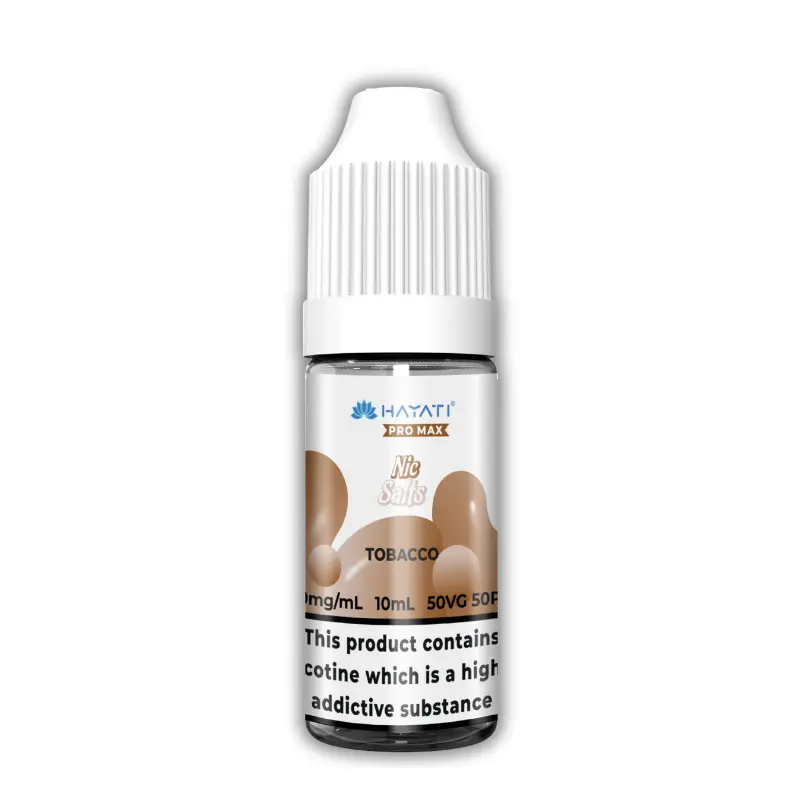
Tobacco is a 10ml bottle of nicotine salt from Hayati's Pro Max line, filled at 10mg, mixed at 50 percent vegetable glycerine to 50 percent propylene glycol, and listed at £2.49 under the code HPM-NS-TOBACCO. Nothing else is in the purchase. No device, no pod, no coil. What arrives is liquid in a bottle, and the heating element it eventually meets is one you bought, chose and will replace yourself.
That reads like an ordinary description of a bottled e-liquid, and it buries the one fact that makes this listing unusual. Hayati make three tobacco-flavoured products. Two of them are prefilled Pro Max Plus items, a boxed kit and a bare replacement pod, and on both of those the coil, the airflow path and the power are settled in a factory before the shell is sealed. This bottle is the third, and it is the only one of the three that ends up in hardware the buyer picked.
On a sweet fruit blend that distinction is worth a paragraph and no more. On a cured-leaf accord it is most of what there is to say, and the reason is in the flavour itself. The notes that give this profile its character, the woody middle and the nutty front and the dry cocoa underneath it, are heavy, low-sitting things that need a certain amount of heat before they arrive in any quantity. Push past that point and the liquid turns acrid, and because there is no sugar in it, no acid and no coolant, nothing in the blend covers for the mistake. A strawberry liquid run slightly too hot still tastes of strawberry. This one does not have that cushion in either direction, and the working window between under-run and over-run is narrower here than anywhere else in the bottled range.
Which means a buyer who tried the prefilled tobacco pod and found it thin, or dusty, or somehow less than they expected, has a second attempt available on this listing that is not available to them anywhere else in the flavour. Nobody has told them that, because the listing does not and no product page has any reason to. The rest of this page is an attempt to say exactly what is adjustable, what each adjustment does to this specific accord, and what it costs you in hardware, money and patience to have the choice at all.
Where the tasting note already lives, and what this page adds to it
The full draw-by-draw account of this flavour family exists on the Smooth Tobacco Pro Max Plus 6000 kit page on this site, and repeating it would produce a thinner version of something already written properly. In summary, so that this page stands up on its own: a constructed cured-leaf accord rather than an extract of anything, nutty at the front in the region of walnut or almond skin, a dry cedar-leaning woody register through the middle with a hay character under it, a faint unsweetened cocoa note giving depth without reading as chocolate, a raisin-dark sweetness at the back that keeps the blend from going papery, no cooling of any kind, and a finish that clears quickly instead of leaving a film. That page also establishes that the profile is perceived mostly through the nose rather than on the tongue, and that the nutty top note is the first thing a tiring coil takes.
Two further pieces of groundwork belong to the bare pod page and are cited here rather than rebuilt. That page counted the tobacco listings in the catalogue and found three out of 492, none of which has a flavour shelf to sit on despite the site maintaining categories for nine-listing groups such as menthol and orange. It also set out what scarcity does to a buyer: no lateral move, no near neighbour to reset the palate against, and a flavour memory that compresses between one purchase and the next because there is nothing to triangulate it with. All of that is true of this bottle too and none of it is re-derived here.
The bottled shelf adds a small footnote to the count rather than a new argument. Of the 65 bottles on the Hayati Pro Max Nic Salts shelf, only six sit on no flavour category at all, and five of those six are either the range-level listing or a name that describes a mood rather than an ingredient: Black Mamba Hayati Pro Max Nic Salts and Blue Fusion Hayati Pro Max Nic Salt among them. This bottle is the only one of the 65 that names a real flavour family in plain language and still has nowhere in the filing system to be put. Widen the frame to the whole bottled range, 105 listings once the two 120ml shortfill lines are counted alongside the nic salts, and tobacco appears exactly once.
What this page owns is the hardware question, and it owns it because of an accident of how the range is built. Everything worth saying about how this accord responds to a coil is untestable on the other two listings, since neither gives the buyer a coil to vary. Here it is not only testable, it is the main decision in front of you.
Reading the three tobacco listings against one another
Hayati write fresh copy for every listing, so a flavour sold three times is described three times by three different hands. Lining those descriptions up is worth doing before trusting any single one of them, and in this case the exercise produces one genuinely useful finding.
All three agree on position rather than on taste. Each one introduces the flavour by saying what it is not, which is fruit, sweets or ice, and each frames it as the understated option in a range built out of sugar. Each says the character holds steady rather than shifting about. That much is unanimous across the family and is the closest thing to a fact the copy offers.
Sweetness is nearly unanimous. The two prefilled listings both attach a small positive sweetness word to the blend, describing a gentle or natural sweetness sitting inside it. This bottle's copy goes the other way and describes it as less sweet, without conceding that any sweetness is present. Those are not in conflict, they are the same low reading approached from opposite sides, and taken together they place the liquid where the kit page places it: low, but not at zero.
The interesting disagreement is about harshness, and it runs exactly the wrong way. Both prefilled listings make a claim about the roughness of the blend. Each of them promises an absence: no dry, ashen edge of the sort that some blends in this family carry, a mellow reading rather than a heavy one. This bottle's copy makes no such promise. It calls the liquid plain and describes it as tobacco-style, and it says nothing whatsoever about whether the leaf character is dense or mellow, rough or rounded.
That is worth sitting with. The two products where the buyer cannot influence the roughness of a draw are the two whose copy guarantees it. The one product where roughness is substantially in the buyer's hands is the one whose copy declines to mention it. The generous reading is that a bottle writer knows they cannot promise what a stranger's hardware will do, which is honest and correct. The less flattering reading is that the prefilled copy is describing the word Smooth in the product name rather than anything in the liquid, and that when the word is absent from the name it drops out of the description too. Nothing published settles which, and the practical consequence is identical either way: on this listing the smoothness of the draw is not a property you are being sold, it is an outcome of your setup.
There is a naming point underneath that, which the kit page has already made and which is only extended here. That page found that Smooth is a claim about intensity rather than sweetness, pointing at a mellow reading of the leaf character, with no published scale behind it. This bottle drops the word entirely. Its title is one noun. So whatever calibration the qualifier offered on the prefilled listings, this one does not offer it, and the only intensity word anywhere in its copy is plain.
Why this accord argues with its hardware more than a fruit does
Here is the mechanism, stated as reasoning rather than as anything Hayati publish, because Hayati publish no recipe and nobody outside the factory knows the formulation.
The notes in this blend do not all arrive at the same energy
Flavour compounds differ in how readily they leave a heated wick. The aroma materials that carry fruit accords are, as a class, small and volatile: they lift at modest temperatures, they arrive early in a draw, and they reach you more or less intact even from a coil that is barely working. That is why a fruit liquid tastes recognisably like itself on almost any device. It is being carried by the easy part of the spectrum.
A cured-leaf accord is assembled from heavier stuff. The roasted and nutty register, the woody cedar note, the dusty cocoa depth and the dried-fruit darkness at the back are all built from larger, less volatile materials, and larger less volatile materials need more energy before they come off the wick in any useful quantity. The nut at the front is the lightest element in the blend and the first to appear. Everything that gives the profile its body sits below it and needs more heat than the nut does to show up at all.
Run this liquid in a setup that does not get there, and what you taste is the top of the accord with the body missing. It is not that the flavour is faint. It is that a specific two thirds of it is absent, and the part that remains, dry nut with very little behind it, reads as thin and slightly dusty. Add the peppery quality that nicotine contributes at the back of the throat, which now has nothing in front of it to occupy your attention, and the honest description of an under-run tobacco bottle is sharp and hollow at the same time. People taste that and conclude the liquid is poor. Frequently the liquid is fine and the vapour is too cool.
The upper limit is closer than it is on a sweet liquid, and it is better disguised
Every liquid has a point past which the wick cannot resupply the coil quickly enough and the residue on the cotton starts cooking rather than evaporating. What differs between liquids is how far away that point is and how obvious it is when you cross it.
On this profile the crossing is unusually easy to miss, and the reason is that the fault and the flavour share a register. A scorched note arriving on top of a strawberry is plainly an intruder: sweet fruit and burnt cotton do not resemble each other in any way, and you know within one draw. A scorched note arriving on top of a toasted, woody, faintly roasted accord sounds, for a while, like more of the same thing. It presents as the blend getting stronger, or drier, or a bit more serious, and a fair number of people push on for another day thinking they have found a setting they like. By the time it is unmistakably acrid, the coil has usually been damaged for a while.
That is the single most useful piece of tobacco-specific handling advice on this page, and it inverts the usual instruction. Elsewhere you are told to stop when it tastes burnt. Here, burnt is a late signal, and the early signal is different: the nut at the front thins while the bottom of the accord gets louder and flatter. If the profile has lost its opening and gained a sort of dry weight, that is the top of your window, not the middle of it.
Three masks this liquid does not have
Sweet, cooled and sour blends each carry something that covers for equipment. It is worth naming all three, because this bottle carries none of them and the absences compound.
Sweetener masks by coating. It puts a layer on the tongue that persists between draws, and that layer has a taste of its own which fills in gaps. It also caramelises predictably, so a heavily sweetened liquid on a hot coil produces a burnt-sugar note that many vapers have learned to read as part of the flavour. Acid masks by scrubbing. A citrus or a sour edge resets the palate between draws, which means small faults do not accumulate over an afternoon the way they otherwise would. Coolant masks most effectively of all, because it is a physical sensation rather than a flavour, and a strong cold signal reliably takes attention away from whatever the aroma is doing.
Look down the bottled nic salt shelf and nearly everything on it has at least one of the three. Blue Razz Gummy Bear Hayati Pro Max Nic Salt and Strawberry GB Hayati Pro Max Nic Salts have the first in quantity. Blue Sour Raspberry Hayati Pro Max Nic Salt and Blueberry Raspberry Lemon Hayati Pro Max Nic Salt have the second. Blue Frozen Hayati Pro Max Nic Salts and Cherry Ice Hayati Pro Max Nic Salt have the third, and several bottles have two of the three at once. This one has nothing. Whatever your coil is doing, good or bad, arrives undisguised.
That cuts both ways and the honest version says so. Undisguised is a liability if your hardware is marginal or your coil is old, because there is nothing to hide behind and you will taste every bit of it. Undisguised is an asset if you actually want to tune something, because the liquid reports faithfully. Small changes that a sweet blend would swallow are legible here within two or three draws, which makes this bottle a genuinely informative thing to run when you are working out what a new coil or a new airflow setting does.
Aroma delivery depends on vapour, and this profile is nearly all aroma
One further asymmetry matters and it is easy to overlook. Because so little of this blend registers on the tongue, most of what you perceive travels up the back of the throat to the nose on the exhale. That route depends on how much vapour there is and how warm it is. A sweet liquid gets a share of its impact delivered directly to the tongue regardless of vapour volume, so it survives a thin draw better. This one does not have that fallback, and a setup producing a small, cool mouthful gives the accord less to travel on.
Which is why airflow, on this liquid, is not simply a density control. It is a delivery route. The same fill through a tighter airway and a wider one differs by more than the usual amount, and it differs in what you can perceive rather than only in how strong it feels.
What is actually adjustable, and what each dial does to this accord
The general case for buying liquid by the bottle rather than sealed in a pod is set out at length on the range-level Hayati Pro Max Nic Salts bottled listing on this site: the coil becomes a decision instead of an unpublished fact, the element can be replaced without discarding liquid, the volume is divisible, the liquid can move between devices, and the bill for all of that is hardware you must own and maintain. None of that is rebuilt here. What follows is the part that page could not write, because it was describing a banana blend: which of those dials matters on a cured-leaf accord, in what direction, and by how much.
Coil resistance, which on a fixed-output device is the only real lever
Resistance sets how much heat a given amount of power produces at the wick, and therefore how much liquid is converted per second and how warm the vapour is when it reaches you. A higher-resistance element at a given power runs cooler and produces a smaller, tighter mouthful. A lower-resistance one at the same power runs hotter and converts more.
Map that onto the accord and the consequence is direct. The cooler, tighter end favours the nut and the dryness, and leaves the woody body under-represented. The warmer end brings the wood, the cocoa and the raisin darkness up into the draw, which is where most people find the profile becomes complete rather than sketchy. The catch is the one described above: the warm end is also where the acrid edge lives, and on this blend it announces itself late.
Two practical notes follow. If your device has a fixed output and no wattage control, which many compact refillable pod systems do, then the coil you fit is your only meaningful adjustment and it is worth treating as a deliberate choice rather than whatever the shop had. And a 50:50 base helps you here in a way a thicker mix would not: thin liquid moves through cotton quickly, so the wick keeps up at warmer settings better than a high-glycerine mix would. That is a real advantage of the ratio on this listing specifically, and it is the reason the upper part of the window is usable at all rather than being a wall you hit immediately.
Power, if you have it, and the size of the steps
On a device with a variable output the instruction is unglamorous: move in the smallest increments the device offers and change nothing else in the same fill. This matters more on this accord than on a fruit because of where the useful region sits. The point at which the woody middle opens up and the point at which the blend starts cooking are closer together here, and the flavour disguises the second one, so a large jump can take you across both at once and leave you thinking the liquid simply gets bitter at higher settings.
Going the other way costs you less and teaches you less. Reducing power on this blend does not ruin anything, it just quietly removes the bottom of the profile, and the result tastes acceptable and incomplete. That is the setting a great many people end up on by default, and it is the most common reason a tobacco liquid gets described as dull.
Airflow, and why it is the dial to move first
Airflow changes two things at once: how much air dilutes the vapour, and how warm that vapour is at your lips. Closing it down concentrates the aroma and raises the perceived warmth. Opening it up cools and dilutes.
For this accord the tighter setting usually reads as more complete, because concentrating the vapour concentrates the delivery route the profile depends on, and because the perceived warmth flatters notes that are themselves warm in character. It also makes the peppery quality of the nicotine more obvious, which some people like and some do not.
The warning attached is specific. Closing the airflow and raising the power push in the same direction, and doing both in one change is how people arrive at an acrid draw and then blame the liquid. Airflow is nonetheless the dial to experiment with first, for the plain reason that it is free, reversible within a second, and does not consume any of the bottle to try.
Draw length and cadence, which you had anyway
Draw length is the one variable a prefilled pod buyer also controls, and the argument for it as the sole user adjustment on sealed hardware belongs to another page in this range and is not repeated. The kit page has already established what it does to this profile: a long, slow pull develops the woody middle and the cocoa, while a short one gives you mostly nut and dryness.
The bottled version of that observation is a different point, and it is a small liberation. On sealed hardware, if you want the heavy end of the accord, changing how you draw is the only route to it, so you end up adapting your habits to the pod. Here you do not. You can reach the same place by fitting a different coil or closing the airway, and keep drawing the way you actually like to draw. Cadence still matters, in that draws taken back to back faster than the wick refills will scorch on any liquid, but it stops being the only tool in the box.
Choosing when the coil goes, instead of being told
The kit page found that the nutty top note is the first casualty of a tiring coil on this blend, and that when it goes what remains reads as more woody and slightly more bitter. On a sealed pod that finding is informative and useless at the same time, because acting on it means throwing away liquid you have paid for. On a bottle it becomes a maintenance trigger, and this is where the format earns its keep on this flavour more clearly than on any other.
The trigger is quiet, though, and worth stating precisely because the usual signals do not apply. A sweetened liquid announces a tiring coil loudly: residue builds, a caramelised note arrives, and eventually the whole thing tastes of scorched sugar. This liquid has very little to leave behind, so the coil fouls slowly and gives you no such announcement. What you get instead is a gradual loss of the front of the draw, and gradual loss is exactly what sensory adaptation also feels like. Distinguishing the two is a real problem on this flavour and the method for it is in the next section.
The pod you dedicate to it, and which direction contamination runs
A refilled chamber keeps a memory of what was in it. That is general, and the range-level page says so. What is specific here is the direction of the asymmetry, because it is not symmetrical at all.
Put this liquid into a pod that has been running Bubblegum Ice Hayati Pro Max Nic Salt or Fizzy Cherry Hayati Pro Max Nic Salt and you will taste the previous occupant for a good part of the fill, because a liquid with no sweetness of its own has nothing to absorb the residue of one that had a great deal. Run it the other way, this accord followed by something sweet, and the sweet liquid will paper over the traces within a few draws. So the rule is not the usual vague one about rinsing between flavours. If you have one pod and several bottles, fit this one straight after a coil change and run the sweet things later in the coil's life. If you have two pods, this is the liquid to give the dedicated one, and the payoff is larger than it would be for any fruit in the range.
What no amount of adjustment will change
The honest counterweight, because a page that lists the freedoms without the fixtures is selling.
The strength is not a variable. All 65 bottles on this shelf are listed at 10mg, so nothing about buying liquid by the bottle opens a choice of concentration inside this range. The ratio is not a variable either: all 65 are 50:50. The two 120ml shortfill lines Hayati list do come in both 50:50 and 70:30, but every one of those 40 listings is filled at zero nicotine and not one of them is a tobacco flavour, so they are not an alternative route to this profile. Within the bottled catalogue there is exactly one tobacco liquid, at one strength, in one ratio. The bottle widens your hardware options. It does not widen the menu.
The recipe is likewise fixed. No setting adds a coolant to a liquid that has none, and no setting turns a dry accord into a sweet one. And it remains unknown whether the blend in this bottle is the same blend as the one in the prefilled pods. The names differ, one carrying the Smooth qualifier and one not, the strengths differ, and neither listing claims a relationship to the other. Treat them as the same flavour family and not as the same liquid.
A method for finding your setting, budgeted in fills
Ten millilitres is a finite thing to experiment with, so it is worth doing this in an order that does not waste it. If your chamber holds 2ml, the bottle is five fills. Tuning will use two or three of them, which is a genuine cost of the format and one nobody mentions.
Start from the cool end rather than the warm one. An under-run draw wastes nothing except the draw, whereas an over-run one can damage the cotton and force a coil change before you have learned anything. So fit a fresh coil, prime it properly, set the airway roughly halfway if it adjusts, and take the first fill at a modest output.
Judge nothing for the first several draws. A newly wetted wick delivers less of the heavy end of this accord than a settled one, so early draws read thin in precisely the same way an under-powered setup reads thin, and confusing the two is the commonest false conclusion on a bottled tobacco. Give it five or six draws and a few minutes before forming any view at all.
Then change one thing per fill and write down what happened. Not a tasting essay, just the setting and one sentence. The questions worth asking each time are narrow and answerable: did the nut at the front get louder or quieter, did the woody middle appear, and was there a dry edge at the end of the exhale that was not there before. Those three observations are enough to locate the window, and they are far more use than an overall verdict of better or worse.
Move the airway before you move the power, since it costs nothing and is reversible mid-fill. If closing it down brings the body of the accord up without producing an edge, you have found part of the answer for free. Only then raise the output, and only in the smallest step available.
Stop one step below the first sign of an edge, not at it. The signs to watch for are the ones described above: the top note thinning while the bottom gets heavier, a flatness on the exhale, a faint papery quality at the very end of the breath. Any of those means you are at the ceiling, and the setting you actually want is the one before it, because a coil ages and what was comfortable on a fresh wick will be marginal on a fortnight-old one.
Keep the record after you have finished tuning, because the one thing this flavour cannot give you is a comparison. On the fruit side of the shelf you can calibrate by tasting a neighbour: someone running Blackberry Raspberry Hayati Pro Max Nic Salts can fill from Blackcurrant Juice Hayati Pro Max Nic Salts and immediately hear what their setup is doing to dark berries in general. There is no second tobacco bottle to do that with, so your only reference point is this same liquid at a different setting, which is exactly what the notes preserve.
The published numbers, split by who decides them
A specification table for a bottle is a strange object, because half of what governs your experience is not on it and never could be. So this one is sorted by that division rather than by type: what the listing settles, and what your drawer settles.
| What arrives | One 10ml bottle of liquid and nothing else |
|---|---|
| Flavour as listed | Tobacco, with no qualifying word attached to it |
| Nicotine | 10mg per millilitre, in salt form |
| Carrier | 50:50 vegetable glycerine to propylene glycol |
| Cooling agent | None named anywhere in the listing |
| Sweetness | Low, and not zero, on the evidence of all three listings in the family |
| Price | £2.49 |
| Product code | HPM-NS-TOBACCO |
| Maker | Hayati |
| Shelves it sits on | Three, the nic salt shelf, the e-liquid shelf and New Products |
| Other strengths in this range | None, all 65 bottles on the shelf are 10mg |
| Other ratios in this range | None, all 65 are 50:50 |
| Coil resistance | Yours, not a property of this purchase |
| Power at the coil | Yours |
| Airflow | Yours |
| Device | Not supplied and not specified, beyond needing a refillable setup with a mouth-to-lung coil |
Two of those rows do more work than the rest. The 10mg figure is fixed across the entire bottled shelf, which means the strength is not something the format opens up for you here even though bottled liquid in general is the place where strength choice usually lives. And the 50:50 ratio, which looks like boilerplate because every sibling carries it, is doing something specific on this liquid: the thinner the mix, the faster the wick recovers between draws, and the faster the wick recovers, the further up the heat range you can go before the accord starts cooking. On a sweet blend that headroom is a convenience. On this one it is the difference between reaching the woody middle and not.
The price sits at £2.49, the same as every other bottle on the shelf, from Juicy Peach Hayati Pro Max Nic Salt to Blue Razz Mojito Hayati Pro Max Nic Salts, so the choice of flavour carries no price signal at all and nothing is being charged for scarcity. Just under 25p per millilitre is the arithmetic. What that figure conceals, and what a prefilled buyer never pays, is the coil: a consumable bought separately, replaced on a schedule set by how you use it, and genuinely the recurring cost of this format. Anybody comparing the bottle price against a prefilled pod price without putting coils on the bottled side of the sum is comparing the wrong two numbers.
One more absence worth flagging plainly. The listing does not name a device, does not name a compatible coil and does not state a resistance, and this page will not fill any of those gaps by guessing at what you own. A refillable pod system with a mouth-to-lung coil is the category the liquid is written for. Which particular one suits you is a question your device's own documentation answers and a retail page does not.
Where it sits on a shelf of 65, and who should buy something else
There is no near neighbour, so the useful comparison is not flavour against flavour. It is this: what you are choosing instead, and how forgiving that alternative would be of the hardware you actually own.
If your setup is fixed and you cannot adjust anything
Say this plainly, because it is the recommendation most likely to save somebody £2.49 and a disappointing week. If your device has one output, one coil option and no airflow control, then the argument on this page mostly does not apply to you, and the odds of your fixed setting landing in the usable window for this accord are no better than chance. In that situation a blend with a mask built into it is the more forgiving purchase, and there is no shame in it. Cola Ice Hayati Pro Max Nic Salt and Cherry Cola Hayati Pro Max Nic Salt both come at low sweetness from a drinks angle with a spiced, slightly bitter backbone, which is the nearest thing on the shelf to a savoury register, and both carry enough sugar to survive a cool draw. Blackberry Ice Hayati Pro Max Nic Salts puts a tannic dark berry under a coolant and will read as intended on almost anything.
If you want unsweetened but not aromatic
The mint and menthol group is the only other part of this shelf that is not built on sugar, and it solves the problem in the opposite way: instead of removing sweetness and replacing it with aroma, it removes sweetness and replaces it with a physical cooling sensation. Menthol Hayati Pro Max Nic Salt is the undiluted version of that, with nothing else in the bottle to get in the way. Black Mint Hayati Pro Max Nic Salt takes the mint somewhere darker and denser, which on paper is the closest structural relative this bottle has on the shelf, in that both are trying for depth without fruit.
The important difference is one of tolerance. A cooling agent is comparatively indifferent to how hard you run it, so a mint bottle will read as a mint bottle across a wide range of settings. That makes the mints the pragmatic choice for somebody who wants out of the sugar but does not want to spend two fills learning their hardware.
If what you liked was the single note rather than the leaf
A fair number of people who settle on a tobacco liquid are really buying its simplicity: one coherent thing rather than three fruits competing. That property is available elsewhere. Juicy Peach Hayati Pro Max Nic Salt and Blackcurrant Juice Hayati Pro Max Nic Salts are both built on one fruit with nothing layered on top, so they behave the same way across a long session: consistent, with no component stepping forward. They are sweet and they are fruit, and this page is not pretending otherwise. The shape of the experience is nearer than the taste, and both are considerably nearer than a stacked construction such as Blueberry Cherry Cranberry Hayati Pro Max Nic Salt or Cherry Berry Hayati Pro Max Nic Salts, where two or three things share the same space.
If you want a tradition rather than a fruit
Double Apple Hayati Pro Max Nic Salts is the one other bottle on this shelf that points at a heritage rather than at a flavour counter, and the page for that bottle deals properly with what the name commits Hayati to and what it does not. It is worth naming here only to head off a reasonable mistake: the tradition it belongs to is a fruit and molasses one, not a leaf one, and the liquid is sweet. Somebody hunting for the second dry bottle on this shelf will not find it there.
If you are coming from the sweet end and want to know the size of the jump
Large, and larger than the equivalent jump between any two fruits. Blue Razz Lemonade Hayati Pro Max Nic Salt, Berry Lemonade Hayati Pro Max Nic Salt and Blackcurrant Lemonade Hayati Pro Max Nic Salts form a thread where syrup and citrus sit on three different fruit bases, and a buyer can move along it without anything feeling unfamiliar. Banana Ice Hayati Pro Max Nic Salts, Blue Frozen Hayati Pro Max Nic Salts and Cherry Ice Hayati Pro Max Nic Salt form another, where the coolant is really the purchase and the fruit underneath it is interchangeable. Neither thread passes anywhere near this bottle. There is no gentle intermediate step between them and here, and anybody expecting one will be surprised on the first fill.
If you already own the prefilled tobacco and were not impressed
This is the case the page was written for. The bare pod and the boxed kit both deliver this flavour family through a coil chosen for a mass-market device, at a setting you cannot alter, with an airway you cannot alter either. If that produced something thin, or hollow, or oddly sharp, the fault might have been the recipe, and it might equally have been a cool draw on an accord that needs warmth to open. Nothing on those listings lets you find out which. This bottle does, for £2.49 plus whatever hardware you already have in a drawer, and it is the only place in the Hayati range where that test is possible.
The honest caveat attached: it is a test rather than a guarantee. The two liquids are not published as the same recipe, so a good result here does not prove the prefilled pod was misjudged, and a poor one does not prove the family is wrong for you. You will have learned something either way, which is more than a second prefilled pod would have told you. If you would rather browse the wider bottled range or check whether anything has been added since, the Hayati E-Liquids shelf collects every bottle Hayati make, New Products is where recent additions land first, and the full Hayati range is where the count of three tobacco listings can be checked against whatever the catalogue holds by the time you read this.
Living with a dry bottle
Most handling advice is generic and this section tries to keep only the parts that change because of what is in the bottle.
Prime with more patience than you think the situation deserves, and understand why. Cotton that has not saturated will scorch on the first draw and will not recover, which is true of every liquid. What is specific here is that a partly wetted wick on this accord does not taste wrong, it tastes weak, and weak is indistinguishable from the under-run condition described earlier. So the impatient failure mode is not a ruined coil, it is a false verdict on the liquid. Fill, leave it standing upright for a couple of minutes, take two gentle draws, then start paying attention.
Judge a fresh coil on the second half of the first fill rather than the first few draws. The heavy end of this accord builds as the wick settles, and the difference between draw three and draw fifteen is larger on this bottle than on a sweet one.
Keep a spare coil in the house at all times. On a prefilled pod, running out means buying another pod. Here, running out means the bottle has nowhere to go and the liquid sits idle until the post arrives, which is a mildly infuriating experience the first time it happens.
Change the coil on the front note rather than on the burn. This has been said above and is repeated here in its practical form because it is the single instruction most likely to improve somebody's experience of the flavour. When the nut at the front has gone and the draw has become bottom-heavy, fit a new element. Waiting for an obviously acrid taste means running a damaged coil for days, and on this profile those days will read as the liquid getting worse rather than the coil.
Separate a tiring coil from your own palate adapting, because both present as a gradual quieting and the bare pod page has already documented how fast this profile recedes with continued use. The test is cheap: take a draw, wait a full minute, rinse your mouth with water, and take another. Adaptation lifts substantially after a short break. A fouled coil does not, and a coil past its best also tends to lose the nut specifically rather than everything evenly. If both draws are equally flat, the element is the suspect.
Store the bottle cool, dark and upright, with the cap properly closed. A liquid this light on sweetener has less to carry any change that does occur, so slow drift over months shows up more clearly than it would in a syrupy blend. Heat accelerates it, sunlight accelerates it, and an open cap in a warm room does both. Keep it out of reach of children and pets, and out of a hot car.
Decant with a little care, because a thin 50:50 runs faster than a thick mix and will overfill a small chamber before you have noticed. Fill to the mark rather than to the brim, and give the pod a moment upright before closing everything up.
Label the pod if you run more than one liquid. Nothing about a filled chamber tells you what is in it by looking, and a mouthful of unexpected dry leaf when you were expecting Blackberry Raspberry Hayati Pro Max Nic Salts is a memorable way to learn that lesson.
Finally, accept that some of this bottle is tuition. Two fills spent working out what your hardware does with a cured-leaf accord is not waste, it is the price of the only tobacco listing in the range that lets you ask the question. The knowledge transfers to every subsequent bottle you buy, and it does not transfer from a prefilled pod at all.
Questions this bottle actually raises
What do I need to own before this is any use to me?
A refillable device with a mouth-to-lung coil, plus at least one spare coil. The listing supplies liquid only, so there is no device, no pod and no charging equipment in the purchase. If you own nothing refillable, this bottle cannot be used at all and the prefilled tobacco listings are the only route to the flavour family.
Is this the same liquid as the Smooth Tobacco pods?
Nothing published says so, and the names are not even identical, since the pods carry the Smooth qualifier and this does not. The strengths differ too. Treat them as the same flavour family described by two different pieces of copy, not as one recipe in two containers.
Is there any cooling in it?
None is named anywhere in the listing, and the title carries no Ice, Frozen, Cooler or Menthol marker. The blend reads warm, which comes from the nutty and woody character rather than from anything the hardware is doing. If you want cooling with your liquid, it has to come from a different bottle.
Can I get it at a different strength or a different VG ratio?
Not inside this range. Every one of the 65 bottles on the nic salt shelf is listed at 10mg and at 50:50, so the format offers you a choice of flavour and not a choice of concentration. The 120ml shortfill lines come in two ratios but are filled at zero nicotine and include no tobacco flavour.
What coil should I use with it?
This page will not name a resistance for hardware it cannot see, and any page that does is guessing. What it can tell you is the direction: a cooler, tighter setup favours the nut and leaves the woody body behind, while a warmer one brings the body up and moves you closer to the point where the blend starts cooking. Start cool, change one thing at a time, and stop a step below the first dry edge.
Why does it taste thin and slightly sharp on my setup?
Most often because the vapour is not warm enough to lift the heavy part of the accord, so you are getting the light nutty top with two thirds of the profile missing, and the peppery quality of the nicotine has nothing in front of it. Before concluding the liquid is poor, close the airway a little or raise the output by the smallest step your device allows.
Why does it seem to go acrid sooner than my fruit bottles do?
Partly because it has no sweetener, acid or coolant to cover an overheating wick, and partly because a scorched note sits in the same warm, toasted register as the flavour itself, so it hides for longer before you recognise it. The early warning is the front of the draw thinning while the bottom gets heavier, not an obvious burnt taste.
How many fills is 10ml?
That depends entirely on your chamber. A 2ml chamber makes it five fills, a smaller one makes it more fills of less. The useful thing about a divisible volume is that a single fill is enough to find out whether the flavour suits you, without committing the rest of the bottle.
Can I run it in the same pod I use for sweet liquids?
You can, but the contamination is asymmetric and it runs against you. Residue from a sweetened blend is plainly audible in a liquid that carries no sweetness of its own, while this accord leaves very little behind for the next occupant. If you only have one pod, run this one first after a coil change rather than last.
How do I tell a tiring coil from my own palate adapting?
Take a draw, leave a full minute, rinse your mouth with water and take another. Adaptation lifts noticeably after a short break, while a fouled element does not. A tiring coil also tends to remove the nutty front specifically, rather than dulling the whole profile evenly.
Does the bottle change if I leave it a few months?
Any flavoured liquid drifts slowly, and a blend with almost nothing sweet in it has less to disguise the drift, so it tends to be a little more noticeable here than in a syrupy bottle. Cool, dark, upright and tightly capped is the whole of the answer, and a part-used bottle stored that way is in a far more stable state than a part-used pod with a wetted wick.
Is it worth buying purely to compare against the prefilled pod?
At £2.49 it is an inexpensive experiment if you already own refillable hardware, and it is the only way to hear this flavour family through a coil you chose. It is not a controlled comparison, though, because the two products are not published as the same recipe, so treat the result as information about your own setup rather than as a verdict on the pod.
Where this leaves you
Tobacco in bottled form is a 10ml, 10mg, 50:50 nic salt at £2.49, carrying a dry cured-leaf accord with a nutty front, a woody middle, a faint cocoa depth and a raisin edge at the back, no cooling and very little sweetness. That description belongs as much to the two prefilled listings as to this one, and the kit page tells it better and at greater length.
What is unique to this listing is everything downstream of the bottle. It is the only tobacco product Hayati make that goes into hardware the buyer chose, and tobacco is the flavour where that matters most, because the notes doing the work sit low and need warmth to arrive, while the penalty for too much warmth is an acrid edge that this liquid has no sugar, acid or coolant to hide. The window is narrower than a fruit's and the failures at both ends are more visible. Given a coil, an airway and an output you control, that is a tuning problem with a real answer. Given fixed hardware, it is a gamble.
So the recommendation divides cleanly. If you own a refillable setup and are willing to spend two fills and a notebook page on it, this is the most informative £2.49 on the shelf and the only route to a leaf accord you can actually adjust. If you do not, or if the administration of coils and filling is precisely what you buy prefilled pods to avoid, the sealed listings are the less demanding option and this bottle will probably disappoint you through no fault of its own.
Strictly for adults aged 18 and over. Nicotine is an addictive substance.
You might also like


