
Home / Hayati Quokka / Hayati Quokka Pods
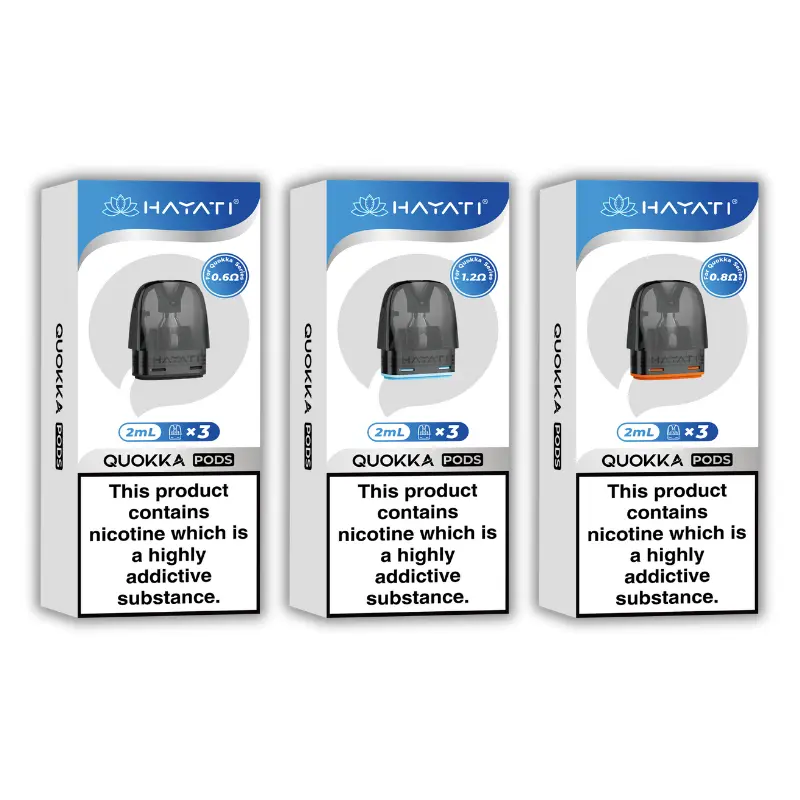
Hayati · Quokka
Hayati Quokka Pods
£6.99
✔ In stock — ready to ship
Genuine Hayati
Free over £20
Same-day dispatch
Secure checkout
Hayati Quokka Pods are the replacement consumable for the Quokka refillable range, listed at £6.99, sold without a device. You get the empty pod or pods and nothing else: no battery, no liquid, no flavour. Everything that makes a vape taste of anything comes from a bottle you buy separately and pour in yourself. That is an unusual listing for this catalogue, and it creates an unusual problem at the checkout, which is what the rest of this page is about.
Almost every other product Hayati sell arrives with the consumable and the liquid fused into one object. A prefilled pod is a plastic shell, a coil, a wick and a measured volume of e-liquid, all bought together, all thrown away together, all priced on one line. When that pod is finished the whole assembly goes, and the next one costs exactly what the last one cost. The running cost is therefore visible. It is printed on the shelf next to the flavour name, and a buyer who wants to know what a month of vaping costs can work it out with a calculator and no assumptions.
This listing breaks that. Here the consumable and the liquid are two separate purchases made at two different times, and the consumable is the one people forget. A buyer walks out with a bottle of e-liquid at a couple of pounds, congratulates themselves on the saving against a prefilled pod at five or six, and never books the pod pack into the sum at all, because the pod pack was bought weeks earlier and feels like part of the hardware. It is not part of the hardware. It is stock, it depletes, and it depletes at a rate nobody has published.
So this page does the arithmetic in full. It works out what a millilitre costs on every prefilled format Hayati sell, because those figures are knowable. It then works out what a millilitre costs when you refill, which is not a figure at all but a range, and it says exactly which of your own habits move you toward the good end of that range and which move you toward the bad one. Two of those habits (how sweet your liquid is, and how often you change flavour) turn out to matter more than anything else, and neither is mentioned in a single line of the product data.
What the listing actually publishes, and what it leaves out
Before any sums, it is worth being blunt about the evidence base, because the gaps are load-bearing. The Quokka pod listing is one of the shortest specifications on the site.
On the record, from Hayati:
- These are replacement pods for the Quokka range.
- They are refillable, and you supply the e-liquid.
- No device is included in the pack.
- Hayati ask buyers to confirm the pods suit their particular Quokka model before ordering.
- A newly filled pod should be left to stand for a few minutes before use.
- The price is £6.99.
- They sit on the Hayati Quokka shelf, on Hayati Pods, and in New Products.
Not on the record, anywhere in the product data:
- How many pods are in a pack.
- The pod's liquid capacity.
- Whether the coil sits inside the pod or inside the device.
- The coil's resistance, if it has one.
- Any expected number of fills, hours, millilitres or days before a pod is finished.
- Which of the Quokka models each pod fits, beyond the instruction to check.
- Any material, seal, valve or fill-port description.
The first two omissions are the expensive ones, and they are the two divisors in every calculation below. The pack quantity is missing even though the title is plural and even though Hayati's own copy talks about keeping one pod for one liquid and another for something else, which only makes sense with at least two in the box. That is an inference from the phrasing of a product description, not a published count, and it is flagged as an inference here rather than smuggled in as a fact. A buyer should treat the pack size as the first thing to establish, because it is the single largest lever in the running cost and it swings the answer by a factor of three.
The capacity is missing from this listing but present on the three devices the pods serve. The Quokka Lite, the Quokka Elite and the Quokka Pro each state a 2ml pod on their own listings. A 2ml pod is therefore what the range's own published data supports, and 2ml is the figure used in the sums below, but it is worth naming the source of it: it comes from the kit listings, not from this one. If your Quokka takes something else, the arithmetic still works, you just substitute your own number into the same formula.
The coil question deserves more than a bullet. In most pod systems the heating element and the wick live inside the pod, which is why the pod is the part you replace and why replacing it restores the taste. If that is true here, then a Quokka pod's working life is really the coil's working life, and everything that shortens a coil's life shortens the pod's. If instead the element lives in the device and the pod is a plain reservoir, the pod would last far longer and the consumable cost would collapse toward nothing. Hayati publish neither arrangement. The fact that they sell the pod as the replaceable part, and sell no separate coil at all, is consistent with the coil being inside the pod, and that is the assumption the rest of this page works under. It is an assumption and it is labelled as one.
The arithmetic, part one: what a prefilled millilitre costs
Start with the side of the catalogue where the answer is knowable, because it gives the refillable figures something to be measured against. A prefilled pod has a published price and a published liquid volume. Divide one by the other and you have the cost per millilitre, exactly, with no assumptions and no unknowns. The pod is discarded when the liquid is gone, so there is no residual value to account for and no second purchase to remember.
Across the four prefilled pod formats on this site, the figures are these.
| Format | Listed volume | Pod price | Cost per ml |
| Rubik pods | 12ml | £3.99 | 33.3p |
| Pro Ultra Plus pods | 22ml | £7.99 | 36.3p |
| Pro Max Plus pods | 12ml | £5.49 | 45.8p |
| Mini Ultra pods | 4ml | £3.49 | 87.3p |
Three things follow immediately. The cheapest millilitre on the site comes from the Rubik format, where something like Blue Sour Raspberry Hayati Rubik Pods puts 12ml on the counter for £3.99. The dearest comes from the Mini Ultra, where Cherry Ice Hayati Mini Ultra Pods and its shelf-mates hold only 4ml for £3.49, which is more than two and a half times the Rubik rate. And the largest pod is not the dearest per millilitre: Blue Sour Raspberry Hayati Pro Ultra Plus Pods costs twice what the Rubik does but holds nearly twice as much, landing at 36.3p and comfortably undercutting the Pro Max Plus.
The prefilled spread, then, runs from roughly 33p to roughly 87p per millilitre. Every one of those numbers is a division sum on two figures Hayati print. A buyer choosing between Blackcurrant Lemonade Hayati Pro Max Plus Pods at 45.8p and the same flavour as Blackcurrant Lemonade Hayati Mini Ultra Pods at 87.3p is making a decision with full information, whatever else they may be guessing about.
One caveat before moving on, because it applies to everything that follows. Cost per millilitre measures liquid volume and nothing else. Every prefilled pod in the table states 20mg. Hayati's bottled range, the range you would actually decant into a Quokka pod, states 10mg on all sixty-five of its listings. A millilitre is therefore not a constant quantity of nicotine across the two sides of this comparison, and if your consumption is governed by something other than volume then the per-millilitre figures need adjusting before they mean anything to you. That adjustment is yours to make. This page will not guess at it.
The arithmetic, part two: what a refilled millilitre costs
Now the difficult side. Refilling has two cost lines rather than one, and only the first is easy.
The liquid is straightforward. Hayati's own bottled nicotine salt line runs to sixty-five listings, every one of them a 10ml bottle at 10mg in a 50:50 ratio, and sixty-four of the sixty-five are priced at £2.49 with a single outlier at £2.79. Call it 24.9p per millilitre. That figure is a current catalogue price rather than a permanent property of the universe, so check it before you rely on it, but the shape of the answer does not change much if it moves by twenty pence.
The consumable is where it gets interesting. A Quokka pod is bought once and used many times, so its cost has to be spread across every millilitre that passes through it. The formula is not complicated:
consumable cost per ml = pack price ÷ (pods in pack × fills per pod × ml per fill)
Three of those four terms are unknown or borrowed. The pack price is £6.99, published. The millilitres per fill is 2, borrowed from the Quokka kit listings. The pods per pack is not published. And the fills per pod is not published, is not publishable in any honest way, and varies more than any other input, because it depends on what the buyer chooses to put in the pod and how they treat it.
What you can do, and what the rest of this section does, is run the formula across a plausible spread of both unknowns and see how wide the answer gets. The point of the exercise is not to produce a number. It is to show that the number does not exist, and that the spread is enormous.
| Fills per pod | If the pack holds 1 (£6.99 a pod) | If the pack holds 2 (£3.50 a pod) | If the pack holds 3 (£2.33 a pod) |
| 5 | 69.9p | 35.0p | 23.3p |
| 10 | 35.0p | 17.5p | 11.7p |
| 15 | 23.3p | 11.7p | 7.8p |
| 25 | 14.0p | 7.0p | 4.7p |
| 40 | 8.7p | 4.4p | 2.9p |
Those fill counts are not claims. Hayati publish no figure and this page is not inventing one; they are round numbers chosen to span the range of outcomes people report from refillable pods generally, put into the formula to show what the formula does. The right way to read the table is as a sensitivity analysis, not as a forecast.
The consumable line alone runs from 2.9p to 69.9p per millilitre, a factor of twenty-four. Add the liquid at 24.9p and the all-in figure runs from about 28p to about 95p. Put that beside the prefilled table and the conclusion is uncomfortable for anyone who assumed refilling is automatically cheaper:
- Bad corner (one pod in the pack, five fills out of it): about 95p per ml, which is dearer than the most expensive prefilled format on the site.
- Middle (two pods, fifteen fills each): about 36.6p per ml, which is within half a penny of a Pro Ultra Plus pod at 36.3p. A dead heat.
- Good corner (three pods, forty fills each): about 27.8p per ml, which beats everything prefilled, but beats the cheapest prefilled format by only about five and a half pence.
That middle row is the finding worth carrying away. At entirely ordinary assumptions, refilling a Quokka costs the same per millilitre as buying a prefilled Pro Ultra Plus pod off the shelf, with the extra work of filling it thrown in for free. The saving people expect from a refillable is real, but it is not a property of the format. It is earned, at the long end of pod life, and it evaporates at the short end.
The threshold, stated plainly
If you want a single number to aim at, work backwards from the cheapest prefilled millilitre on the site. To beat the Rubik format's 33.3p, your total has to come in under that, and since the liquid alone accounts for 24.9p, your consumable has to cost less than 8.4p per millilitre. Reading that off the table, you need roughly fifteen fills from a three-pack, twenty-five from a two-pack, or more than forty from a single pod. Anything less and a prefilled Rubik pod such as Blue Razz Cherry Hayati Rubik Pods is doing the job for less money.
Against the Pro Max Plus format the bar is lower. Beating 45.8p needs a consumable under 20.9p, which the table clears at ten fills from a two-pack. And against a Mini Ultra at 87.3p almost any outcome wins, because a 4ml pod at £3.49 sets a very high price per millilitre and refilling will normally undercut it comfortably.
So the honest comparative answer depends entirely on which prefilled format you are leaving behind. Coming off Blueberry Raspberry Menthol Hayati Mini Ultra Pods, a refillable is very likely to save you money. Coming off the Rubik format, it is a coin toss that you decide by how well you look after the pods.
The cost line nobody mentions: the device is nearly free
One more sum, and it is the one that most sharply illustrates why the consumable is the product here. The Quokka shelf currently lists three kits, the Lite at £8.99, the Elite at £14.99 and the Pro at £20.99, and each of those kits includes a pod. This pod pack is £6.99.
Set the pod pack against the cheapest kit. If the pack contains a single pod, then £6.99 buys you one pod, and £8.99 buys you one pod plus an entire working device with a battery in it. The marginal cost of the whole body, on those listed prices, is two pounds. In that scenario a buyer who needs a spare pod is better off buying a second Quokka Lite and keeping the old body as a backup, which is an absurd outcome that arises purely because the consumable is priced close to the machine.
If the pack contains two, the per-pod figure is £3.50 and the pack is clearly the better buy. If it contains three, £2.33, and it is not close. This is exactly why the unpublished pack quantity is not a trivia question. It decides whether the sensible purchase is this listing or a whole second kit, and no amount of reading the page will tell you. Check the pack before you order, and if you cannot, that uncertainty is itself a cost.
The broader point about who chooses the liquid, and what changes when a vape shop's catalogue becomes a menu rather than a product, is set out on the Quokka Lite kit page. That argument belongs there and is not re-run here. What this page adds is the part that sits underneath it: whoever supplies the liquid, somebody still has to buy the pod, and on a refillable that somebody is you, repeatedly, on a schedule nobody has told you.
Sweeteners are the variable you control, and they are the one that matters
Of the two unknowns in the formula, the pack size is fixed by whatever is in the box. The fills per pod is not fixed by anything. It is decided almost entirely by what you pour in, and the single biggest influence is how heavily the liquid is sweetened.
The mechanism is not exotic. Sweeteners used in e-liquid, sucralose most commonly, along with the various maltol compounds that supply the sugary body in confectionery and bakery profiles, do not turn cleanly into vapour the way propylene glycol and vegetable glycerine do. At coil temperature they caramelise instead, and what is left behind is a dark, slightly tacky deposit on the heating element and in the fibres of the wick. Each fill adds another layer. As the layer thickens it insulates the element from the liquid it is supposed to be heating, so more of the energy goes into cooking the residue and less into vaporising the fresh liquid. The taste turns first flat, then faintly burnt, then unmistakably so, and at that point the pod is finished regardless of whether anything has physically failed.
A dry, sharp, low-sweetener liquid leaves very little behind and a pod can go a long way on one. A thick confectionery or dessert liquid can visibly darken a coil in two or three fills. The gap between those two outcomes is not marginal, and it maps directly onto the table above: the same £6.99 pack of pods can sit at the four-pence end of the consumable column or the thirty-five-pence end, on nothing but the choice of bottle.
How sweet is Hayati's own range? A count rather than an impression
It is easy to assert that a flavour catalogue is heavily sweetened and harder to show it, so here is the count. Across all 492 listings on this site, 464 use a sweetness word in Hayati's own description of the liquid. Widen the net to include sugar, candy, syrup and jammy and the figure is 469. Only 21 listings anywhere in the catalogue use the words dry or unsweetened at all, and in several of those the word is doing something other than describing a low-sweetener recipe.
Narrow it to the sixty-five bottles you would actually decant into a Quokka pod and the picture is tighter still. Sixty-two of the sixty-five bottled nicotine salt listings describe their liquid in sweet terms. Thirty-two reach for sugar, candy, syrup, jam or bubblegum specifically. Exactly one uses dry or unsweetened. Six are mint-family. One is tobacco-flavoured.
Two honest qualifications on those numbers. They count the vocabulary of a product description, not the sucralose content of a formulation, which nobody publishes. And a description is written to sell, so it may lean sweet because sweet sells rather than because the liquid is unusually sugary. Even with both caveats applied, a catalogue in which 62 of 65 bottles are described as sweet and 1 as dry is telling a refillable buyer something real: the default choice in this range is a sweetened liquid, and the low-residue options are a small minority you have to go looking for.
That is actionable, which is the point of raising it. If the running cost matters to you, the mint-family bottles and the single unsweetened one are the ones that will get the most fills out of a pod. If you want the sweet profiles, you can have them, but book the shorter pod life into the sum rather than being surprised by it. A buyer who runs bakery and candy liquids exclusively and then wonders why their pods die quickly has not been unlucky. They have been paying the sweetener tax and calling it bad luck.
There is a mirror of this on the prefilled side worth noticing. When you buy Blueberry B'Gum Hayati Pro Max Plus Pods or Blackcurrant Cotton K / Blue Raspberry Hayati Pro Ultra Plus Pods, both of them squarely confectionery profiles, the sweetener is still cooking onto the coil in exactly the same way. The difference is that the coil was bought with the liquid and both run out together, so the cost of the shortened coil life is already inside the 45.8p or the 36.3p. On a refillable it is not inside anything. It is a separate future purchase that the sweet liquid is quietly bringing forward.
Flavour carryover, and why a used pod is not a neutral container
The second thing that shortens a pod's useful life has nothing to do with wear. Pods are frequently retired while still working perfectly, because of what they taste of.
A pod that has held one liquid holds a residue of it. Some of that is liquid trapped in the wick fibres and the corners of the reservoir, which a rinse will not reach and which will keep seeping into whatever you put in next. Some of it is the baked-on layer described above, which is not going anywhere at all. The result is that the first fill after a change of flavour is a blend, not the new liquid, and depending on what came before it can be a blend for several fills.
Hayati's own product copy acknowledges this, which is notable because it is one of very few substantive things the listing says. The suggestion to keep one pod for one liquid and a second for another, and the observation that a spare pod gives you a fresh start rather than pouring something new over something old, are both descriptions of carryover. They just do not name it.
Carryover is not symmetrical, and that is the practically useful part. Some profiles dominate whatever follows them and some vanish under anything. Ranked roughly by how long they persist in a pod:
- Menthol and mint. The most persistent family by a distance. Cooling agents cling to plastic and wick and will sit under the next two or three fills as a cold edge you did not order. A pod that has held a menthol is effectively a menthol pod now.
- Aniseed, liquorice, spice and tobacco profiles. Strongly persistent for the same reason, with a heavier, rounder residue.
- Dark berry, blackcurrant and grape. Moderately persistent. They also stain, so a pod that has held a blackcurrant often looks used even when it is not.
- Confectionery and bakery. Persistent in a different way. The sweetener residue keeps contributing body and sugariness to whatever comes next, even once the specific flavour note has gone.
- Light citrus and pale fruit. The least persistent, and the most easily obliterated. A lemon or a pear in a pod that previously held anything from the first two categories will not taste of lemon or pear.
The working rule that follows from all of this: dedicate, and when you cannot dedicate, only ever move up the list, never down. A pod that has held a delicate fruit can take a menthol next and the menthol will win cleanly. A pod that has held a menthol cannot take a delicate fruit and give you an honest reading of it. If you rotate, keep a permanent pod for the mint-family and heavy-anise liquids and treat everything else as belonging to the general pod. That single habit is worth more fills than any amount of rinsing.
There is a corollary for anyone who buys liquid to try it. Never judge a new bottle on the first fill of a used pod. You are tasting a blend and you will form an opinion of a liquid you have not actually tasted, which is how people end up deciding they dislike a flavour they have never met. Give it a fresh pod, or give it three fills in the old one before you decide.
Now bring that back to the money. Every pod you retire on taste rather than on performance is a pod you paid for and did not use up. A buyer who changes flavour weekly and insists on a true reading of each one is buying pods on a flavour schedule, not a wear schedule, and their fills-per-pod number will sit at the top of the table where the consumable costs thirty-five or seventy pence a millilitre. A buyer who picks one liquid and stays with it for months is at the bottom of the table. Neither is doing anything wrong. They are simply running very different businesses, and only one of them is saving money against a prefilled pod.
The Quokka range in brief, and where this pod sits in it
The Quokka line is small: four listings in total, three devices and this pack of pods. The Lite, the Elite and the Pro all publish a 2ml pod and all three are filled by the user. They are the only refillable devices Hayati list, which makes this one of only a handful of listings in a 492-product catalogue where the flavour decision is not made at the point of purchase.
What is in this pack is pods, and nothing else. No body, no charging lead, no liquid, no instructions about which bottle to buy. If you do not already own a Quokka, this is not the listing you want; the devices are on the Quokka shelf alongside it.
The one specification that matters most for this particular purchase is the one that is missing, and it is worth repeating because it is the whole reason this page is arithmetic rather than description: the pack quantity. Everything else about the pod, its shape, its seals, how it is held in the bay, what the coil is rated at, is unpublished, and this page will not fill those gaps by reasoning from the product name. Hayati do not publish how the pod is retained in the device and we do not know, so do not assume anything about the fitting from a photograph or from another brand's hardware. Confirm the pod suits your model before you buy, once, and then stop worrying about it.
Specifications, and what each line is doing
The table below is short, and half of it is empty. That is not a formatting failure. On a product whose economics depend on two numbers, the absence of both is the most important information the specification contains, so the blanks are printed rather than hidden.
| Pack price | £6.99 |
| Brand | Hayati |
| What you receive | Replacement pods only. No device, no liquid. |
| Fills with | Bottled e-liquid, bought separately |
| Flavour | None supplied. Determined entirely by the bottle you choose. |
| Nicotine strength | None supplied. Determined entirely by the bottle you choose. |
| Pods per pack | Not published |
| Pod capacity | Not published on this listing. The three Quokka kits each state 2ml. |
| Coil resistance | Not published |
| Fills per pod | Not published, and genuinely variable |
| Compatibility | Hayati Quokka range. Confirm your model before ordering. |
| Before first use | Let a fresh fill stand for a few minutes |
| Shelves | Hayati Quokka, Hayati Pods, New Products |
Two rows repay a second look. The flavour and nicotine rows are blank in a way no other product on this site is blank: on Berry Lemonade Hayati Pro Max Plus Pods both of those cells are filled in at the factory and cannot be changed, whereas here they are questions you answer at a second checkout. That is the freedom people buy a refillable for, and it is also the reason the running cost cannot be printed on this page.
The strength row deserves one specific note for anyone arriving from a prefilled pod. Every prefilled pod format on this site is listed at 20mg, and every bottle in Hayati's own salt line is listed at 10mg. A Quokka pod does not care what goes in it, and other brands of bottled liquid exist, but if you intend to stay inside Hayati's own range then the bottled strength on offer is 10mg and that is simply the fact of the catalogue rather than a recommendation about what you should use.
How it compares with buying prefilled
The comparison that matters is not between this pod and another pod. It is between the whole refillable approach and the prefilled shelf, and the previous sections have already done most of the work. What follows is who lands where.
You are probably better off refilling if: you have settled on one or two liquids and expect to stay with them; you tend toward mint, menthol or the drier fruit profiles rather than bakery and candy; you fill before the pod runs dry rather than after; and the pack turns out to hold more than one pod. On that combination the consumable line falls to single-figure pence and the total lands under every prefilled format on the site. Someone currently buying Blackberry Ice Hayati Pro Max Plus Pods at 45.8p per millilitre could reasonably expect to land nearer 30p.
You are probably better off prefilled if: you change flavour constantly and want each one to read true; you are drawn to the confectionery end of the range; you dislike carrying a bottle; or you would rather pay a known price than manage a variable one. The prefilled shelf is where the cost is legible, and legibility has a value. It is perfectly rational to pay 45.8p a millilitre for a Blackcurrant Juice Hayati Pro Max Plus Pods specifically because you know it is 45.8p and it will still be 45.8p next month.
On the prefilled side itself, the formats separate cleanly on price per millilitre, and this is worth knowing whichever way you go, because it sets the bar the refillable has to clear.
The Rubik format is the value option and sets the target at 33.3p. Banana Ice Hayati Rubik Pods gives you the same 12ml as a Pro Max Plus pod for a pound and a half less. The Pro Ultra Plus format is close behind at 36.3p and holds far more per pod, so Blackcurrant Lemonade Hayati Pro Ultra Plus 25K Pods means fewer trips to the drawer even if the ticket price is higher. The dual-flavour listings on that platform, such as Blue Razz Cherry/Blue Razz GB Hayati Pro Ultra Plus 25K Pods and Blue Razz GB / Lemon and Lime Hayati Pro Ultra Plus 25K Pods, are a single pod divided into two reserves with a collar that picks which one feeds the coil, which is the nearest the prefilled shelf gets to the two-pods-two-liquids arrangement a Quokka buyer sets up by hand. It costs nothing extra and it is instant, but the two halves share one budget and whatever is left in the side you stop using is thrown away with the pod.
The Pro Max Plus format sits in the middle at 45.8p and has by far the widest flavour list, which is its real argument. If your taste runs to things like Black Mamba Hayati Pro Max Plus Pods, Blue Frozen Hayati Pro Max Plus Pods or Blue Razz Cherry Hayati Pro Max Plus Pods, the choice on that shelf is much broader than anything you can assemble from sixty-five bottles. Breadth of catalogue is a genuine reason to accept a higher price per millilitre, and it is a reason a refillable cannot answer, because a Quokka can only ever taste of liquids somebody bottles.
The Mini Ultra format is the one the arithmetic is least kind to. At 4ml for £3.49 it is 87.3p a millilitre, more than two and a half times the Rubik rate, and a pod of Blue Sour Raspberry Hayati Mini Ultra Pods holds a third of what the same flavour holds in Blue Sour Raspberry Hayati Pro Max Plus Pods. There are perfectly good reasons to pay it, mostly to do with the size of the thing in your pocket, but cost per millilitre is not among them. Anyone currently on that format who is thinking about a Quokka has the strongest case of anybody on this site.
One last comparison for the rotators. The Quokka approach lets you run two liquids simultaneously in two pods with no carryover between them, which no single prefilled pod can do, and swapping is a matter of changing the pod rather than buying another one. That is a real advantage and it is the advantage Hayati's own copy leads on. Set against it, the prefilled route lets you run six flavours at once if you like, by simply owning six pods, at the cost of buying six pods. Someone who keeps Banana Ice Hayati Pro Max Plus Pods for the mornings and Blueberry Raspberry Lemon Hayati Pro Ultra Plus 25K Pods for the evenings has already solved the same problem in a different currency. The full range of both is on the Hayati Pods shelf and across the wider Hayati catalogue.
Getting more fills out of a pod
Everything in this section is aimed at one number: the fills-per-pod figure in the middle column of the formula. Each item below moves it, and the sums above show what moving it is worth.
Fill before it empties, not after. A wick with liquid in it is being cooled by that liquid every time the element fires. A wick that has run dry is not, and a single dry draw can leave a scorched patch that never tastes right again. Watching the level and topping up early is the cheapest single habit available, and on a 2ml pod there is not much margin between comfortable and empty.
Let a new fill soak. Hayati's own advice is a few minutes and it is sound. A dry wick needs time to draw liquid through its full thickness, and firing before it has is the same event as running dry. The wait is longest on a brand-new pod and shortest on a top-up, but it is never zero.
Pick your liquid with the coil in mind. The sweetener argument above is the big lever. If you are choosing between two bottles you like equally, the drier one will get you more fills, and given that 62 of Hayati's 65 bottles describe themselves as sweet, that choice is usually between degrees of sweet rather than between sweet and not.
Pace it. Drawing repeatedly with no gap gives the wick no time to refill the space next to the element, which brings you back to the dry-wick problem by a different road. This matters more on a 2ml pod than on a 22ml one simply because everything is smaller.
Dedicate pods to liquids. Covered above, and it belongs here too, because retiring a pod on taste is the most common way people waste one. Two pods each doing one job will outlast two pods taking turns at four jobs.
Do not try to wash it back to new. Rinsing a pod that contains a coil pushes water into a wick that then has to be dried completely before use, and the baked-on residue that is actually causing the problem does not rinse off anyway. Tipping out old liquid and wiping the reservoir is worth doing. Soaking is generally how a pod that had a few fills left in it ends up with none.
Store it upright, sealed, and cool. A part-used pod left on its side will weep past whatever seals it has, and a hot windowsill thins the liquid and speeds up every chemical process inside it. Upright in a drawer is enough. If a pod is going to sit unused for weeks, it is better to empty it than to leave liquid standing against a wick for a month, because what you pour out later will not taste like what you poured in.
Know when it is finished, and accept it. A pod is done when a fresh fill of a liquid you know well tastes flat, muted or scorched from the first draw. That is the coil, not the bottle. Carrying on past that point does not save money, it just means the last few millilitres of a perfectly good liquid are wasted on a consumable that has already failed. Retire it, note roughly how many fills it gave you, and use that number instead of the table above, because your own figure beats anybody's estimate.
Dispose of it properly. If the coil is inside the pod, and the reasoning above suggests it is, then a spent pod is a small piece of electrical waste and not ordinary rubbish. Empty it, and take it to a shop or council point that accepts vaping hardware. The awkward truth of a refillable is that you will be doing this repeatedly, which is the same fact the economics section is built on, seen from a different angle.
Questions buyers actually ask
How many pods come in a pack?
Hayati do not publish the quantity, and this page is not going to guess it. The plural title and the wording of the description both imply more than one, but that is an inference from copy rather than a stated fact. It matters a great deal, because the pack size is the largest single variable in the cost per millilitre, so it is worth confirming before you order.
What flavour are these?
None. The pods arrive empty and taste of whatever bottled liquid you put into them. That is the defining feature of the listing rather than an omission from it, and it is why this page is about arithmetic instead of tasting notes.
Is refilling actually cheaper than buying prefilled pods?
Sometimes, and by less than most people assume. Using Hayati's own bottled price of about 24.9p per millilitre, the all-in figure lands anywhere between roughly 28p and roughly 95p depending on how many pods are in the pack and how many fills each one gives. The prefilled shelf runs from 33.3p to 87.3p, so the two ranges overlap heavily and the refillable only wins at the long end of pod life.
How many times can I refill one pod?
Nobody has published a figure and any specific number you are told is an estimate. It depends mostly on how heavily sweetened your liquid is, whether you let the pod run dry, and how often you change flavour. The practical answer is to count your own fills on the first pod and use that number for everything afterwards.
Why do sweet liquids wear a pod out faster?
Sweeteners do not vaporise the way the base liquid does. They caramelise on the heating element instead, leaving a residue that thickens with every fill and gradually insulates the element from the liquid. The taste flattens and then turns burnt, at which point the pod is finished even though nothing has physically broken.
Can I put a different flavour in a pod I have already used?
Yes, but the first fill afterwards will taste of both. Some profiles persist far longer than others: menthol, aniseed and heavy confectionery liquids will colour the next several fills, while a light citrus will simply disappear underneath whatever was there before. If you want an honest read of a new bottle, give it a pod that has not held anything else.
What capacity is the pod?
This listing does not state one. All three Quokka kits, the Lite, the Elite and the Pro, publish a 2ml pod on their own listings, so 2ml is what the range's data supports. Treat that as the reading from the kit pages rather than a figure printed on this product.
Will these fit my Quokka?
They are made for the Quokka range, and Hayati ask you to confirm the pods suit your specific model before ordering. Nothing is published about the fitting itself, so do not infer compatibility from a photograph or from how a pod from another brand looks. One check before the first order settles it permanently.
Is a coil included, or do I buy those separately?
Hayati publish no separate coil for the Quokka and no resistance figure for these pods, so there is nothing to buy alongside them. Pod systems normally carry the element inside the pod, which would mean a new pod is a new coil, but that arrangement is not stated in the product data and is presented here as a reading rather than a fact.
What nicotine strength do I get?
Whatever is in the bottle you buy, because the pods contain nothing. For reference, every one of the sixty-five bottles in Hayati's own salt range is listed at 10mg, while every prefilled pod format on this site is listed at 20mg. That is a description of the catalogue, not a suggestion about what belongs in your pod.
Should I buy this or a second Quokka Lite kit?
It depends entirely on the pack quantity. At the prices currently listed on the Quokka shelf, a single pod at £6.99 against a complete Lite kit at £8.99 makes the kit look like the better purchase, since it includes a pod and a device. Two or three pods in the pack reverses that comfortably, which is why the unpublished quantity is worth establishing first.
Can I use any bottled e-liquid, or only Hayati's?
The pod does not know who made the liquid, and Hayati place no restriction on it in the listing. The practical consideration is thickness rather than brand: a 50:50 ratio, which is what all sixty-five Hayati bottles use, wicks readily in a small pod, while a much thicker high-vegetable-glycerine liquid intended for larger hardware may not keep up and will bring the dry-wick problem forward.
The short version
Hayati Quokka Pods at £6.99 are the replacement consumable for a refillable range, sold empty and without a device, and they are one of the few listings on this site where the running cost is not printed anywhere. That is the whole story of the product. A prefilled pod tells you exactly what a millilitre costs, from 33.3p on the Rubik format up to 87.3p on the Mini Ultra, because the pod and the liquid are bought and thrown away together. A refillable pod cannot tell you, because the answer depends on how many pods are in the pack and how many fills each one survives, and Hayati publish neither.
Run the numbers and the honest answer is a spread of roughly 28p to 95p per millilitre all in, with the middle of that spread landing almost exactly on the price of a prefilled Pro Ultra Plus pod. Refilling saves money at the long end of pod life and costs money at the short end, and the two things that decide which end you are at are how sweet your liquid is and how often you change it. Both are under your control, neither is on the label, and that is the case for reading the arithmetic before rather than after.
Strictly for adults aged 18 and over. Nicotine is an addictive substance.
You might also like


