
Home / Hayati Pro Max Plus Pods / Peach Green Tea Hayati Pro Max Plus Pods
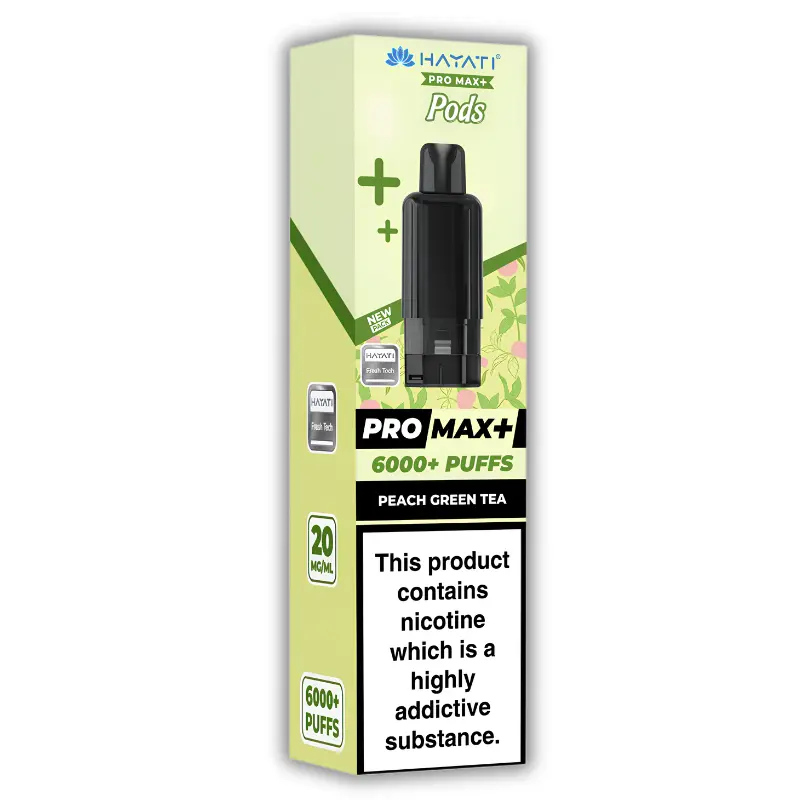
Hayati · Pro Max Plus
Peach Green Tea Hayati Pro Max Plus Pods
£5.49
✔ In stock — ready to ship
Genuine Hayati
Free over £20
Same-day dispatch
Secure checkout
This is the restock listing. At £5.49 you get one prefilled pod holding 12ml of 20mg liquid and nothing else, which means the page assumes you already own a Pro Max Plus body and have already decided you like Peach Green Tea. If either of those is not true yet, the Peach Green Tea Pro Max Plus 6000 Pod Kit is the listing that bundles a device with the same liquid, and that page is where the flavour itself gets taken apart draw by draw: what the peach does on the inhale, what the tea does underneath it, why tea is difficult to render in vapour at all, and how the airflow path treats a dry liquid. None of that is repeated here. Read it there once and you will not need it again.
What that page does not cover, because a first purchase has no history behind it, is the thing that separates a second order from a first one. You are no longer choosing. You are replacing. And replacing this particular liquid is not the same job as replacing a berry pod, for a reason that has nothing to do with how good it is and everything to do with how fast it goes.
Some flavours occupy a day. You fit them in the morning, they are what you reach for at every point until you put the device down at night, and the pod is empty inside a week. Others occupy a slot. They get used at particular moments and passed over at the rest, they share the week with two or three alternatives, and the same 12ml takes three or four times as long to disappear. A low-sweetness blend built on an astringent, faintly bitter tea base is the clearest example of the second kind this shelf sells. That is not a criticism. It is a scheduling fact, and it changes the arithmetic of every reorder you make from here: how many to buy at once, how long the gap between orders gets, which of your other pods triggers the order, and how a flavour you like ends up being the one you keep running out of.
That is what the rest of this page is about. Consumption rate, and the ordering cadence it forces.
What makes a flavour a slot rather than a day
Start with the distinction itself, because it is not the same as liking something more or less. Plenty of people have an all-day flavour they would rate seven out of ten and a slot flavour they would rate nine. The difference is not quality, it is tolerance across repetition within a single stretch of hours.
An all-day liquid is one whose character does not degrade in your perception over consecutive draws. Sweet fruit blends are built for this deliberately. Sugar and acid are both additive sensations, they refresh the palate each time in a way that does not accumulate, and a competent berry pod tastes roughly the same on draw two hundred as it did on draw two. That consistency is the entire commercial logic of a 12ml single-flavour format, and it is why so much of the Pro Max Plus pod shelf is sweet.
Astringency does not work like that. It is subtractive, it accumulates within a session, and past a certain number of draws the mouth stops having anything left for it to take. The kit page describes the sensation and how a glass of water resets it, so the mechanism is covered there. The consequence is arithmetic rather than taste: a liquid whose sessions have a natural ceiling consumes less volume per hour than one whose sessions do not. It self-limits. You put the device down not by decision but because the twelfth draw is not doing what the third did, and twenty minutes later it is doing it again. Nobody plans this. It simply produces a lower draw count per waking hour than a sweet pod, and across three weeks that gap compounds into a large difference in pods bought.
There is a second mechanism stacked on top of the first, and it is about ordering rather than fatigue. Low-sweetness liquids do not register well against a coated palate. Spend the previous hour on something sugared and this pod tastes thin and hollow for the first few draws, because the reference level your mouth is working from is too high. Reverse the order and it reads normally. So Peach Green Tea has good positions and bad positions in a day, and most people find the good ones without looking. Somewhere after food, when a sweet pod reads as cloying to a lot of people and a dry one does not. Mid-afternoon, when a sugared liquid has stopped registering at all. Late, when you want less of everything. Those are taste observations rather than schedules and yours will differ, but the pattern holds: they are moments, not a default.
Say the obvious thing about the name before going further. Tea here is a flavour, not an ingredient with a job. Nothing in Hayati's data for this pod records tea leaf, caffeine, or anything else beyond the liquid, and this page makes no claim that the flavour produces any effect whatsoever, on alertness or on anything else. It tastes of something. That is the whole of it. If the words "green tea" are doing any work for you beyond describing a taste, they should not be.
Hayati's own listing text takes a different view from this page, and it is worth flagging rather than quietly disagreeing. Their copy suggests the understated character makes it easy to come back to across a day, and for some buyers that is exactly right. The claim here is narrower: of the eighty-odd flavours on this shelf, this is the one most likely to end up as a slot for a given person. If you turn out to be an all-day Peach Green Tea drinker, the next section still applies with the numbers pushed to one end.
How do you find out which one you are? Not by introspection, which is unreliable about this. Count. Not draws, which nobody can be bothered to track, but sessions: the number of separate times in a day you pick the device up with this pod fitted. Do it for four days. If the answer is six or seven and you barely touch anything else, this is a day flavour for you and your reorder interval will look like everybody else's. If the answer is one or two while three other pods take the rest, it is a slot, and the numbers below are yours.
Three weeks a pod instead of four days
The useful way to model this is as a share of your total draws rather than as an absolute figure, because absolute figures are unknowable. Hayati put an upper bound of 6,000 puffs on the pod, measured on test equipment running a fixed draw at fixed intervals, which is nothing like how a person uses a device. Real draws are usually longer than bench draws, so the true number is lower, and how much lower depends on you. None of that matters for the calculation, because the ratio survives it. Whatever your real sole-pod duration is, running the pod at half your draws doubles it and running it at a fifth multiplies it by five.
So take two anchors and work outwards. Call the fast case four days, which is what a 12ml pod does for a frequent user with nothing else in the rotation. Call the moderate case six days. Then:
| Share of your draws | Pod lasts (fast user) | Pod lasts (moderate user) | Reorder interval |
| Everything you vape | 4 days | 6 days | Weekly |
| Half | 8 days | 12 days | Fortnightly |
| A third | 12 days | 18 days | Every two to three weeks |
| A quarter | 16 days | 24 days | Monthly |
| A sixth | 24 days | 36 days | Every three to five weeks |
| A tenth | 40 days | 60 days | Twice a quarter |
A fifth to a quarter is where most slot users land, which puts a single pod somewhere around the three week mark. Hold that number, because almost everything awkward about restocking this flavour comes out of it.
Cost first, since it is the easy part and it points the wrong way. At £5.49 a pod, three weeks of use works out at about 26 pence a day on this line. The same pod consumed in four days is about £1.37 a day. On paper the slot flavour looks five times cheaper, and people do sometimes reason from that to "so I can afford to stock up".
That reasoning is broken, and it is worth seeing why. Your total pod spend has not changed at all. The draws you are not taking on Peach Green Tea are being taken on something else, and that something else is also £5.49 a pod. Split your habit evenly across four flavours and you buy exactly the same number of pods per year as you would running one flavour solo. What changes is not the money. It is that a single reorder decision with one clock has become four reorder decisions with four clocks, and those clocks immediately drift out of phase with each other.
That is the whole problem in one sentence, and it has a consequence almost nobody notices until it bites. Think about what actually triggers you to place an order. For most people it is not a date or a stock check, it is the moment a pod goes empty or starts thinning. Now notice which pod generates that prompt. It is always the fastest-consumed one. Your all-day flavour empties every four to six days, so it triggers every order you place, and the slot flavour is never the thing about to run out at the moment you are standing there with the basket open. It has to be remembered. It never gets triggered.
Run the numbers and the failure mode is obvious. If your all-day line prompts an order roughly weekly and this pod lasts three weeks, two orders in every three are placed while it still has plenty in it and nothing is pointing your attention at it. You have to actively check something that is not currently annoying you, two times out of three, forever. That is a poor bet against ordinary attention, and it is why the flavour you never run out of is the one you use daily, and the one you find unavailable is the one you use twice a week.
A second consequence of the three week figure is about decisions rather than logistics. A four day pod gives you around ninety opportunities a year to change your mind about what you are buying. A three week pod gives you seventeen. Each individual purchase is the same £5.49, so the money at stake per decision is identical, but the commitment is not: you are signing up for three weeks rather than four days. That argues for thinking slightly harder per order than you would about a fast line, and it argues quite strongly against buying a long run of anything you have not fully settled on.
Then there is the question of whether the pod or your interest goes first. Slow consumption cuts both ways. In its favour, a flavour used for a fifth of your draws stays novel far longer, because palate fatigue is driven by exposure and you are getting a fifth as much. What kills an all-day pod by day five, simply having had too much of it, takes weeks to arrive at slot pace and often does not arrive. Against it, the calendar exposure is long enough that other things change around you. Three weeks is enough time for the weather to turn, for a new listing on New Products to catch your eye, or for your taste to drift toward something sweeter for a fortnight. A four day pod is over before any of that can happen. A three week pod is not.
One more effect of the long calendar life is worth knowing because it gets misdiagnosed constantly. The kit page notes that this liquid does not stay constant across a pod: the fruit aromatics are the volatile part and deplete first, the tea-adjacent notes are heavier and hold on, so the last portion of any pod is drier and more herbal than the first was. For a sole-pod user that shift happens over a few days and reads as an obvious change. At slot pace it is stretched across three weeks, which makes it imperceptible from one session to the next and unmistakable if you set week one against week three. People then reach for the wrong explanation: the coil is going, or they have gone off the flavour, or the batch is different. Usually it is none of those. It is the same drift every pod has, played at a fifth speed. If week three tastes drier and greener than week one did, that is the pod doing what it always does, and the next one will open bright again.
How many to order, and why the obvious answer is half wrong
The intuitive move is straightforward. You are using it slowly, so buy less of it. Buy one, use it for three weeks, buy another. Keep your money in your pocket and your shelf clear. On the arithmetic alone this is sound: there is no volume discount on a single pod listing, nothing about holding two makes each one cost less, and a single-pod purchase matches consumption perfectly.
It is also the approach that produces the most common bad outcome with a flavour like this, and the reason is the mismatch between two different clocks.
Your warning signal runs on use time. You find out a pod is nearly finished by using it: the vapour thins, the flavour goes papery for a draw or two, and you get maybe two or three sessions of notice. That is a perfectly generous warning if you are taking six sessions a day, because two or three sessions is half a day and you will place the order that evening.
Your reorder, though, runs on calendar time. Postage takes what it takes. And at slot pace, two or three sessions of remaining liquid is not half a day, it is most of a week, which sounds like more slack rather than less. The slack is illusory, because the same slow pace means you may not pick the pod up for four days after the warning draw, then reach for it on day five expecting a session and get nothing. The signal arrived on time. You were not there to act on it.
Worse, and this is the specific downside a slot flavour has that a daily one does not: when you go to reorder, the information you are working from is old. You last bought this pod three weeks ago, or six, or three months if it is a real occasional, so your confidence that it is still there to buy rests on a memory from the last time you looked. A pod you buy weekly gives you that status check for free. This one does not, and this page cannot tell you what is available today, which is rather the point. The structural observation is only that among the two hundred listings on the prefilled pods and refills shelf, the ones you check least often are the ones you know least about, and a slot flavour is by definition one of those.
So the answer to "how many" is not one, and it is not six. It is set by your reorder interval rather than by your appetite, and it works out like this.
Hold two: one in use, one unopened behind it. At three weeks a pod that is six weeks of coverage, which is enough that no plausible gap in ordering can strand you. The rule that goes with it is the part that actually does the work: the moment you break into the spare, add one to the next order you place for anything. Not a diary reminder, not a monthly audit, just a single trigger tied to a physical event you cannot miss, because you are holding the new pod in your hand when it fires. That converts an untriggered line into a triggered one, which is the entire failure mode solved for about five pounds and no effort.
Why not three or four? Because six weeks of buffer is already more than any ordinary delay needs, and each further pod extends the commitment without adding anything. Four pods is nearly three months at slot pace. Six is well past four months. That is a long way to project a preference forward on a line where, by definition, you have accumulated less total experience than on anything else you buy. The paradox is worth sitting with: the flavour you have owned for the longest stretch of calendar time is often the one you know least well, because ownership in months and use in hours are not the same measurement.
There are two cases where buying more than two is genuinely correct. The first is a fixed slot you never skip, reached for at the same point every day without variation, because then the rate is predictable and the buffer is doing real work. The second is an order you are placing anyway, where adding a pod costs nothing you were not already spending. Neither is a reason to buy six. They are reasons to buy three instead of two.
And there is one clear case for buying only one: you are still deciding. If this is your second ever pod of Peach Green Tea and you are not yet certain it has a permanent slot, a single pod is three more weeks of evidence for £5.49 and no exposure at all. Take the evidence first. A dry, astringent, low-sweetness liquid is exactly the sort of thing people are enthusiastic about for a fortnight and ambivalent about at week six, and that is a normal outcome rather than a failure of judgement. Better to find out on one pod than on five.
What arrives for £5.49
One pod, prefilled, sealed, with 12ml of 20mg liquid in it. No body, no cable, no spare. Hayati's data for this listing itemises nothing else, and where the data is silent this page stays silent: no carrier ratio is published for it, no coil resistance, and no charging connector appears anywhere in this product's specification, so none is named here.
It fits a Hayati Pro Max Plus and requires one. That is the only compatibility statement the listing supports, and it is the reason the kit exists as a separate product. Subtract this price from the £7.99 kit and the remainder is what the device costs you on its own, which makes the first purchase and every purchase after it obvious in opposite directions.
The one specification that matters for a slot user is the 12ml, and it matters differently here than for anyone else. Twelve millilitres in one undivided unit is a commitment to a single flavour, which every page on this platform says in some form. What nobody says is that the commitment is measured in volume and experienced in calendar. A daily user commits for four days. You are committing for three weeks, long enough that the pod fitted on any given evening was chosen by a version of you with different weather outside. That is not an argument against the format. It is an argument for being deliberate about which pod you break the seal on, since it will be there a while.
Everything else about the hardware is shared with the whole Hayati pod range and has been covered at length elsewhere. Two or three paragraphs is all it warrants on a restock page.
The listing in numbers, and what it costs a week
| What you pay | £5.49 for the pod alone |
| Supplied as | A single sealed prefilled pod, no device |
| Liquid inside | 12ml, filled at the factory |
| Strength | 20mg, the only one published for this flavour |
| Fits | Hayati Pro Max Plus, and nothing else is claimed |
| Profile | Peach over green tea, low sweetness, dry finish |
| Coolant | None named in the listing and none detectable |
| Hayati's puff figure | Up to 6,000, a bench number rather than a forecast |
| Cost per week, day-flavour pace | Roughly £7 to £9.50, working from this page's own arithmetic |
| Cost per week, slot pace | Roughly £1.80, on the same arithmetic |
| Reorder interval, slot pace | About three weeks per pod |
| Range and shelves | Pro Max Plus Pods, Hayati Pods, Prefilled Pods and Refills, Peach Vapes |
| Listing reference | peach-green-tea-hayati-pro-max-plus-pods |
Two of those rows are mine rather than Hayati's and should be read that way. The cost per week figures are derived from the share-of-draws table above, not published by anyone, and they will be wrong for you by whatever margin your habits differ from the anchors used. They are included because per-pod pricing is the wrong unit for comparing a slot flavour against a daily one. Both cost £5.49. Only one of them costs £5.49 a week.
The strength row deserves a note specific to intermittent use. Twenty milligrams is the legal ceiling in the UK and it is the same twenty milligrams whether you take two hundred draws a day on this pod or twenty. What changes with slot use is context: arriving at a 20mg pod with no coolant and little sweetener, straight off a stretch of something cold and sugared, makes the nicotine read more prominently for the first few draws, because nothing here masks it and your reference point was set elsewhere. That is perception and it settles. Nicotine is addictive, and how much you take is your own business.
The puff figure is worth one sentence of caution for the same reason. Hayati's 6,000 is an upper bound produced by a machine drawing at a fixed length and a fixed interval, and its only honest use is ranking pod sizes against each other. It is not a prediction of days, and at slot pace the gap between the bench conditions and your actual conditions widens rather than narrows, because your draws are fewer, longer and spread across a much larger stretch of time than any test rig simulates.
The cooling row is a flat absence, and it bears on the slot question. Cold is the other common reason a liquid gets used at particular times, so a coolant blend sorts itself into your day partly on temperature. This one has no such lever, and whatever scheduling it ends up with, it gets there on sweetness and dryness alone.
Restocking this against the rest of what you buy
The comparisons that matter on a repeat purchase are not "which tastes better". You have answered that. They are about which lines in your rotation empty fast, which empty slowly, and how to stop the slow ones falling off the order. Sorted that way, the pod shelf divides fairly cleanly.
The obvious day flavours are the sweet, balanced, mid-acidity fruit blends that nothing about their construction makes you put down. Blue Razz Fruit Twist is the archetype, and it is the single most likely pod on this shelf to be the one triggering all your orders. Blueberry Raspberry and Blackberry Raspberry behave the same way, as does Blueberry Raspberry Cherry. If you run one of those alongside this, expect roughly a five to one ratio in pods bought, and expect every order to be generated by the berry line. Put Peach Green Tea on the same order form anyway.
Sugared soft-drink profiles sit at the same end. Berry Lemonade, Blue Razz Lemonade and Blackcurrant Lemonade are all built to keep registering across long stretches, which is what makes them fast movers, and Cherry Cola is in the same group despite carrying a bitter edge of its own under the sugar. Anything from that set will outrun this pod by a wide margin.
Several listings tend toward slot behaviour for reasons other than dryness, and knowing which they are matters because two slow lines in one rotation means two untriggered reorders rather than one. Heavy cooling is the commonest cause. Blue Frozen and Blackberry Ice are emphatic enough that a lot of people ration them without deciding to, and a hard coolant has its own accumulating effect on the palate that shortens sessions the way astringency does. Banana Ice is softer but distinctive enough to be an occasional for many. Lemon Lime can go either way: sharp citrus is bracing in short bursts and tiring across a full day, so it lands as a slot for about as many people as it lands as a daily.
Among the peaches, the split is instructive because it is almost entirely about sweetness rather than fruit. Juicy Peach is the straight, wet, sweet version and behaves like a day flavour. Mango Peach Pineapple is three sweet fruits with nothing restraining them, firmly in the fast-moving group. White Peach Raspberry uses acid where this uses tannin, and acid does not accumulate, so it empties faster despite a similar position on structure. Cherry Peach Lemon moves at an ordinary pace. Peach Aura is unpredictable, since its second word names an intention rather than an ingredient. The peach section runs to thirty-two listings and the pace varies across it far more than the fruit does.
The single most useful neighbour for a restocker, though, is Blackcurrant Juice, because blackcurrant skin carries a genuine tannic bite and it is the only fruit listing on this shelf that behaves anything like this one in the mouth. If you are trying to work out whether you want a second dry line or whether one is enough, that is the cheapest experiment available. Run them in parallel for a month and watch which empties. Whichever does is your actual dry preference, and the other one can go back to being occasional.
For deliberate contrast at the other extreme, Guava Kiwi Passion Fruit is three tropical fruits with no dry element anywhere, and Blackcurrant Mango pairs one fruit that has a little grip with one that has none. Both will move faster than this pod, both by a lot.
Worth a separate mention: Cherry Ice and Peach Mango on the Pro Ultra Plus at £7.99 is a different device family, relevant here only for what a larger pod does to the cadence problem. Scaling up the volume on a slot flavour stretches the reorder interval further, which sounds like a fix and is closer to the opposite: two months of pod means two months between status checks on that line, and the interval is what causes the trouble. For a slow line, smaller and more frequent is the more robust shape of purchase.
If you are working out what to order alongside this rather than instead of it, the practical filter is simple. One fast line to carry the bulk of your draws and generate your order prompts, this as the slot, and at most one other slow line, because every additional slow line is another clock you have to remember. Recent listings appear in New Products first if you want to see what has been added since your last order, and the full catalogue is there if you would rather browse the lot than be steered.
Running a pod you only open twice a week
Intermittent use changes a handful of practical things, and the ones below are the ones that actually differ. Everything generic about prefilled pods applies as normal and is not repeated.
The first draw of a session is no longer an edge case. On a pod you use constantly, the thicker, darker first pull after a gap happens once or twice a day and most people barely clock it. The kit page explains why it happens and how it tastes on this liquid, and the mechanism is unchanged here. What changes at slot pace is frequency: if every use follows a gap of hours or a day, that first draw is not an occasional quirk, it is how every session of yours begins. The tap-the-mouthpiece-down routine therefore stops being optional housekeeping and becomes part of picking the device up. Do it every time and the sessions start where they should. Skip it and your impression of the flavour is being formed, repeatedly, from the least representative draw the pod produces.
Second, judge the pod by sessions rather than days. A daily user knows a pod is old because they fitted it on Monday. You will have no such anchor, because three weeks ago is not a thing anybody remembers accurately. Count openings instead, even roughly. Two a day for three weeks is around forty sessions, and if you are at session forty and the vapour has thinned, the pod is finished rather than faulty. This matters because slow users are the ones most likely to conclude a pod has failed early, having genuinely lost track of how much use it has had.
Third, a coil's working life here is counted in draws, not in dates on a calendar, so a slot user simply reaches the end of it later. That is the whole of it. What an unopened pod does over long periods before you get to it is a separate subject with its own page, and this one does not take it on.
Fourth, expect the week one to week three drift covered earlier and do not act on it. The temptation at week three, when the fruit has thinned and the green note is more prominent, is to replace the pod early on the assumption something is wrong. Usually nothing is. If the dryness has turned genuinely sharp and ashy rather than merely drier, that is different and the pod is done. Drier is normal. Bitter and scratchy is not.
Fifth, on swapping. If Peach Green Tea holds a slot and something else holds the rest of the week, you will be taking pods in and out of one body constantly, which a single-flavour user never does. Seat each one deliberately rather than pushing it in while distracted, and give a refitted pod a minute before drawing. None of that is peculiar to this liquid. It follows from a use pattern that racks up many times more fitting operations per pod than a one-flavour habit does.
Sixth, and last, on when to stop rebuying. A slot flavour can coast for a long time on a slot nobody has re-examined. If you notice you are down to one session a week, then one a fortnight, then finding an unfinished pod you cannot remember opening, the honest reading is that the slot has closed and the line should come off the order rather than being topped up out of habit. That is not a criticism of the flavour. Slots close. The useful signal is the unfinished pod, because a pod you are not finishing is telling you something a pod you are finishing cannot.
Questions that come up on the second order
I already have the device. Is there any reason to buy the kit again?
Only if you want a second body, either as a spare or because the one you have no longer holds charge as long as it did. The liquid in both listings is identical and the price gap is purely the hardware. For a pure restock this pod is the correct listing.
How long should one pod actually last me?
That depends entirely on what share of your total draws it takes. Used as your only liquid, expect something in the region of four to six days. Used for a fifth of your draws, which is typical for this flavour, expect around three weeks. Both figures are estimates built from the same 12ml, not published durations.
Should I stock up since it lasts so long?
Hold two, not six. Two pods is about six weeks of coverage at slot pace, which comfortably absorbs any ordering gap, while six is over four months of commitment on a line you have accumulated relatively little actual experience with. The rule that matters more than the quantity is adding one to your next order the moment you break into the spare.
Why do I keep running out of this one and never the others?
Because your orders are triggered by whichever pod empties fastest, and that is never this one. A slow line has to be remembered rather than prompted, and it is invisible at the moment you are placing most of your orders. Tie a check on it to a physical event, such as opening your spare, instead of relying on noticing.
Is it noticeably different at the end of a pod compared with the start?
Yes, and at slot pace the change is spread over three weeks so it creeps up on you. The fruit thins out first and the drier, greener side becomes more prominent. That is normal behaviour for this blend rather than a fault, and a new pod will open bright again.
Does the tea part mean there is caffeine in it?
No such ingredient appears anywhere in Hayati's data for this product, and this page makes no claim that the flavour does anything at all beyond taste. Green tea here is the name of a taste, in the same way that cola or lemonade is on other listings in the range.
Any cooling in this pod?
None is named in the listing and none is detectable in the vapour. The fresher feeling some people describe comes from the dry finish, which is a different sensation in roughly the same place. If you want actual cold, the shelf has plenty of listings that carry it in the name.
Can I make a pod last longer by using it less?
In calendar terms obviously yes, and that is the whole subject of this page. In terms of total draws, no: the liquid is the liquid, and spreading it over six weeks instead of three does not produce more of it. The reason to use it at slot pace is that you prefer it that way, not that it makes the pod go further in any meaningful sense.
What is the 6,000 figure actually telling me?
It is Hayati's upper bound, produced on test equipment taking a fixed draw at fixed intervals. Its honest use is ranking pod sizes against each other, not predicting how many days you will get. Your own draw length can move the real number substantially in either direction.
Is this pod refillable once it is empty?
It is supplied prefilled and Hayati do not publish it as refillable, so treat it as a consumable and fit a fresh one when it is spent. That is also why the restock cadence covered on this page is worth thinking about at all.
Does it come in anything other than 20mg?
One strength is published for this flavour and that is 20mg. Where Hayati offer alternatives they appear as separate listings rather than as options on a single page, so there is nothing to select here.
What should I pair it with if it is only taking a fifth of my draws?
One fast, sweet line to carry the bulk and generate your reorder prompts, and at most one other slow line, because each slow line adds a clock you have to remember. A berry or lemonade blend is the usual choice for the fast line.
The short version
Peach Green Tea as a bare pod is £5.49 for 12ml of 20mg liquid that fits a Pro Max Plus you already own, rated by Hayati at up to 6,000 puffs on test equipment. The flavour is dealt with properly on the kit listing and this page does not duplicate it. What this page is for is the second purchase and every one after it, and the argument is straightforward: this is a flavour that most people end up using at particular moments rather than throughout a day, which stretches one pod from roughly four days to roughly three weeks.
Everything awkward about restocking it follows from that number. Your total spend does not change, but your orders get triggered by whatever you use fastest, and this line is never the thing about to run out when you place them. So it gets forgotten, and the flavour you like turns out to be the one you cannot have when you want it. The fix is small: hold one unopened pod behind the one in use, and add another the moment you break the seal on the spare. Do not buy six, because six is four months of commitment on a line you have spent fewer hours with than anything else you own. Expect the last week of a pod to taste drier than the first and do not replace it early on that basis. And if you find a pod you opened and never finished, take the line off your order rather than topping it up.
Strictly for adults aged 18 and over. Nicotine is an addictive substance.
You might also like


