
Home / Hayati Pro Max Plus Pods / Pink Lemonade Hayati Pro Max Plus Pods
Hayati · Pro Max Plus
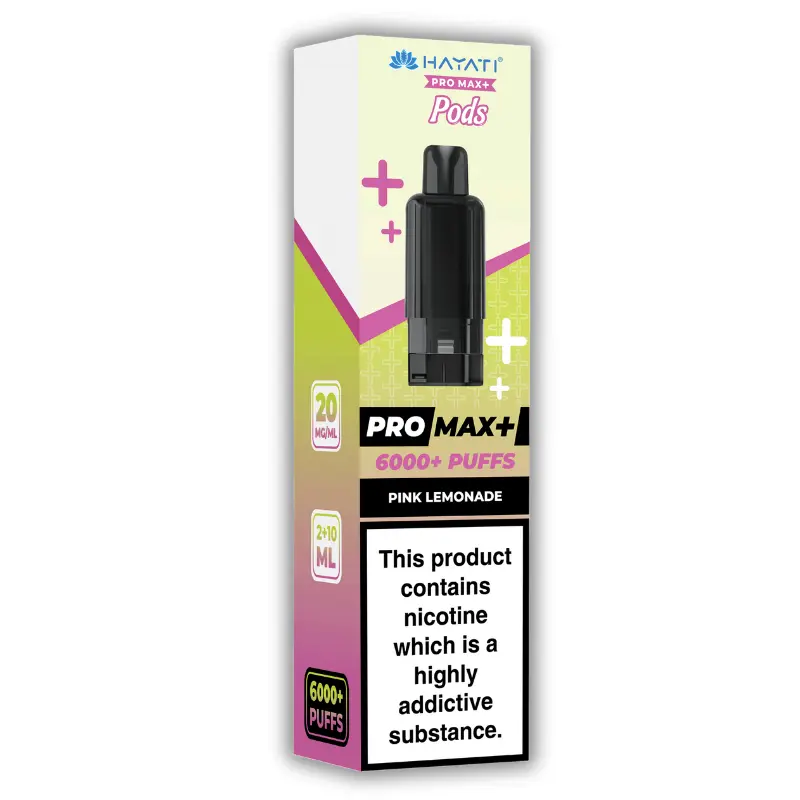
Pink Lemonade Hayati Pro Max Plus Pods
£5.49
✔ In stock — ready to ship
Genuine Hayati
Free over £20
Same-day dispatch
Secure checkout
£5.49 puts one sealed Pink Lemonade pod in the packet and nothing beside it: 12ml of liquid at 20mg nicotine salt, the coil already fixed inside, no body, no lead, nothing to assemble. Hayati rate a filled pod at up to 6,000 puffs, a laboratory figure produced by equipment drawing to a timer, which is serviceable for ranking pod formats against each other and useless as a forecast of your fortnight. The listing only does anything for somebody who already owns a Pro Max Plus body, and in practice only for somebody who has already emptied one of these and decided to have another.
That second condition is what this page is about. The flavour case for the liquid was made in full on the Pink Lemonade kit listing, which is the same 12ml of the same recipe with a device attached for £7.99, and none of it is repeated here. Its central argument was about grammar: attach a colour to a fruit and it behaves one way, attach it to a drink and it behaves another, because a drink already has an expected appearance and announcing a different one amounts to reporting that something went in. It counted the colour words across all 492 listings and set out the four-way taxonomy of what a colour can attach to. It used Mr Pink as the control experiment and Peach Green Tea as the exception that defines the rule. It lined up the three separate Hayati descriptions of this liquid and read them against each other. It worked out mechanically what adding a red fruit to a lemonade does, which is to blunt the sourness and add body, and it gave a listening method for judging a first pod, together with the plain cost of the design, which is that anybody whose reason for choosing a lemonade is the sourness has been sold less of it on purpose. Anyone still deciding whether to buy this flavour at all should read that page rather than this one.
What the kit page did last is the thing that opens this one. Its closing move was to explain why the blunting is defensible rather than merely a loss, and the explanation was about coil wear: the soft red half is the durable half, so this blend survives a tiring coil better than the sharper lemonades do, because less of what makes it recognisable was resting on the component that fades first. That is a claim about the pod's decline, and it was made on the page addressed to a first-time buyer, who has no decline to observe yet.
A repeat buyer does. And a repeat buyer who has read it is in an unusual position, because the easiest explanation for the most common complaint about a second or third pod has already been taken off the table before they arrive. When a pod reads softer than the one before it, the reflex is to blame the pod. Here a sibling page has argued in advance that this particular recipe is the one least likely to deserve the blame. What follows is what that leaves, how confident anyone can be about it, and what a buyer can actually do with the answer. It also corrects two claims I was handed with the commission, because both turned out to be larger than the catalogue supports.
What the kit page settled, and what it left standing
The finding, taken as read and then narrowed
Take the durability argument at face value first. The name of this liquid points at the sharp half and the recipe puts its weight on the soft half. A tiring mesh coil loses light volatile material before it loses heavy material, so the citrus top thins while the red sweetness underneath carries on. A blend whose identity is mostly in the durable component therefore keeps its outline longer than a blend whose identity is mostly in the fragile one. That reasoning is sound and I am not going to relitigate it.
What it does not say is that nothing fades. It says the blend holds its outline. The sharp half still goes, and it goes first, exactly as it does on every other citrus listing in the range. So a reader who takes the kit page's conclusion to mean that a softening reading cannot be the pod has over-read it. The correct version is narrower and, awkwardly, less helpful: the coil explanation has been demoted, not removed.
There is a sting in that narrowing which is worth sitting with, because it makes this liquid harder to diagnose rather than easier. The component a tiring coil takes first is the acid. The component a palate adapts to fastest is also the acid. Two completely different processes, one running in the hardware and one running in the reader, act on the same half of the same blend and produce the same subjective report. The kit page's argument did not separate them. It put them on top of each other.
Where the commission overreached, and the real number
The brief for this page said that Pink Lemonade is the only liquid in this corpus whose coil explanation has been closed off in advance by a sibling page. That is a rarity claim, and rarity claims in this project have a poor record, so I counted rather than repeating it.
Across the 297 product pages written so far, 22 carry an explicit claim that their liquid ages well, holds its shape, degrades gracefully or has no fragile component. That is roughly one page in fourteen, which is not rare by any reading. Several of them are twins in exactly the sense the brief meant: the White Peach Raspberry pod page states outright that neither half of its blend is fragile, the Blueberry Raspberry Cherry pages argue that three overlapping contributors should degrade more gracefully than one, and the Cherry Sour Raspberry pod page distinguishes sharpness carried by an aromatic from sharpness carried by a dosed acid precisely in order to predict how each ages. A buyer of any of those arrives with the same prior.
So the claim fails as written and I am saying so on the page rather than writing around it. What survives the count is smaller and more specific. Of those 22 durability claims, most assert symmetry: both halves hold up, or the whole blend holds up. This one asserts asymmetry, and it asserts it against the half named in the title. That combination is what creates the diagnostic problem described above, and it is the reason this page exists in the form it does. Not because the coil has been ruled out, but because the ruling has been made about the wrong half, in a way that makes the two candidate explanations point at the same sensation.
Three explanations, not two
Lay them out plainly, because the rest of the page is about telling them apart.
- The coil. Real, demoted rather than eliminated, and it has a signature: the effect grows through a single pod and disappears when a new one goes in.
- Your own reading. Sour perception is not a fixed instrument. It moves with what you last ate, what you last vaped, how long ago, and how dry your mouth is. It has a signature too, and it is different: the effect comes and goes within a day and a fresh pod does not fix it.
- The liquid. Batch-to-batch variation exists in principle for every manufactured liquid and Hayati publish nothing that would let anyone measure it here. A single pod is not evidence of it and neither is a single disappointing week.
The third one is where people land by default and it is the one with the least behind it. The first two are separable at no cost, and separating them is the practical content of this listing.
A sour threshold is not a cold one
The general finding, borrowed and credited
The idea that a reader's own threshold moves, and that a trend in perception is indistinguishable from a trend in the product when you only have your own mouth to measure with, was established on the Smooth Strawberry Ice Hayati Pro Max Plus Pods page. That page is the reference for the general point and it makes it better than a summary would. It also establishes the harder half of the problem, which is that you cannot taste the difference between a liquid weakening and yourself adapting, because both arrive as less of something.
Everything below takes that as given and then departs from it, because the stimulus is not the same kind of thing and the difference changes every practical conclusion.
Why the timescales differ
A cooling agent works by acting on a receptor that reports cold. Nothing in the mouth removes it, dilutes it or breaks it down on any useful timescale, so the exposure is simply however much of it you draw, for however long you keep drawing. Sustained exposure of that kind moves a resting threshold over days and weeks, and the threshold comes back slowly, which is the whole basis of the argument on the Smooth Strawberry Ice page and the reason its advice is about building gaps into a rotation.
Acid does not behave like that, and the reason is a feedback loop that has no equivalent on the cooling side. Sourness stimulates salivary flow. Saliva dilutes and buffers acid. So the stimulus you are adapting to is actively removed by the response it produces, within seconds to minutes, and the exposure is self-limiting in a way a coolant's never is. The practical upshot is that sour adaptation is a fast process on both the way up and the way down: it builds inside a session and it substantially clears between them.
Two consequences follow and they matter more than the mechanism does.
The first is that there is no ratchet here. The escalation trap set out on the Smooth Strawberry Ice page, where you buy something colder, the new level becomes the baseline, and the moderate product is deleted from the range as far as you are concerned, depends on a threshold that does not come back on its own. A threshold that has largely reset by the following morning cannot ratchet. I am deliberately staying off that argument rather than borrowing it, because applying it here would be wrong, and it would be wrong in the direction that costs a reader money.
The second is that the useful variable changes. On a cooled liquid the question is how many consecutive pods of it you have had. On this one the question is what you did in the twenty minutes before the draw. The unit of analysis moves from the month to the afternoon.
Honest limits on all of the above
None of this is measured for this recipe. Hayati publish no acid concentration, no titratable acidity, no pH and no curve of any kind, and nobody outside the company could produce one from a retail listing. What I have described is the general behaviour of sour perception, applied to a liquid whose acid content is unknown in absolute terms and known only to be lower than that of its siblings, which the kit page established from Hayati's own copy.
Individual variation is wide and I have no way to narrow it for you. Recovery between sessions is substantial rather than complete, and how substantial is exactly the sort of number that gets invented on pages like this one. I am not going to give you one. What I can give you is a set of conditions that reliably move the reading in a known direction, which is enough to run the comparison properly even without knowing the magnitudes.
What moves your reading inside a single day
These are ordered by how much difference they make on this particular liquid, which is a blend with less acid in reserve than any of the other four lemonade names and therefore the one that loses most from a given amount of suppression.
- Sugar immediately before. Sweetness and sourness suppress each other in perception, which is why a squeeze of lemon into a sugared drink flattens both. Draw on this after a biscuit, a sweet coffee or a confectionery pod and the citrus reads noticeably lower than it did an hour earlier. On a sharper lemonade the acid has enough headroom to survive the suppression. Here it does not.
- Acid immediately before. Another tart liquid, a citrus drink, anything vinegared. This is direct adaptation rather than suppression and it is the most complete of the effects listed here, because you are raising the threshold on the exact receptor population you then ask to report.
- Chain-drawing. Four draws inside ninety seconds and the fourth is flatter than the first. This resolves in a few minutes and is the most familiar version of the whole phenomenon. It is also the one most often mistaken for a pod going off, because it happens at the moment you are paying most attention.
- A dry mouth. Less saliva means less dilution and less buffering, so the first draw of the morning tends to read as the sharpest of the day. The same pod at four in the afternoon, after lunch and several cups of something, is a different reading of the same liquid.
- Strong mint. Toothpaste in particular distorts sweet and citrus perception for a considerable while afterwards, which is a familiar enough effect that most people have noticed it with orange juice.
- The previous pod in a rotation. If this follows a confectionery blue it reads flat. If it is the first thing you draw on, it reads as intended. That is a rotation-order effect, not a product fault, and it is entirely under your control.
Put those together and a single conclusion falls out. The most common way to arrive at the belief that a Pink Lemonade pod is weaker than the last one is to compare a reading taken in a good slot against a reading taken in a poor one, weeks apart, from memory. That is not a measurement. It is two measurements taken with the instrument set differently and no record of the settings.
The instrument you do not have
Three listings, and the claim I had to narrow
The way to settle a question like this is to take a second reading of the same liquid through different hardware. Hold the recipe still, move the pod, and anything that changes is the pod rather than the recipe or you.
The brief for this page said Pink Lemonade offers no second format to do that with. Counting the catalogue, that is not quite right and the correction is worth making precisely.
Pink Lemonade appears three times in 492 listings. This pod at £5.49, the kit at £7.99, and a 10ml bottle in the Pro Max Nic Salt line at £2.49 and 10mg. The first two are the same pod with and without a device, so they are one reading, not two. The third genuinely is a second format. What the flavour lacks is not a second format but a second prefilled listing: there is no Pink Lemonade on the Pro Ultra Plus platform and none on the Mini Ultra, so there is no way to buy this liquid at 20mg in a different pod.
Why the bottle is not the control it looks like
A 10ml bottle at £2.49 looks like a cheap way to run the test and it is not, because it moves three variables at once when the experiment needs one.
It halves the nicotine, from 20mg to 10mg, and that is not neutral to the thing being measured. The kit page made the converse observation about the same interaction, noting that the bite a lemonade produces at the throat comes partly from its acid and partly from its nicotine, so cutting the acid leaves 20mg standing out more here than the identical figure does on a sharper member of the set. Run that backwards and halving the nicotine changes the composition of the sensation you are trying to score.
It also puts the liquid into hardware you own, with a coil of an age you probably have not tracked, at a power setting of your choosing and an airflow you can adjust. Every one of those is a variable that a sealed pod holds still for you. The bottle hands them all back at the moment you least want them.
And it is not certain to be the same liquid. Hayati publish no formulation for either listing, and the kit page has already pointed out that two listings sharing a flavour name have never been guaranteed to share a formulation. A 50/50 bottled salt built for a refillable pod kit and a sealed 12ml prefilled pod are made for different hardware and there is no published reason to assume the liquid inside them is identical.
The bottle is still worth owning for other reasons, including the obvious one that it is the cheapest route into this flavour by a wide margin. As a control for the question on this page it is close to useless.
Five lemonade names, and which two can run the clean version
Here is the count that makes the situation checkable rather than merely asserted. The Lemonade Vapes shelf holds 19 listings and those resolve to five distinct lemonade names plus one dual pairing that combines two of them. Sorted by how many prefilled platforms each name reaches:
- Blackcurrant Lemonade: seven listings across three prefilled platforms plus a bottle. A buyer can take a second reading on Blackcurrant Lemonade Mini Ultra Pods at £3.49 or Blackcurrant Lemonade Pro Ultra Plus 25K Pods at £7.99, both at the same strength as their Pro Max Plus pod.
- Straw' Lemonade: four listings across two prefilled platforms and no bottle at all. Straw' Lemonade Mini Ultra Pods at £3.49 and Straw' Lemonade Pro Ultra Plus 25K Pods at £7.99 give the same two readings.
- Berry Lemonade: three listings, one prefilled platform, one bottle.
- Blue Razz Lemonade: three listings, one prefilled platform, one bottle.
- Pink Lemonade: three listings, one prefilled platform, one bottle.
So the honest version of the claim I was handed is this. Pink Lemonade is not unusual among the lemonades in lacking a second prefilled format. Three of the five are in the same position, and the two that are not are unusually well served rather than the other three being unusually badly served. The £3.49 Mini Ultra route is the cheap clean instrument in this catalogue: for a third of the price of the pod you are trying to check, a Blackcurrant or Straw' buyer can hold the recipe still and vary only the hardware. A Pink Lemonade buyer's cheapest second reading of the same liquid is a bottle at a different strength in a device of their own, which is not the same experiment.
That is a smaller claim than the one I started with and it is still the operative fact for a reader of this listing. You cannot run the clean test. You have to borrow a reference, and a borrowed reference is a weaker instrument. The next section is about borrowing it as well as it can be borrowed.
Borrowing a reference from a sibling
What a useful borrowed reference has to satisfy
Three requirements, and they rule out most of the 89 listings on the Pro Max Plus pod shelf immediately.
It has to be on this platform, so the pod format, the airflow and the coil design are held constant and are not silently doing the work. It has to be something you will actually buy and finish rather than a sample, because a borrowed reference taken from three draws is worse than no reference at all. And its relationship to the axis you are measuring has to be known in advance, because otherwise a difference between the two pods tells you nothing about which of them moved.
Two listings satisfy all three, and they satisfy them in opposite directions, which is better than either on its own.
The negative control: Blackcurrant Lemonade on this platform
Blackcurrant Lemonade Hayati Pro Max Plus Pods costs the same £5.49, holds the same 12ml at the same 20mg, and sits on the same shelf. What makes it the right control is a finding the kit page established and I will not re-derive: blackcurrant's characteristic grip is astringency rather than acidity, and those are different sensations physically, one tactile and one a taste.
The consequence is the useful part. A shifted sour threshold should leave astringency more or less where it was, because it is not the same signal. So if the blackcurrant reads normal on an afternoon when the Pink Lemonade reads soft, the most economical explanation is that your reading of acid has moved rather than that two separate pods have both gone off. If both read flat, the common factor is something other than an acid threshold: the device, a blocked nose, a cold room, a mouth that has just had coffee in it.
That is a genuine discriminator and it costs one pod you were probably going to buy at some point anyway.
The positive probe: Berry Lemonade on this platform
Berry Lemonade Hayati Pro Max Plus Pods is the same price, the same volume and the same strength again, and its own page grades it at length as a default flavour rather than an occasion one, arguing that its palate neutrality is close to the best on the shelf. What matters for this purpose is where its acid sits: more of its character rests on the sharp component than this one's does, which the kit page's ranking of the five lemonades sets out.
Run it as the probe rather than the control. If your sour threshold has genuinely moved, the acid-led listing should show it more clearly than the acid-reduced one, because there is more of the relevant signal there to lose. A Pink Lemonade that reads soft while a Berry Lemonade still reads sharp is a poor fit for the threshold explanation. Both reading soft together is a good one.
Between them, the two bracket the measurement: one liquid whose severity should be unaffected by the thing you suspect, and one that should be affected more than the pod in your hand.
The third lemonade on this shelf, and why it is the worst choice
Blue Razz Lemonade Hayati Pro Max Plus Pods completes the set of same-platform lemonades and it is the one to leave out. Its apparent sharpness comes from a confectionery sherbet edge rather than from citrus acid, a distinction the kit page draws when it ranks how each of the five disguises its softening. A reference whose sharpness is not the kind of sharpness you are measuring will move for reasons you cannot attribute, which is the definition of a bad control.
What a borrowed reference cannot tell you
Be clear about the trade, because it is not a small one and pretending otherwise would undo the point of the exercise.
The clean experiment holds the recipe constant and varies the pod. Borrowing does the reverse: it holds the pod format constant and varies the recipe completely. Two different recipes differ along a dozen axes, of which acid is one, and you are trying to read a change in that one axis through all the others. Your memory of how the sibling used to taste is itself a reading taken under conditions you did not record. And a borrowed reference introduces a second coil, of a different age, carrying a different sugar load at a different rate.
A second prefilled format of this exact liquid would hold twelve things still and move one. Borrowing holds one thing still and moves twelve. It is genuinely the weaker instrument and there is no way around that on this flavour, which is the cost of the catalogue structure counted out above. What makes the borrowed version worth running anyway is that the alternative is not a better experiment. It is a guess.
What to do once you have an answer
If the answer is your reading, change the order of play
The fix is sequencing and it is free. Draw on this before the sweet things rather than after them. Take the pod's measure in the first hour of the day, when the mouth is driest and the suppression from whatever you last ate has cleared. Leave a couple of minutes between draws when you are trying to judge it rather than trying to enjoy it. If it lives in a rotation, put it at the front of the rotation and not behind a confectionery pod.
That is the whole of the advice and it is deliberately not a purchase. Buying something sharper because this pod read soft on a Thursday afternoon is solving a Thursday afternoon with twelve millilitres.
Do not escalate, and the reason is specific
Nothing here is a reason to trade up the acid scale. The escalation trap documented on the Smooth Strawberry Ice page is real and it is real because a coolant threshold does not restore itself, so each step up becomes permanent. A sour threshold that resets substantially overnight does not build that kind of staircase, and treating the two the same way would have you buying a sharper liquid to solve a condition that was going to clear by breakfast.
Wanting more acid as a standing preference is a different matter entirely and a perfectly good reason to buy something else. The distinction is whether the wish survives a night's sleep. If it does, it is a preference and the catalogue has answers. If it does not, it was the afternoon.
If the answer is the pod after all
It sometimes will be, because the coil explanation was demoted rather than deleted. The kit page names the end-of-pod signal for this specific liquid and explains why the usual one is unreliable here, so I will not restate it; read that section rather than a paraphrase of it.
What I will add is the timing test, because it is the one thing a repeat buyer can do that a first-time buyer cannot. Coil-driven softening is monotonic within a pod and resets when you fit a new one. Palate-driven softening is not monotonic and a new pod does nothing for it. So the single most informative reading you can take is the first draw of the morning on a brand new pod. If that reads sharp, the previous pod was tired and the mystery is solved. If a fresh pod on a dry mouth first thing still reads soft, the pod is not the problem and no amount of reordering will make it one.
The record worth keeping, and the one already written
Keeping a record of how a pod behaves across its life is not my idea and the method belongs to Blue Razz Fruit Twist Hayati Pro Max Plus Pods, which sets out how to anchor readings to the pod rather than to the calendar and what three consistent pods entitle you to conclude. That page is about the axis running from the first millilitre to the twelfth.
The axis here is perpendicular to it and needs three different things noted, none of which that method captures: the time of day, what you last ate or drank, and how many draws you had taken in the previous ten minutes. Two numbers and a word. Without them, two readings a fortnight apart are not comparable, and with them a difference means something. Use both records together if you are inclined, or neither, but do not take the pod-life record and expect it to answer a question about the afternoon.
The refill itself, briefly
The hardware is identical across the whole Pro Max Plus pod shelf and has been explained properly there. What is in this packet is one prefilled pod: 12ml of liquid at 20mg, the coil fixed inside and retired with it, nothing to refill and nothing to charge. No connector type, coil resistance or carrier ratio appears anywhere in this listing's data, so none of them appears on this page either, and a figure quoted confidently on some other retail page is still not a specification. Check the range name printed on your device against the range name in this title before ordering, since Hayati publish no compatibility chart.
One specification bears directly on the argument above, and it is the volume. Twelve millilitres is enough liquid that a single pod spans many days, which means you will draw on this same pod first thing in the morning, after lunch, after a sweet coffee, on a cold walk and at the end of a long evening. Most pages treat that as a problem, since it confounds the pod's age with everything else going on. For the question on this page it is the opposite: it is the only reason a within-day effect is observable at all. A 2ml pod turns over faster than your habits do, so you never get to compare two conditions on the same coil. At 12ml you get dozens of chances.
Everything else about this listing is a repeat purchase, which is the point of it. It is one of the 201 listings on the Hayati Prefilled Pods & Refills shelf and the pod half of a pair, with the £7.99 kit being the same thing with a body attached. The £2.50 between them is hardware and nothing else.
The sheet, with the reading conditions in it
| What arrives | One prefilled pod, no device, nothing to assemble |
| Liquid | 12ml, filled and sealed at the factory |
| Nicotine | 20mg, the United Kingdom ceiling for a prefilled pod |
| Form | Nicotine salt, which is what prefilled pods of this type normally use; the listing publishes only the figure |
| Price | £5.49 |
| Rated by Hayati at | Up to 6,000 puffs, a laboratory estimate rather than a forecast |
| Coolant | None named in the title or in any of the three descriptions |
| Other listings of this flavour | Two: the kit at £7.99, and a 10ml bottle at 10mg for £2.49 |
| Second prefilled platform | None. No Pro Ultra Plus and no Mini Ultra version exists |
| Cheapest second reading of this liquid | The bottle, at a different strength in hardware of your own |
| Coil | Not published. Fixed in the pod and discarded with it |
| Carrier ratio | Not published for this listing |
| Brand | Hayati |
| Filed under | Pro Max Plus Pods, Hayati Pods, Prefilled Pods and Refills, Lemon Vapes, Lemonade Vapes, New Products |
Two of those rows are unusual for a specification table and they are the two this page turns on. Nothing about a second prefilled platform belongs on a spec sheet in the ordinary way, and it belongs on this one because its absence is the reason a reader here has to borrow a reference instead of taking one. A buyer comparing this against the Blackcurrant Lemonade pod at the identical price is choosing between two liquids that are not equally checkable, and no conventional row says so.
The 20mg figure is the only strength offered against this listing, and lower strengths in the range are separate listings rather than an option here: Hayati Pro Max Plus Prefilled Pods 10mg is the same money for a reduced-strength pod, sold by strength rather than by flavour. Nicotine is an addictive substance, and the choice of strength belongs to the person buying.
Treat the puff rating as a statement about capacity and nothing else. What it establishes reliably is proportion: triple the volume of a 4ml unit, roughly half of the biggest pod in the Hayati range, and those ratios survive any drawing style. It says nothing about days, and on this liquid it also says nothing about the more useful quantity, which is how long the pod stays interesting rather than how long it stays wet. Write down when you seated the pod and when you gave up on it, then work from that interval instead of the rating.
Neighbours, sorted by what they would do to this experiment
Same platform, same money, different acid
The three listings already named are the ones with a defined relationship to the axis being measured, and their prices are identical to this one, so nothing about the comparison is distorted by spending more. Blackcurrant Lemonade is the control because its severity is tactile. Berry Lemonade is the probe because more of it is acid. Blue Razz Lemonade is the one to leave out because its sharpness is confectionery rather than citrus.
Outside the lemonades, Fizzy Cherry Hayati Pro Max Plus Pods is worth a mention as a near miss. It reads sharp and it is on the same shelf at the same price, but its sharpness is a carbonation reference rather than fruit acid, which puts it in the same category as the blue razz for these purposes: it will move, and you will not be able to say why.
If you want the sharpness back permanently
Supposing the wish survives the night and turns out to be a preference rather than an afternoon, there are 54 listings filed under Lemon Vapes, and the citrus-led end of that shelf goes considerably further than any of the five lemonades do.
Lemon Lime Hayati Pro Max Plus Pods is the plainest of them, two citrus fruits with very little sweetening behind them, and it is where to go if the red half is the component you want subtracted. Lemon Pineapple Hayati Pro Max Plus Pods is the rare case of a second fruit going in without much acid coming out, since pineapple arrives carrying sourness of its own instead of only sugar. Pineapple Lemon Burst Hayati Pro Max Plus Pods is the sweeter reading of that same pairing and sits closer to where you already are. Cherry Peach Lemon Hayati Pro Max Plus Pods puts the citrus third and names the red fruit that this listing leaves unnamed, which makes it the obvious comparison for anyone who wants the same shape with the mystery removed.
Rotation partners that do not interfere
If the diagnosis came back as sequencing, the useful move is choosing what sits either side of this pod in a rotation. What you want beside it is something that does not suppress acid on the way in and does not leave sugar behind on the way out.
Blackberry Raspberry Hayati Pro Max Plus Pods goes darker and drier and leaves the palate in a reasonable state for a citrus to follow. Blueberry Cherry Cranberry Hayati Pro Max Plus Pods is the one on this shelf with a genuinely sour component in the mix, so it is the poorest partner to put immediately before this pod and the most interesting one to put after it. Blueberry Raspberry Hayati Pro Max Plus Pods is the neutral middle option, familiar enough that it will not distract from a reading. Blueberry Pomegranate Hayati Pro Max Plus Pods brings a drying edge of its own rather than a sugar load.
The partners to avoid immediately before a reading are the sugar-forward ones, which is not a criticism of any of them. Dragon Berries Hayati Pro Max Plus Pods is a soft unresolvable accord built to be easy rather than bracing. Cola Ice Hayati Pro Max Plus Pods and Cola Lime Hayati Pro Max Plus Pods both carry a heavy sugared-drink character, and the iced one adds a coolant on top of it, which is the one thing guaranteed to make the next twenty minutes unreadable. Banana Ice Hayati Pro Max Plus Pods is the heaviest and most coating of the group.
For genuine cold as a deliberate choice rather than an accident of ordering, Blackberry Ice Hayati Pro Max Plus Pods is the direct listing, and anyone running iced liquids consecutively should read the Smooth Strawberry Ice page before settling into a pattern, because the timescale argument there is the opposite of the one here and the advice does not transfer in either direction.
Handling a pod you are measuring
General pod handling is the same across the shelf and lives there. What follows is what changes because of what this particular pod is for.
Let it settle upright for two or three minutes, then go gently at first. The kit page raises this for a first-time buyer and the reason applies just as much on a fourth pod: a dry-fired wick is difficult to detect underneath a profile this soft. Brightness exposes a cooked coil immediately. Softness conceals it, presenting instead as a thin papery quality that gets filed under the blend being unremarkable, an accusation this liquid attracts anyway.
Take your baseline reading in the first hour. If you are going to compare this pod against the next one, the reading has to be taken under repeatable conditions, and the most repeatable slot most people have is before anything else has happened in their mouth. A baseline taken after lunch is a baseline you will never be able to reproduce.
Resist pulling harder at a soft reading. Drawing longer and stronger pushes more liquid through a coil per unit of time, baking deposits onto the mesh sooner and bringing the genuine end of the pod closer. If a soft reading turns out to have been you, you will have shortened the pod's life to fix nothing.
Residue accumulates at a sweetened-drink rate. Sugar loading here is above the shelf midpoint, with less acid alongside it than the other lemonades carry, so deposits build faster than on a bare citrus listing and slower than on a sweet-counter one. Nothing about a factory-sealed unit lets you intervene, which is why taste gives out ahead of volume.
Keep unopened pods somewhere dark, upright and not warm. Heat lowers a liquid's viscosity, and a thinner liquid migrates where the seals were not designed for it to go, with no recovery available on a unit you cannot open. An indoor drawer does the job. The parcel shelf of a car in July does not. Store them out of reach of children and pets.
A spare that has been sitting for two months is not a fresh pod. This matters more than usual for a reader running comparisons, because storage time is a variable you will not have written down and it moves the reading in the same direction as everything else on this page. If you are comparing pods, compare pods bought at roughly the same time.
Record the full title, not the flavour. Three Pink Lemonade listings exist at three prices, and two of them are not this one. Searching the flavour on its own lands you somewhere between a kit you did not want and a bottle for hardware you are not using.
When a pod is finished it still contains a coil and a little liquid around the wick, so it belongs in electrical recycling rather than in the household bin. Many places that sell these take them back over the counter.
Questions from the second pod onwards
My second pod tastes softer than my first. Has the recipe changed?
Possible but unlikely, and it is the explanation with the least evidence behind it. Two better candidates come first: the coil, which softens a pod steadily through its life and resets when you fit a new one, and your own reading of acid, which moves within a single day depending on what preceded the draw. Take the first draw of the morning on a brand new pod before concluding anything, because that reading separates the first candidate from the other two.
Does this liquid really hold up better than the other lemonades as the coil tires?
That is the kit page's argument and it is a reasonable one, but it is comparative rather than absolute. It says the blend keeps its outline because the durable half is the half carrying its identity. It does not say the sharp half survives, and the sharp half is the one you notice going. So the claim is true and it does not mean a softening reading cannot be the pod.
How long does it take for a sour threshold to recover?
Nobody can give you a figure for this recipe and any page that does is inventing it. What is reasonable to say is that sour adaptation builds and clears on the scale of minutes to hours rather than weeks, because saliva dilutes and buffers the stimulus as you produce it. A few minutes between draws handles the short version and a night's sleep handles most of the rest.
Should I buy something sharper if this reads flat?
Not on the strength of one afternoon. Check the wish the following morning: if it has gone, it was the sequencing, and if it survives, it is a preference worth acting on. Lemon Lime is the plainest route to more citrus on this hardware and Lemon Pineapple adds a second fruit without softening the result much.
Can I compare this against the 10ml Pink Lemonade bottle?
Not usefully, for the purpose described here. The bottle is 10mg rather than 20mg, it goes into hardware of your own with a coil of an age you have probably not tracked, and Hayati publish no formulation for either listing, so a shared name does not guarantee a shared liquid. It is the cheapest way into the flavour and the worst available control.
Which sibling should I use as a reference instead?
Two, used for different jobs. Blackcurrant Lemonade on this platform is the control, because its grip is astringency rather than acidity and should be largely unaffected by a shifted sour threshold. Berry Lemonade on this platform is the probe, because more of its character is acid, so it should show the shift more clearly than this pod does. Both are £5.49 and 12ml at 20mg, so nothing else about the comparison changes.
Why does the time of day make a difference?
Mostly because of what is already in your mouth. A dry mouth first thing dilutes and buffers less, so acid reads higher. Sugar eaten or vaped shortly beforehand suppresses sour perception, and another tart thing beforehand raises the threshold directly. None of that is a property of the pod, which is why the same pod gives different readings before and after lunch.
Is there any ice or menthol in this one?
No. Where a coolant exists, Hayati put it in the title, and nothing of that kind appears in this one or in any of the three descriptions written for this liquid. The refreshing quality people associate with a lemonade comes from acidity making the mouth water, which is a different sensation from cold and behaves differently over time.
Is buying this pod cheaper than buying the kit again?
Yes, by £2.50, and that gap is a device rather than any difference in the liquid. Both carry 12ml at 20mg. That £2.50 is worth paying only for hardware, and a repeat buyer wanting hardware normally wants either a charged backup or a second device so that two pods can be kept on the go at once.
Why does the flavour flatten before the pod empties?
Because a coil stops carrying light volatile material before it stops carrying heavy material, and residue from sweetener builds on the mesh as liquid passes over it. The citrus top thins first here and the red sweetness carries on, which is exactly why the kit page argues this blend keeps its outline longer than the sharper lemonades. It is also why the usual end-of-pod signal is unreliable on this listing, and that page explains what to watch instead.
Would a second flavour running alongside this one help?
For the diagnostic question, yes, and that is most of the argument above. A second pod on the same platform gives you a reference point taken on the same day in the same mouth, which is the one thing a single pod can never provide. Choose it for a known relationship to acid rather than because you like it, or it will not tell you anything.
Is 20mg the only strength on this listing?
Yes. It is the United Kingdom maximum for a prefilled pod and there is no dropdown here. Reduced-strength pods exist in the range as separate listings sold by strength rather than by flavour, so look across the shelf rather than on this page. Nicotine is addictive at any strength.
The short version
This is the refill on its own at £5.49: 12ml at 20mg, no device, aimed at somebody who has already settled the flavour question. The flavour itself is worked through on the kit listing, including the naming argument, the colour counts across the catalogue, the diff of Hayati's three descriptions of this liquid, and the plain cost of a lemonade that has had its sourness deliberately reduced.
The argument here follows from that page's last move. It closed with the claim that the soft red half is the durable one, which is true and which does less than it appears to, because the half a tiring coil takes first and the half your palate adapts to fastest are the same half. Two explanations for one sensation, pointing at the same component. The general finding that a reader's own threshold moves belongs to the Smooth Strawberry Ice page, and the important thing about acid is that it is a different animal from a coolant: adaptation builds and clears fast, so there is no ratchet and no case for escalating to something sharper. The variable is what happened in the twenty minutes before the draw, not how many pods you have had.
Testing that properly would mean tasting the same liquid at the same strength through a different pod, and this flavour does not offer one. Counting the shelf: Pink Lemonade has three listings, two of which are the same pod with and without a body, and the third is a 10ml bottle at half the strength in hardware of your own. Blackcurrant Lemonade has seven listings across three prefilled platforms and Straw' Lemonade four across two, so their buyers can run the clean version for £3.49. Two other lemonade names are in exactly the same position as this one, so the limitation is common rather than peculiar, and it still applies to you.
What is left is to borrow a reference. Blackcurrant Lemonade on this platform is the control, since its severity is tactile rather than acidic, and Berry Lemonade on this platform is the probe, since more of its character is acid. Both are the same price, volume and strength as this pod. A borrowed reference varies the recipe, which is a bigger variable than the one you are measuring, so be honest that it is the weaker instrument. It is still better than the guess it replaces.
Strictly for adults aged 18 and over. Nicotine is an addictive substance.
You might also like


