
Home / Hayati Pro Max Plus Pods / Hayati Pro Max Plus Pods 20mg
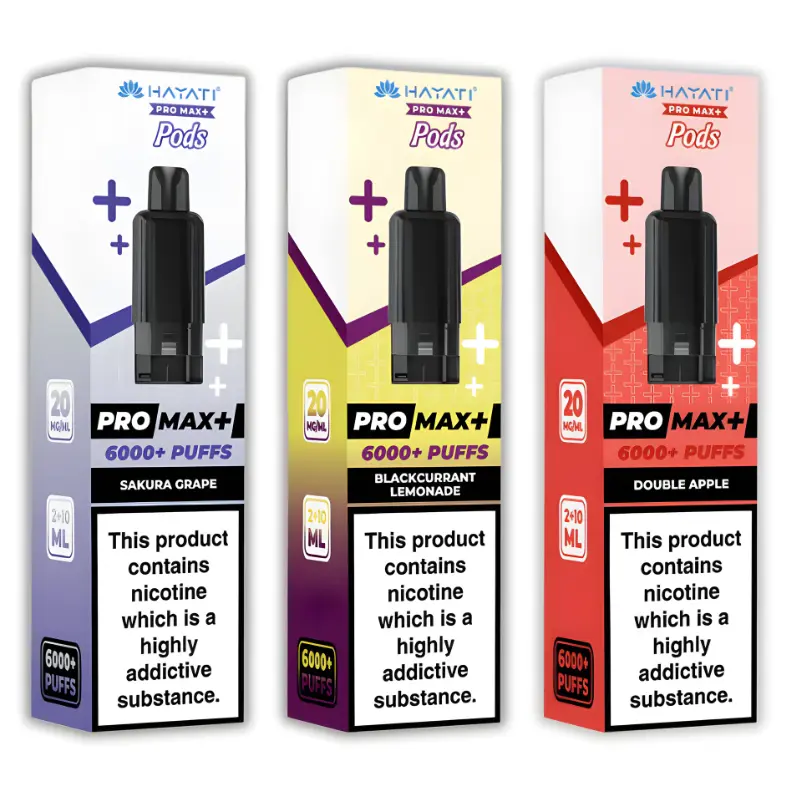
Hayati · Pro Max Plus
Hayati Pro Max Plus Pods 20mg
£5.49
✔ In stock — ready to ship
Genuine Hayati
Free over £20
Same-day dispatch
Secure checkout
What arrives for £5.49 is one sealed replacement pod for the Hayati Pro Max Plus, already holding twelve millilitres of liquid at 20mg nicotine salt. No body, no cable, no spare parts. Hayati put a ceiling of 6,000 puffs against a filled pod, a figure generated on bench equipment repeating one identical draw rather than a forecast of anybody's week. The flavour recorded against this particular listing is Banana Ice, which four other pages on this site have already taken apart in detail, and which is not what this page is about.
This is the umbrella entry for the whole Pro Max Plus pod library, and the library is the subject. It is the largest single shelf of one product in one format that Hayati publish: 89 listings, every one at £5.49, every one twelve millilitres, every one a sealed refill for the same body. The next largest comparable line is the bottled Pro Max nic salt range at 65, and the Pro Ultra Plus pod shelf at 52. Nothing else in a catalogue of 492 products comes close to putting this many interchangeable choices in front of one buyer at one price.
That sounds like an unambiguous good and it is not quite one. A range this size stops being a menu and becomes a scrolling problem, and the two are not solved the same way. A menu you read. A library you need an index for, and Hayati supply the tiles without supplying the index. The Hayati Pro Max Plus Pods shelf presents 89 identically priced squares in no useful order, and a person who has decided they want something red and cold is asked to evaluate all 89 of them to find the eight that qualify.
So the argument this page makes is a counting argument, and it runs against the impression the grid gives you. Eighty-nine tiles is not eighty-nine decisions. Most of the range clusters, heavily, into a small number of repeated ideas with one component swapped, and when you count the clusters properly the number of genuinely separable propositions comes out somewhere around a quarter of the tile count. That is worth establishing with real figures rather than asserting, because a vague claim that a range is repetitive is worthless and an exact one is a map. What follows counts the shelf, reports the distribution honestly including the places where my own starting assumption turned out to be wrong, and then lays the result out as something you can navigate in both directions: from nothing, and from a decision you have already made.
What is actually on the shelf, counted
Begin with the split between listings that name a flavour and listings that name a number, because it governs everything after it. Of the 89, eighty-five carry a flavour name in the title and four carry a nicotine strength instead. The zero-nicotine pod page on this site worked that split out first and set out what it costs a buyer, so the finding belongs to it and is cited here rather than re-derived. The four strength-titled entries are this one at 20mg, the Hayati Pro Max Plus Prefilled Pods 10mg, a 5mg pod and a zero-nicotine pod, and all four carry the same Banana Ice value in their product data. Eighty-five of the 89 are therefore the library proper, and the other four are a fill specification wearing the same packaging.
Eighty-five flavour names is a larger number than it looks. Normalise every title in the catalogue by stripping the brand, the platform and the format words, and 492 listings reduce to 173 distinct flavour names. Our Black Mamba page counted 174 using a slightly different normalisation, and the one-name gap is a rounding artefact of where you cut the string rather than a disagreement about anything. Take either figure and the conclusion is the same: this one shelf carries very close to half of every flavour Hayati sell, in any format, on any platform. A buyer working through these 89 tiles is not looking at a subset of the range. They are looking at most of it.
Thirty-six of those 85 names appear nowhere else in the catalogue outside this shelf and its matching kit shelf. Strawberry Guava, Peach Green Tea, Sakura Grape, Triple Melon, Lychee Ice, Blueberry Pomegranate, Hubba Bubba, Pipeline Punch, T-Misu and twenty-seven others exist on the Pro Max Plus prefilled platform and on nothing else Hayati make. The remaining forty-nine have a counterpart somewhere, usually as a 10ml bottle in the nic salt line or as a reserve inside a Pro Ultra Plus pod. That division matters for anybody who owns two devices, and it matters for anybody thinking about what happens if they ever change platform, because slightly over two fifths of what is on this shelf does not travel.
The kit shelf is a mirror, with one exception
Alongside the 89 pods sits a shelf of 88 complete kits, every one of them £7.99, each pairing a body with one prefilled pod. Line the two shelves up name against name and they match almost perfectly: all 85 flavour names exist both ways, the 10mg exists both ways, the zero-nicotine exists both ways. The single asymmetry in the entire pair is the 5mg pod, which has no kit counterpart at all. One missing listing out of 173 slots is about as close to a deliberate mirror as a catalogue of this size gets.
The practical reading is straightforward and it saves a lot of scrolling. If you find a flavour you want on either shelf, it exists on the other, and you do not need to go and check. The £2.50 between the two numbers is the whole of what the body costs, bought once. Our range-level page for the Pro Ultra Plus 25000 Prefilled Pod Kit works through the general form of that arithmetic, volume against price and what a millilitre ends up costing on each route, and does it properly with the figures for both platforms. That analysis is theirs. Repeating it here would be filler, and the navigation question is the one this page can actually answer.
One listing that is not on either shelf is worth flagging so you do not go looking for it: Hayati publish a Pro Max Plus 4000 pod holding 7ml, filed separately, in Banana Ice alone. Whether it shares a fitting with the 12ml pods described here is not published by Hayati and should not be inferred from the shared range name. If you own one, the arithmetic on it sits on its own page.
The distribution, family by family
Here is the shape of the library. I sorted all 85 flavour-named listings into twelve groups using a priority rule, so that each listing lands in exactly one group and the twelve add up to 85 rather than double-counting the blends that could sit in two places. Cherry Cola goes to the soft-drink group rather than the cherry group, Blue Razz GB goes to confectionery rather than to blue, and so on. A different priority order would move a handful of listings between adjacent rows without changing the picture.
| Group | Listings | Share of 85 |
| Red-berry led (strawberry, raspberry, cherry, cranberry, blackberry, generic berry) | 18 | 21% |
| Blue-signalled (blue razz, blueberry, and the unnamed blues) | 16 | 19% |
| Tropical and stone fruit (mango, peach, pineapple, guava, kiwi, passion fruit, lychee, banana, melon) | 16 | 19% |
| Confectionery-named (GB, B'Gum, H'Bubba, Hubba Bubba, candy, ice pop) | 8 | 9% |
| Opaque, naming no ingredient at all | 8 | 9% |
| Citrus and lemonade | 5 | 6% |
| Blackcurrant led | 3 | 4% |
| Cola and soft drink | 3 | 4% |
| Mint led, no fruit | 3 | 4% |
| Grape led | 2 | 2% |
| Apple led | 2 | 2% |
| Tobacco | 1 | 1% |
Three rows carry more than half the shelf. Red berries, blue, and everything tropical or stone-fruited come to fifty of the eighty-five between them, and the remaining nine groups share thirty-five listings, six of those groups holding three listings or fewer. That is a range with two crowded rooms, one moderately busy one, and a corridor of cupboards.
Loosen the definition and the berry weighting gets heavier still. Counting every title that contains any berry at all, including blue raspberry and blueberry, including blackcurrant, and including the four listings whose names say blue without saying which blue, gives forty-four of eighty-five. Slightly over half the library is a berry of some description. Forty-one listings are not, and that forty-one is where every non-berry idea Hayati have on this platform lives: two apples, three colas, three mints, one tobacco, one tea, one floral, one dessert, and a scatter of tropical and citrus blends.
Which fruits, and how often
Counting words rather than groups sharpens it. Across the 85 titles: strawberry appears eleven times, raspberry eleven, cherry ten, lemon eight, blue razz seven, blueberry six, peach six, pineapple five. After that it drops off a cliff. Blackcurrant four, mango four, lemonade four, sour four, grape three, kiwi three, cola three. Then a long tail of ingredients that appear exactly once in eighty-five listings: pomegranate, lychee, passion fruit, orange, green tea, sakura, tobacco, melon as a thing in its own right rather than as watermelon.
Three fruits, strawberry and raspberry and cherry, account for thirty-two title appearances between them across a shelf of eighty-five names. No other ingredient reaches half of any one of those. If you were building this range from scratch and had to guess what was in a randomly chosen pod, red berry would be the sensible guess and the twenty-nine titles carrying one of those words would make you right about one time in three.
The other axis worth counting is how much a title tells you. Twenty-two of the 85 name no fruit whatsoever, which includes the eight fully opaque names and also the ones that gesture at a category without itemising it. Thirty-two name exactly one ingredient. Twenty-three name two. Eight name three. So the modal listing on this shelf is a single named fruit, and the median buyer's scan of a grid tile resolves either to one fruit or to nothing at all.
Four listings, one recipe, one variable
The clearest illustration of how this range is built sits in the strawberry-raspberry pairing. Four listings on this shelf lead with those two fruits and then differ by exactly one component: Blueberry Raspberry Cherry is a variation on the same idea from the other side, and within the strawberry-led set you get Strawberry Raspberry Cherry, Strawberry Raspberry Blueberry, Strawberry Raspberry Ice and Strawberry Raspberry Mojito. Same two-fruit base, four third elements: a red berry, a blue berry, a coolant, and a citrus-and-herb treatment. That is a range being generated combinatorially rather than recipe by recipe, and once you see it in one place you see it everywhere on the shelf.
The blue raspberry set does the same thing seven times. Blue Razz Cherry, Blue Razz Blackcurrant, Blue Razz Lemonade, Blue Razz GB, Blue Razz Mojito, Blue Razz Fruit Twist and Blue Razz Pineapple: one fixed base, seven partners drawn from red fruit, dark fruit, citrus, confectionery, cocktail, an unstated blend and a tropical. Seven tiles, one decision about the base and a second decision about what sits on top of it.
Cherry runs a smaller version of the same pattern with four: Cherry Peach Lemon, Fizzy Cherry, Cherry Cola and Cherry Berry, plus Cherry Sour Raspberry if you count a cherry that leads a two-berry blend. Blackcurrant runs three: Blackcurrant Juice on its own, Blackcurrant Lemonade with a citrus carrier, and Blackcurrant Mango with a tropical one. The shape repeats at every scale.
Two things I expected to find and did not
An argument about a large range being repetitive is easy to make badly, by asserting the pattern and skipping the arithmetic. Two of the specific claims I set out to verify turned out to be false, and reporting that is more useful than quietly writing around it.
Almost none of the shelf is an iced duplicate of something else on the shelf
The claim I started with was that a good slice of the range would be coolant variants of listings already present, the same fruit sold twice with and without the cold. It is a reasonable guess. It is also wrong, and not marginally. I took every title carrying Ice, Frozen or Cooler, removed the cooling word, and checked whether the remaining name exists as a separate listing on the same shelf. Not one does. There is no plain Blackberry to sit beside Blackberry Ice, no uncooled Watermelon, no Pineapple without the Ice, no Cola without it, no Banana. Every one of the cooled listings is the only appearance of that fruit as a solo flavour anywhere on the shelf.
Which inverts the point rather than removing it. The cooling word is not duplicating the range, it is doing the opposite: it is the marker Hayati attach to a single-fruit listing, and the shelf has no uncooled single-fruit listings to duplicate. Twelve titles carry a cooling word in total, ten saying Ice, one Frozen and one Cooler, and three more listings are mint-led without any fruit. Fifteen of eighty-five announce cold. Ice Pop is excluded from that count deliberately, because the name describes a frozen confection rather than applying a temperature to a fruit, and counting it would inflate the figure by one for no reason.
Whether those three cooling words form a ladder has already been settled elsewhere and is not reopened here. Our Blue Frozen pods page ran the census across all 492 listings and found Ice in ninety titles, Frozen in three, Cooler in two, Chill and Freeze in none, with no listing anywhere combining an ice-family word and a mint-family word. My own count of the same catalogue returns the same figures, so the finding holds and the conclusion holds with it: the words are labels, not grades. Do not read Frozen as colder than Ice on the strength of the word.
This shelf is not unusually berry-heavy. The whole catalogue is
The second claim worth testing is the implied one, that the berry concentration is a property of this shelf. Check each word against its rate in the rest of the catalogue and it evaporates. Strawberry appears in 13 per cent of the 85 titles here and in 12 per cent of all 492 listings. Raspberry, 13 per cent here against 15 per cent overall. Cherry, 12 against 13. Blue razz, 8 against 10. Blueberry, 7 against 9. Ice, 13 against 18. On every one of those the shelf is level with the catalogue or slightly below it.
The honest statement is therefore not that the Pro Max Plus pod range is a berry range. It is that Hayati's entire catalogue is about half berries, and this shelf, being roughly half the catalogue's distinct flavour names, faithfully reproduces that. The clustering is real and the numbers above are real, but it is a house characteristic rather than a quirk of one platform. A buyer who finds the berry density here frustrating will find exactly the same density on the Hayati Prefilled Pods & Refills shelf and in the bottled range, so switching format is not the escape it looks like.
Eighty-five tiles, forty-three propositions
Now the number the page exists to produce. To turn tile count into decision count you need a rule for when two listings are near-neighbours rather than alternatives, and the rule has to be mechanical or it is just an opinion with arithmetic painted on it.
The rule I used: extract the named ingredients from every title, then link two listings if they lead with the same ingredient or if they share any two ingredients. Link them transitively, so that a chain of near-neighbours collapses into one group. Run that over the 85 and the library resolves into 43 clusters.
The distribution of those 43 is the interesting part, because it is nothing like even. One cluster holds twenty listings: the great red-and-blue berry mass, everything from Cherry Sour Raspberry and Blueberry Raspberry through Strawberry Kiwi and Strawberry Watermelon to Blueberry Cherry Cranberry and Blue Sour Raspberry, chained together because each shares two fruits with the next. A second cluster holds the seven Blue Razz listings. A third holds four cherry-led ones. Five clusters hold three each. Four hold two. And thirty-one listings are singletons, sharing no lead ingredient and no ingredient pair with anything else on the shelf.
Twenty-seven of the eighty-five, very nearly a third, sit inside the two largest clusters. A buyer who wants a red or blue berry blend is therefore choosing within a group of twenty-seven listings that share most of their content, at one price, on one device, and the grid gives them no help at all in ranking those twenty-seven against each other.
The singletons are not all real options either
Thirty-one singletons sounds like thirty-one distinct choices and it is not, because seventeen of them name no ingredient. Midnight Dream, Galaxy Aura, Sunset Aura, Summer Dream, Blue Fusion, Mad Blue, Mr Blue, Black Mamba, Pipeline Punch, Caribb Crush, Fruit Twist, Vim Ice, Tropical Sour Juice, T-Misu, Hubba Bubba, Ice Pop and Dragon Berries are all singletons in the arithmetic because the classifier cannot find a fruit in them to match against anything. They are singletons in the sense that a locked door is a room you have not been in.
That is not a complaint about those listings and several of them have good pages behind them. Our Galaxy Aura page works through what an unnamed blend costs a repeat buyer trying to price-check it, and the Black Mamba page counts how many names in the catalogue reach for that register and finds six out of 173. But for the purpose of drawing a map, a tile you cannot classify is a tile you cannot route a buyer to on the strength of a preference.
Strip those seventeen out and forty-three clusters becomes twenty-six legible propositions. Twenty-six is the number I would put in front of somebody who asks how many meaningfully different things are on this shelf. Eighty-nine tiles, eighty-five flavours, forty-three clusters, twenty-six of them legible from the title, and two of the twenty-six holding a third of the stock between them. That is the library, measured four ways.
In defence of the near-neighbours
None of the above is an argument that the other fifty-nine listings are padding, and a page that left it there would have told you something true and useless. Repetition inside a cluster is worth real money to the right reader, and the reason is that the two decisions a buyer makes are not the same size.
The first decision is coarse. Red berry or blue, cold or not, sweet or sour, fruit or confectionery. It has maybe a dozen realistic answers and it is the decision the grid is bad at supporting. The second decision is fine, and it only exists once the first has been made. Somebody who has established over several months that they want a red berry with a coolant has a question the first-time reader cannot even formulate: which of the eight versions of that has the acid in the right place. Strawberry Raspberry Ice and Smooth Strawberry Ice and Blackberry Raspberry are near-identical from a standing start and meaningfully different to somebody who has had two of them.
Small differences matter enormously at that stage, and a range with only twelve entries could not serve it. The manufacturer who publishes eight versions of one idea is not failing to differentiate. They are servicing the second decision, which is where the repeat orders live and where most of the money in a prefilled pod range actually is. The failure is not the count. The failure is presenting eighty-nine tiles in one undifferentiated grid, which forces the first-decision reader to do the second-decision reader's work before they have earned the ability to do it.
So the map below is built for both. The first half routes by coarse preference and deliberately names one or two representatives per group rather than listing everything. The second half is for people already inside a cluster, and it is about what separates the neighbours.
The first decision: twelve doors, not eighty-nine
Start here if you have no fixed preference or if you are deliberately trying to leave one. Each entry below names the group, says how many listings sit in it, and points at one or two that represent it fairly rather than dumping the whole membership on you. Picking the group is the work. Picking within it is easier and comes later.
- Red berry, eighteen listings. The default of the range, structured around acid cutting through sweetener. Mixed Berries is the unspecified version of the idea and Strawberry Raspberry Cherry is the itemised one. If you want one of these with the acid sharpened rather than rounded, the four titles carrying Sour are where it lives.
- Blue, sixteen listings. A confectionery-derived accord rather than a fruit, which the Blue Fusion pod page sets out properly. Blue Razz Cherry is the most conventional entry point, Blue Razz Lemonade the one with a carrier rather than a second fruit.
- Tropical and stone fruit, sixteen listings. The lowest-acid part of the shelf and therefore the part most dependent on a coolant for structure. Guava Kiwi Passion Fruit is the three-fruit version, Juicy Peach the single-fruit one, Banana Ice the one this listing's own data points at.
- Confectionery-named, eight listings. Titles that reference a sweet rather than a fruit, which reliably signals a higher sweetener load and a flatter acid line. Blue Razz GB and Blueberry B'Gum are the clearest cases; Ice Pop is the one that also carries cold.
- Opaque, eight listings under the strict count and seventeen once you include the ones that gesture at a family. You cannot route to these on preference. Galaxy Aura and Caribb Crush are representative, and each has a page that says plainly what can and cannot be established.
- Citrus and lemonade, five listings. The carrier group. A lemonade in this range is not usually a lemon flavour, it is a second fruit sitting on a sharp fizzy base, which Berry Lemonade demonstrates and Lemon Lime does not.
- Blackcurrant, three listings. Darker and more tannic than the red group, and the only part of the shelf that reads as a European hedgerow fruit rather than an American confectionery one. Blackcurrant Juice is the unaccompanied version.
- Cola and soft drink, three listings. Spiced, not fruited. Cherry Cola is the crossover into the berry side.
- Mint, three listings. Spearmint, Fresh Mint and Double Menthol, and they are the only three listings on the shelf with no fruit component whatsoever apart from the tobacco one. Worth knowing if a fruit-free option is what you are after, because three out of eighty-five is the whole of it.
- Grape, two listings. Grape GB is the confectionery reading and Sakura Grape the floral one, and those two are as far apart as any pair in the same group on this shelf.
- Apple, two listings. Double Apple borrows a shisha term and reads mint-led, Red Apple Ice is a straightforward cold apple. Different products despite the shared fruit.
- Tobacco, one listing. Smooth Tobacco is the single entry in its group, which makes it the easiest decision on the shelf: either that profile is what you want or the shelf has nothing adjacent to offer you.
Read down that list and the useful fact emerges on its own. Six of the twelve groups contain three listings or fewer. If your preference lands in one of those six, your decision is nearly made before you start, and the eighty-nine tiles were never your problem. The grid is only overwhelming if you want a berry, and slightly over half the shelf is one.
The second decision: telling near-neighbours apart
This half is for somebody already inside a cluster. The question is no longer which fruit but which version, and the range answers it along four axes that recur across every group.
How many fruits are named
Thirty-two listings name one, twenty-three name two, eight name three. That count is a decent proxy for how the liquid will behave over a long session. A single named fruit has one thing to say and says it on every draw, which is why the single-fruit listings on this shelf almost all carry a coolant: the cold is supplying the variation the recipe does not have. Two fruits give you a foreground and a background that swap depending on draw length. Three tend to blur into a general fruit impression in which no component is separately identifiable, which some people want and some find muddy. Blueberry Cherry Cranberry and Cherry Peach Lemon are both three-name listings and both illustrate it.
Whether an acid word is present
Four listings carry Sour, one carries Fizzy, and nine carry a citrus or lemonade term. Those fourteen are the sharp end of the shelf. The distinction is not decoration: an acid note resets the palate between draws, which is the single biggest determinant of whether a pod is still pleasant at hour six. The listings with no acid word anywhere in the name, which is most of the tropical group and all of the confectionery group, rely on sweetener and cold instead, and they fatigue faster for most people.
Whether cold is declared
Fifteen of eighty-five say so. The rest say nothing, and saying nothing is not the same as containing nothing, because the house habit is to name cold only when it is a feature. A blend can carry a small coolant load and not mention it. What you can rely on is the positive: if the title says Ice, Frozen or Cooler, cold is a deliberate part of the design.
Whether the name is a description or a mood
Seventeen listings sit on the wrong side of this and the rest do not. The practical consequence is about reordering rather than first purchase. A named blend can be compared against other manufacturers' versions and against your own memory. An unnamed one can only be compared against itself, which the Galaxy Aura page works through in detail.
Run a candidate through those four questions and most near-neighbour pairs separate cleanly. Blackberry Ice against Blackberry Raspberry: one fruit plus declared cold, against two fruits and no declared cold. Blackcurrant Lemonade against Blackcurrant Mango: same dark berry, one carried on an acid base and one paired with a low-acid tropical. Those are real differences and they are legible from the titles alone once you know which four things to look at.
Why the shop's own filing will not do this for you
An obvious objection to everything above is that a shop has categories and a buyer should just use them. Worth testing, because the filing on this range is better than it is given credit for and worse than it needs to be, and the failure is concentrated in one specific place.
The catalogue runs thirty flavour shelves, from Berry Vapes with 218 members down to Menthol Vapes with ten. Cross them against the 89 pods and the coverage is mostly good. Berry Vapes catches 36 of the 89. Raspberry catches 19, Blueberry 18, Exotic 15, Cherry 14, Ice 12, Strawberry 12. Sixteen of the 89 sit on exactly one flavour shelf, thirty-three on two, twenty on three, six on four, seven on five, and one lands on six.
Six carry no flavour shelf at all: Smooth Tobacco, Black Mamba, Blue Frozen, Pipeline Punch, Fruit Twist, and this listing. Our Black Mamba page put that figure at seven; counting it again returns six, and I am recording the discrepancy rather than repeating either number on trust. Five of the six are listings whose titles name no fruit, which is exactly what you would expect if the filing keys off the title rather than off anything deeper.
The sixth is this one, and it fails in a more interesting way. This listing has no flavour shelf because its title is a strength. But the other three strength-titled pods do have flavour shelves, and the shelves they have are wrong. The 5mg pod is filed under Blueberry and Cherry. The 10mg pod and the zero-nicotine pod are filed under Apple, Blueberry and Cherry. All three contain Banana Ice according to their own product data, and none of the three contains apple, blueberry or cherry by any reading of it. They are carrying an inherited set of family tags that has nothing to do with the liquid.
The Banana Ice case makes the mechanism plain, and the zero-nicotine pod page got there first. Eighteen listings in the catalogue carry a banana ice tag. Eight of them say Banana Ice in the title, and all eight are filed on the Banana shelf. Ten of them are titled with a range and a strength instead, and not one of those ten appears on the Banana shelf. The split is perfect. Filing works when the title names the flavour and stops working when it does not, which is a tidy result and also a warning: a shelf that looks authoritative is reproducing what the titles say, and where the titles say nothing, the shelf is guessing or silent.
For navigating this range, that means the flavour shelves are usable for the eighty-five and useless for the four. If you are looking for a specific strength rather than a specific fruit, no flavour shelf will help you, and the only reliable route is the range shelf itself.
Specifications
Everything Hayati publish about this listing is in the table, and it is short. The row order below is deliberately arranged by how much each figure varies across the shelf, most variable first, because on an 89-listing range the constant values are the ones a buyer can stop checking.
| Flavour recorded in the product data | Banana Ice |
| Nicotine strength | 20mg, as a nicotine salt |
| What comes in the pack | One prefilled replacement pod, no device |
| Liquid volume | 12ml, sealed in at the factory |
| Price | £5.49, the same as all 89 pods on this shelf |
| Manufacturer puff figure | Rated by the manufacturer at up to 6,000, a laboratory estimate |
| Brand and range | Hayati, Pro Max Plus |
| Shelves this listing appears on | Pro Max Plus Pods, Hayati Pods, Prefilled Pods & Refills, New Products |
| Coil resistance, wick material, power draw | Not published for this listing or for any other on the shelf |
Two rows repay attention. The strength is the highest a nicotine product may be sold at in the United Kingdom, and on this shelf it is not a choice, because eighty-six of the eighty-nine listings are filled at it and the other three are the strength-titled ones. If 20mg is not what you want, you are choosing between three listings and all three hold the same liquid, which is a much smaller shelf than the grid suggests.
The last row is the one people most often assume is knowable. It is not. No listing on this shelf states a resistance, a wattage or a wick material, and a page that supplies one has either copied it from a different product or invented it. That silence is uniform across all eighty-nine, so it is not a reason to prefer one listing over another, but it does mean that any comparison between two of these pods is a comparison of liquids on identical unstated hardware rather than a comparison of hardware.
The pod, the body, and the £2.50
The hardware section is short by design, because eighty-eight other pages on this platform describe the same device and there is nothing left to say about it that has not been said better somewhere else. What is in the packet: one pod, prefilled and sealed, and nothing else at all. You supply the body. If you do not have one, the matching kit at £7.99 is the same pod with a rechargeable body underneath it, and the difference between the two prices is what the body costs, once.
The one specification that actually bears on choosing from this shelf is the volume, because it is the same on all 89 and therefore cancels out of every comparison. Twelve millilitres at £5.49, eighty-nine times over, means the entire decision is about flavour and nothing else. That is unusual and it is the shelf's best feature: no listing on it is a better purchase than any other on price, capacity or strength, so you can ignore three of the four axes a buyer normally has to juggle. Our Pro Ultra Plus 25000 Prefilled Pod Kit page handles the cross-platform version of that question, where volume and price do move and the cost per millilitre becomes the whole argument.
The usual compatibility caution applies once and briefly: check the range name printed on your device against the range name in the listing title, because Hayati run several pod platforms and the pods are not interchangeable between them. Beyond that there is nothing to assemble, no setting to choose and no maintenance to perform. The pod is not refillable, the coil inside it is not replaceable, and when the flavour goes the pod goes with it.
Working a library this size without losing track
Practical handling, aimed at the specific problem an eighty-nine listing range creates rather than at prefilled pods in general. The problem is memory. Nobody can hold eighty-nine near-identical tiles in their head, and the failure mode is not buying something bad, it is buying the same thing twice by accident and never getting round to the four listings you actually meant to try.
Write down what you finish, not what you buy. The useful record is one line per completed pod with the name and a two-word verdict. Buying lists drift because they record intention. Finishing lists do not, because a pod you abandoned at the halfway mark tells you more than one you meant to order. After six or seven entries you will be able to see your own cluster, and at that point the first decision is permanently made and you can spend all your attention on the second.
Compare inside a cluster, not across the shelf. Two pods from opposite ends of the range teach you very little, because everything differs at once. Two from the same cluster, run back to back, isolate the one component that changes. Strawberry Raspberry Ice against Strawberry Raspberry Cherry tells you exactly what the cold is doing, because that is the only variable between them. This is the one case where buying two at a time is worth the outlay.
Order fewer than you think, especially early. Twelve millilitres is a long commitment to a liquid you have not met, and the shelf's uniform price makes it tempting to stock up. A pod you turn out to dislike is not returnable once opened and the liquid cannot be decanted into anything, so an unwanted choice costs the full £5.49 whatever you do with it. The second decision rewards stockpiling. The first one punishes it.
Unopened pods sit better than part-used ones. A sealed pod in a drawer at room temperature, out of sunlight and away from anything warm, is stable for a long time. A pod that has been in a device and taken out again is a different object: the wick is saturated, the liquid has been through heat cycles, and it will taste flatter when you come back to it. If you are running a shortlist of three or four, finish one before opening the next rather than rotating half-used pods, because the rotation is what degrades them.
Know what a spent pod feels like. Flavour drops before the liquid runs out, not with it. The sweetener and the coolant both outlast the fruit, so the late stage of a pod tastes sweet and cold and vague rather than tasting of nothing. On this shelf that matters most in the tropical and confectionery groups, where the fruit was the quietest component to begin with. If a pod has gone sweet-and-blank on you, it is finished regardless of how much liquid you can still see.
Dispose of it properly. A finished pod still holds its coil and whatever the wick did not reach, which keeps it out of the ordinary household bin. Most vape retailers operate a take-back bin for exactly this, and household waste sites accept small electrical items. It costs nothing and it is the correct route.
Questions this listing raises
What flavour is in this pod, given the title does not say?
The product data records Banana Ice, and the supplied description describes a soft banana with a cooling finish. That is the flavour value on the record rather than a promise in the title. Four listings in this range are titled by strength and all four carry the same Banana Ice value, which our zero-nicotine pod page examines properly, including the reading that it may be a family default rather than four separate decisions.
How many pods are actually on this shelf?
Eighty-nine, all at £5.49 and all holding 12ml. Eighty-five are named for a flavour and four for a nicotine strength. That is the largest single-format shelf Hayati publish, against 65 bottles in the Pro Max nic salt line and 52 pods on the Pro Ultra Plus shelf.
Is the range really as repetitive as it looks?
Measurably, yes, though less so than the raw impression suggests. Clustering the 85 flavour names by shared ingredients gives 43 groups, of which 26 are legible from their titles. One cluster alone holds 20 listings. So the shelf offers roughly a quarter as many distinct propositions as it does tiles.
Which flavour family has the most options?
Red berries, at 18 listings under a strict count. Blue-signalled blends are next at 16, and tropical or stone fruit blends also at 16. Counting any title containing a berry of any colour, including blackcurrant, gives 44 of 85.
Are there many cooled versions of the same flavour?
None, which surprised me. Strip the cooling word from every Ice, Frozen or Cooler title on this shelf and not one of the resulting names exists as a separate listing. The cooled entries are single-fruit listings and the shelf has no uncooled single-fruit listings for them to duplicate.
Is Frozen colder than Ice?
Nothing published supports that reading. The Blue Frozen pods page counted the whole catalogue and found Ice on ninety titles, Frozen on three and Cooler on two, with no grading anywhere and no listing ever combining an ice word with a mint word. Treat the three as labels rather than as tiers.
How many listings have no cooling at all?
Seventy of the eighty-five carry no cooling term in the title. That is not a guarantee of no coolant, because the house habit is to name cold only when it is a designed feature. What you can rely on is the positive case: a title that says Ice, Frozen or Cooler has cold in it deliberately.
Does every pod flavour also come as a complete kit?
All 85 flavour names do, at £7.99 rather than £5.49. The kit shelf holds 88 listings against the pod shelf's 89, and the only entry that exists as a pod with no kit counterpart is the 5mg. So if you find a flavour on one shelf it will be on the other.
Can I get a flavour I like at a different nicotine strength?
Not on this platform. Eighty-six of the eighty-nine listings are filled at 20mg, and the three that are not all hold the same recipe. Choosing a strength other than 20mg on the Pro Max Plus prefilled range means accepting whatever liquid those listings contain rather than choosing one.
Why does this listing not appear on any flavour shelf?
Because the filing keys off the title naming a flavour, and this title names a strength. Six of the 89 carry no flavour shelf, and five of those six are listings with no fruit in the name. The related quirk is that the other three strength-titled pods do carry flavour shelves, and the shelves are wrong: apple, blueberry and cherry on listings whose recorded liquid is Banana Ice.
How many of these flavours are exclusive to this platform?
Thirty-six of the 85 appear nowhere else in Hayati's catalogue outside this shelf and its kit twin. The other 49 have a counterpart somewhere, usually a 10ml bottle in the nic salt line. Worth checking before you commit to a flavour if you also use other hardware.
What is the sensible way to work through a range this large?
Settle the coarse question first, using the twelve groups above, then stop looking at the rest of the shelf entirely. Keep a one-line record of each pod you finish. Once you know your cluster, compare only inside it, two at a time, changing one component between them.
Is there anything on this shelf with no fruit in it at all?
Four listings. Spearmint, Fresh Mint and Double Menthol are the mint group, and Smooth Tobacco is a single entry in a group of one. Four out of eighty-five is the entire non-fruit provision, so if that is what you want, your choice is made almost before you start.
In summary
This listing is one prefilled 12ml pod at £5.49, filled at 20mg, sold without a device, with Banana Ice recorded against it in the product data and a manufacturer laboratory figure of up to 6,000 puffs. It sits at the head of the largest single-format shelf Hayati publish: 89 pods, one price, one volume, eighty-five flavour names covering close to half of everything the brand sells.
The useful thing to take from this page is the shape of that library rather than any single recommendation. Eighty-nine tiles reduce to 43 clusters and 26 legible ones, with two clusters holding a third of the stock, six of the twelve flavour groups containing three listings or fewer, and a berry weighting that turns out to be a property of Hayati's whole catalogue rather than of this shelf. The repetition inside the big clusters is not waste; it is what makes the second decision possible once the first is settled. But the first decision has to be made at the group level, because made at the tile level it is eighty-nine comparisons of things that mostly differ by one component.
Pick a group. Then pick inside it. The Hayati Pro Max Plus Pods shelf and the wider Hayati Prefilled Pods & Refills shelf hold everything discussed here, and the flavour shelves will do useful work for the eighty-five listings whose titles name what is in them.
Strictly for adults aged 18 and over. Nicotine is an addictive substance.
You might also like


