
Home / Hayati Pro Max Plus Pods / Sakura Grape Hayati Pro Max Plus Pods
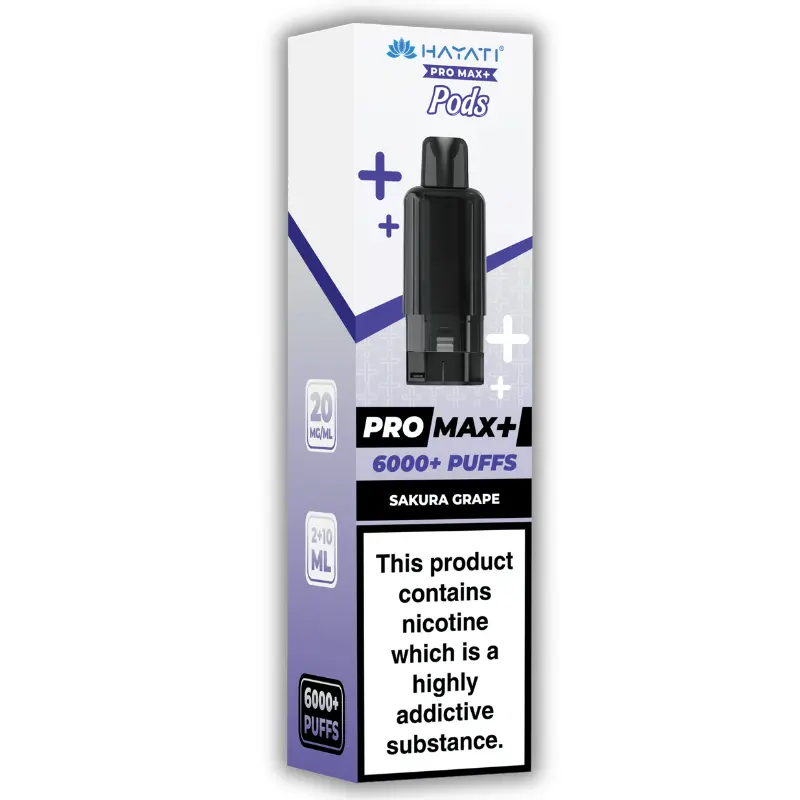
Hayati · Pro Max Plus
Sakura Grape Hayati Pro Max Plus Pods
£5.49
✔ In stock — ready to ship
Genuine Hayati
Free over £20
Same-day dispatch
Secure checkout
Five pounds forty-nine, one sealed pod, twelve millilitres of liquid at 20mg, and no device in the packet. That is the transaction. The listing exists for someone who already owns a Hayati Pro Max Plus and is choosing what goes in it next, which makes almost everything on this page a question about the liquid rather than about the hardware.
What is unusual about this particular liquid has nothing to do with how it tastes and everything to do with what is printed on it. Hayati sell four hundred and ninety-two products. Exactly two of those listings have a flower in the title, and they are the same flavour sold twice, once as this pod and once as Sakura Grape Hayati Pro Max Plus 6000 Pod Kit with a body included. One flavour, out of everything on the shelf, is named after a blossom.
That is not an accident of taste and it is not a gap waiting to be filled. Floral is the single hardest register to sell in a mass-market flavoured product, because the aromatic compounds that make something smell of flowers are the same ones that make something smell of hand soap, fabric conditioner and the back of a chemist's shelf. A substantial minority of people do not experience a floral note as a flower at all. They experience it as cleaning product. Printing a flower on the front of a pod is a decision to put that minority off before they have tasted anything, in exchange for signalling something to everyone else.
So this page is about a naming decision and its consequences, and then about the specific question of what the word sakura is actually promising. Those turn out to be two different flavours depending on whether you read the word in a British confectionery context or a Japanese culinary one, and the gap between them is wide enough to decide whether you like this pod. The grape sitting next to it is doing more work than it looks like it is doing, and not the work you would expect.
One flower in four hundred and ninety-two names
The rarity claim came to me as a hypothesis and it survived the count, which is not how these usually go. Here is the arithmetic in full so you can weigh it yourself.
Searching every product title in the catalogue for a flower name, in English or in Japanese, turns up sakura and nothing else. No rose, no jasmine, no lavender, no elderflower, no hibiscus, no violet, no blossom of any other kind. Two listings match, they are the kit and the pod of one recipe, so the honest number is one flavour in four hundred and ninety-two listings. Narrow it to the shelf this pod actually sits on, Hayati Pro Max Plus Pods, and it is one title in eighty-nine.
Now compare that against what Hayati are perfectly willing to name. Twenty-five titles carry a leaf or a herb: mint appears in sixteen, menthol in seven, green tea in two. Nobody at Hayati is squeamish about putting a plant on a label. They will name the leaf twenty-five times and the flower once, and the difference between those two numbers is the entire commercial argument on this page.
The word floral itself is a different story again. Fifteen listings in the catalogue use it in their description text, where the buyer only meets it after clicking through. Guava gets called floral, twice. White peach gets called floral and honeyed. Bubblegum gets called faintly floral on three separate listings, including Hubba Bubba Hayati Pro Max Plus Pods, where the floral note is offered as the thing that makes gum flavours recognisable rather than as a risk. Lychee gets called floral on both of its listings. Seven listings across the range use the word perfumed. Twenty-six use fragrant.
Fifteen uses of the word inside the copy. One use of a flower in a name. That ratio is the decision being made, over and over, by people who have to sell the thing. Describing a floral note to a buyer who has already shown interest is low risk, because they are reading a paragraph and can put it in context. Printing it on the front is high risk, because a name is read in half a second by somebody scanning eighty-nine tiles.
The most telling of the fifteen is Black Mamba Hayati Pro Max Plus Pods, which uses the word floral only in order to deny it. Its copy says to expect something dark and intense rather than light and floral. That is the word being deployed as a warning about what a product is not, on a listing with no flavour information of its own to give. Out of fifteen appearances, one is an explicit reassurance that floral is the thing you are being spared. That tells you how the category treats the register.
Hayati are aware of all of this, incidentally, and they say so on the kit version of this same flavour. Their copy notes that floral notes turn up "less often in fruit vapes" and offers that as the reason Sakura Grape stands out. They are right, and they are understating it. Less often implies a minority. The true figure is one flavour in the whole catalogue, which is not a minority so much as a single exception.
Why the word is expensive, and what the Lychee pages already settled
The mechanism behind the soap problem is not mine to explain, and re-deriving it here would waste your time and mine. It belongs to Lychee Ice Hayati Pro Max Plus Pods and to the kit listing behind it, which between them set out the chemistry properly: lychee's identity is carried by rose-family aromatics, those are the same class of molecules that sit at the centre of rose oil and Turkish delight and muscat grapes, and a nose cannot tell a molecule in a fruit from the identical molecule in a bottle on a bathroom shelf. That page also works out what a coolant does to the balance, because suppressing sweetness leaves the aromatics standing unaccompanied, and it gives a self-test involving rosewater for working out which camp you are in. If the soap question is what brought you here, read that page. It is the better page on the mechanism and I am not going to pretend otherwise.
What I want from it is one sentence, used as a foundation rather than restated as a discovery. The perfume risk on a floral liquid is real, it is population-level rather than a matter of taste in the ordinary sense, and it splits buyers into two groups who will describe the same pod in incompatible terms.
Here is where this page diverges, and the divergence is the whole of it. Lychee Ice runs that risk at the moment of tasting. Nothing in the name lychee tells a British buyer that they are about to meet a flower. The word reads as tropical fruit, the tile shows something pink and round, and the soap problem arrives, if it arrives at all, after money has changed hands. Sakura Grape runs the risk earlier. It runs it at the moment of reading, on a shelf, before anyone has paid for anything.
Those are different commercial events and they have different costs. A buyer who is surprised by a perfumed lychee has bought a pod and disliked it, which costs them five forty-nine and costs the maker one disappointed customer who will probably buy something else next time. A buyer who reads the word sakura, correctly decodes it as cherry blossom, and skips the tile has cost the maker the sale without ever generating a complaint. The second failure is silent. It does not appear in reviews, it does not come back as a return, and it is invisible to everyone except whoever is looking at the sales figures for one listing out of eighty-nine.
Which is exactly why the register stays out of product names. Not because makers think floral tastes bad, but because the losses are unobservable and the wins are not worth the exposure when there are nine hundred other fruit combinations available. Printing sakura on a pod is an unusual thing for a range this size to do, and the fact that it happened once in four hundred and ninety-two attempts is a measurement of how unusual.
There is a hedge built into it, though, and it is worth seeing. Hayati did not call this Cherry Blossom Grape. They used the Japanese loanword, and a loanword does two jobs at once. To a buyer who knows what sakura means, it reads as a flower and carries the full risk. To a buyer who does not, it reads as an unfamiliar proper noun, possibly a place, possibly a grape variety, possibly just a word that signals somewhere in East Asia. The English translation would have been unambiguous and would have carried the risk to everybody. The Japanese word carries it only to the people who can read it, which is a smaller group, and it buys an exotic framing from the rest. That is the most careful piece of naming in the range, and it is doing something the naming grammar analysis on Blue Razz Fruit Twist Hayati Pro Max Plus Pods does not have to account for, because every other name on the shelf is in plain English.
Notice also the word order. Sakura comes first. The risky word is in the leading position and the reassuring one follows it, which is the opposite of how you would hedge if hedging were the only goal. Somebody decided the flower was the selling point rather than the liability, and then softened it by keeping it in Japanese. Two decisions pulling in opposite directions, visible in three words.
What sakura means where the flavour comes from
Everything in this section is about a culinary tradition, not about this pod. I have no ingredient list, Hayati publish none, and nothing here should be read as a description of what is in the liquid. It matters anyway, because the word on the front is borrowed from that tradition and the tradition means something specific.
Start with the flower itself, because it undercuts the expectation immediately. The cherry blossoms that people travel to see, the pale Somei Yoshino that lines the rivers, have almost no scent. Stand under a tree in full bloom and you get very little. Whatever sakura flavour is, it is not an extract of what the flower smells like in the air, because there is not enough there to extract.
What Japanese confectionery actually uses is cured plant material. The leaves, usually from the ōshima variety because they are large and soft, are salt-pickled. The blossoms are pickled too, typically in salt with ume vinegar, which is the sour liquor left over from making pickled plums. Sakura mochi arrives wrapped in one of those salted leaves and you eat the leaf with the sweet. Sakura-yu is preserved blossoms unfurled in hot water and served at formal occasions. Salted blossoms turn up pressed into breads and set into jellies. In every case the ingredient has been through a cure, and the cure is not a preservation step that happens to leave the flavour alone. The cure is where the flavour comes from.
Two things develop in the process. Coumarin, which is present in the fresh leaf in a bound form and is released and concentrated by curing, is the dominant aroma. Coumarin smells of new-mown hay, sweet grass, tonka bean and, at the edges, something almondy. It is the smell of a hay meadow drying in the sun rather than the smell of a flower. Alongside it sits benzaldehyde, which is the cherry-kernel note, the thing that makes marzipan taste of marzipan and makes glacé cherries and cherry bakewell taste the way they do. It is a stone-fruit pit character, not a petal character. Then there is the salt, which is not incidental, and often a thin sourness from the ume vinegar.
Put those together and the culinary reading of sakura is a salted, faintly bitter, hay-and-almond flavour with a whisper of something floral at the top and a savoury edge underneath. It is closer to the kernel of the cherry than to the blossom of the tree. Someone raised on sakura mochi does not associate the word with perfume. They associate it with salt.
That has a direct bearing on the soap question, and it runs the opposite way to what you would guess. The coumarin and benzaldehyde end of the register is not where perfume lives. Hay and almond and stone-fruit pit are not confusable with hand soap, and a salted, slightly bitter sweet is about as far from the fabric-conditioner reading as a flower-named product can get. If a liquid were genuinely built on the culinary tradition, the floral name would be a poor description of it and the perfume risk would be mostly absent. The name would be misleading in a direction that made the product easier to sell rather than harder.
There is a practical reason to doubt that a European-supplied liquid reproduces that character head on. Coumarin is a restricted flavouring substance in UK and EU food law rather than a freely available one, tolerated through natural sources within limits rather than added at will. Mark that as background and as inference on my part rather than as a fact about this product. I do not know where this liquid is formulated, I have not seen what is in it, and a nicotine liquid is not a foodstuff, so the rule I have just described may not apply to it in the form I have described. What I am doing with it is narrowing a probability, not establishing one.
What the word is likely to mean to you
Now the other reading, which is the one most people buying this pod in Britain will be carrying.
Sakura in British and wider Western usage is a visual and cosmetic idea before it is a flavour. It means pink. It means petals on water, the seasonal display, a soft-focus aesthetic that has been attached to hand creams, room sprays, scented candles, bath products, limited-edition drinks cans and bubble tea syrups. Where it does appear as a taste, in a syrup or a latte or a seasonal chocolate sold outside Japan, it has usually been built to match the visual promise: sweet, pink, lightly perfumed, sometimes closer to rose or to a generic blossom than to anything a Japanese confectioner would recognise.
So the expectation a British buyer brings to the word is a perfumed pink sweetness. Delicate, fragrant, floral in the ordinary English sense, with no salt and no bitterness anywhere in it. That expectation is coherent, it is widely shared, and it is roughly the opposite of the culinary tradition in two of its three defining characteristics.
And it is the reading that carries the soap risk. Perfumed pink sweetness is precisely the register the Lychee pages describe, and a buyer whose nose files rose-family aromatics under cleaning product will file this under cleaning product too. The gap between the two readings is therefore not a matter of nuance. One of them is exposed to the perfume failure mode and the other is largely not. Working out which one a given pod is built on is not trivia. It decides whether a whole category of buyer should go near it.
Worth saying that neither reading is wrong. The culinary one has the better claim to authenticity and the cosmetic one has the better claim to being what the word communicates in the market where this pod is sold. A product named in Britain for British buyers is under no obligation to honour a Japanese confectionery convention. It is only under an obligation not to mislead, and a perfumed pink sakura would not be misleading here, because perfumed pink is what the word means here.
Which of the two this pod is probably built on
This is the part that decides a purchase, so I want to be explicit about how firm each step is. Tags are mine: reasonably confident, probable, unknown.
Reasonably confident: it is the perfumed reading rather than the cured one. The strongest evidence is Hayati's own copy, which does the work of disambiguating for us. Their text calls the blossom note a delicate, floral fragrance and describes it as keeping the blend light rather than heavy. Those are words from the cosmetic register, not the culinary one. Nobody describing a salted, hay-and-almond cure reaches for delicate and light. If the liquid were built on coumarin and benzaldehyde and salt, the copy would say almond, or marzipan, or something about a savoury edge, because those are the notes that would actually be in the glass and they are easier to sell than an abstraction like fragrance. The absence of any kernel or salt language across a description that otherwise goes into detail about the grape is the clearest signal available.
Reasonably confident: there is no salt and no bitterness. Mass-market prefilled pods at 20mg are built sweet, and a savoury or bitter anchor is a commercially difficult thing to put in one. Nothing anywhere on the eighty-nine-listing shelf is described in savoury terms. The nearest thing to a non-sweet flavour on it is Double Menthol Hayati Pro Max Plus Pods, and menthol is cold rather than savoury. A salted sakura would be a genuinely strange product for this range to make, and ranges do not usually make genuinely strange products in a single listing out of eighty-nine.
Probable: the floral note is a top note and a small proportion of the blend. Hayati describe the blossom as lifting the grape rather than as sharing the billing with it, and they describe grape as supplying the body. Read straight, that puts the flower in the same structural position as a garnish. A top note that sits above a heavier fruit is the standard way to use a risky aromatic, because the base can be dialled up and the aromatic dialled down until the perfume reading disappears for most people.
Probable: there is no cooling in it. No cooling word appears in the title, and the census of cooling vocabulary on Blue Frozen Hayati Pro Max Plus Pods establishes how consistently Hayati flag chill in a name when it is present. Absence of the word is decent evidence of absence of the coolant, though it is not proof. This matters more here than on most flavours, because the Lychee pages show that a coolant suppresses sweetness and thereby exposes a floral note. A warm, uncooled floral has its sugar intact and is the less exposed construction of the two.
Unknown: how strong the floral note actually is. Delicate is a relative word and it is a maker's word. I have no measurement, no ingredient list, and no way to tell you whether the blossom sits at the edge of perception or arrives as an unmistakable perfume on the exhale. This is the axis that decides whether a floral-wary buyer should risk five forty-nine, and it is the axis on which nothing is published. If a perfumed note would ruin the pod for you, that is not a reason to talk yourself into it. It is a reason to buy something built out of acid instead.
Unknown: whether any kernel or almond character is present at all. A formulator who knew the tradition could easily have put a trace of benzaldehyde in, because it sits comfortably next to both cherry and grape and would give the blend a depth that pure fragrance does not have. I would not bet on it. I also cannot rule it out, and if you taste marzipan in this pod, that is what you are tasting rather than an artefact.
Here is how to settle it on your own first pod, since none of the above is a substitute for tasting the thing. Take the first two or three draws at ordinary length and pay attention only to the exhale, which is where an aromatic sits. Ask one question: is this pink, or is it nutty? Pink means fragrance, petals, something soft and cosmetic sitting over the grape. Nutty means marzipan, glacé cherry, the inside of a cherry stone, a faint hay-like sweetness at the back. Those two are not easy to confuse once you are looking for the difference. If you get pink, the cosmetic reading is what was built and the perfume risk applies to you in full. If you get nutty, somebody has done something more interesting than the copy suggests.
Second test, and this one is more useful than it sounds. Buy a bag of purple grape sweets, the artificial kind, and eat a couple before you open the pod. If that flavour already reads to you as slightly perfumed rather than as fruit, you are the sort of taster who will find the sakura obvious, and the grape will not shelter it. If purple grape candy reads as straightforwardly fruity to you, the same tolerance will probably carry you through this. The reason that test works is the subject of the next section.
The grape is not the contrast. It is the cover.
The obvious reading of Sakura Grape is that a flower has been added to a fruit, so that a familiar thing carries an unfamiliar one. Fruit for safety, flower for interest. That reading is not wrong exactly, but it misses what is actually going on, because artificial grape is already a floral.
The flavour that British and American confectionery calls grape is not the flavour of a supermarket table grape. It is built on the Concord grape, and the compound that dominates Concord grape aroma is methyl anthranilate. That same compound is a major constituent of orange blossom and is present in jasmine and gardenia. It is used in perfumery as a floral material. Purple grape candy, grape soda and every grape e-liquid built in that lineage are, in aromatic terms, carrying a flower note that has been naturalised into meaning fruit through sheer repetition.
Take that as well-established flavour chemistry rather than as a claim about this specific liquid, because I do not know what Hayati's supplier used. The general point holds regardless of the particular recipe: the grape register and the floral register are neighbours, not opposites.
Which changes the design entirely. Putting sakura next to grape is not adding a flower to a fruit. It is adding a declared flower to an undeclared one. The two notes are in the same aromatic family, so they blend rather than contrast, and the flower has somewhere to hide. Most people have eaten grape sweets since before they could read, have never once thought of them as floral, and have a fully formed category for that flavour filed under fruit. The sakura can borrow that category. It is close enough to be absorbed into it.
Compare what would happen with a different partner. Sakura and lemon would put the flower against acid, and acid does not blend with aromatics, it cuts across them. The blossom would stand out as a separate event on every draw and the perfume reading would be unavoidable for anyone prone to it. Sakura and blackcurrant would be worse again, because blackcurrant's own sulphurous top notes would fight the blossom rather than absorb it. Grape is the one partner in the whole fruit vocabulary that can take a floral aromatic and make it look like part of the family.
There is a second job the grape is doing, and the Lychee pages supply the concept for it. Their argument turns on lychee having no acid and no body, so that when the top aromatics thin out there is nothing underneath, and the fruit becomes unnameable. Grape does not have that problem. Grape candy flavour has real weight to it, a round sweetness with a slightly tannic, skin-like edge, which is the thing that stops Grape GB Hayati Pro Max Plus Pods from reading as syrup. This blend therefore has a floor, and a floor is what a floral top note needs in order not to be left standing alone. Put crudely: the flower cannot become the whole flavour here, because the grape will not get out of the way.
That is a meaningfully better construction than a cooled floral, and it is the strongest thing I can say in this pod's favour without having tasted it. A coolant suppresses sweetness and exposes an aromatic. A heavy sweet fruit does the reverse. If the floral note is going to be survivable for a floral-wary buyer anywhere on this shelf, it is going to be survivable here, sitting on top of the one fruit family that shares its chemistry and supplies the sugar signal that keeps aromatics reading as food.
None of which makes the pod safe from the perfume reading. It narrows the risk rather than removing it, and the name is still doing what the name does, which is telling half the market to look elsewhere before they get as far as the description.
The pod itself, briefly
There is one item in the packet and it is a prefilled pod holding twelve millilitres at 20mg. No body, no cable, no spare anything. Hayati rate it at up to 6,000 puffs, which is a laboratory estimate produced by a machine drawing to a fixed pattern, so treat it as a ranking tool for comparing listings in the same range rather than as a figure your own use will reproduce.
The specification that matters most for this particular liquid is the one that sounds least interesting: the strength. Twenty milligrams per millilitre is the UK maximum, and on a liquid whose selling point is a fine aromatic sitting above a heavy fruit, a high nicotine load is not neutral. Nicotine at that concentration contributes a perceptible throat sensation, and a throat sensation competes for attention with delicate top notes in a way it does not compete with a blunt sweet fruit. On a blackcurrant this is a non-event. On something whose interest lives in a fragrance, it is worth knowing that the strength is fixed at the ceiling and that the only version at a different strength is the unflavoured zero-nicotine option, Hayati Pro Max Plus Prefilled Pods Zero Nicotine (0mg), which is not this flavour.
Check that the range name on the packet matches the range name printed on your device before ordering, because Hayati sell several pod families that are not interchangeable and a retail page is not the place to settle a fitment question. Everything else about how the device behaves is on the shelf page at Hayati Pro Max Plus Pods, where the kit listings carry the hardware detail. The coil is inside the pod and its resistance is not published, which is worth stating plainly rather than guessing at.
Specifications
The table below is ordered by what actually varies between one listing on this shelf and the next, which is a different ordering from the usual one. The first two rows are the only ones that change at all across eighty-nine products.
| Flavour name | Sakura Grape | The only listing in the catalogue with a flower in the title |
| Price | £5.49 | Same as every other bare pod on this shelf, so the choice between them costs nothing |
| What is in the packet | One prefilled pod, no device | Requires a Hayati Pro Max Plus you already own |
| Liquid volume | 12ml | Roughly six times a standard small pod, so one pod is a long commitment to one flavour |
| Nicotine strength | 20mg/ml | The UK maximum. Nicotine is addictive, and at this level it contributes throat sensation that sits alongside the aromatics |
| Manufacturer puff rating | Up to 6,000 | A laboratory estimate from machine draws, useful for comparison only |
| Cooling | None stated | No Ice, Frozen or Cooler in the name, which on this range usually means an uncooled liquid |
| Coil | Not published | Sealed inside the pod, resistance not given by Hayati |
| Refillable | No | Prefilled and disposed of complete when the liquid is gone |
| Brand and SKU | Hayati, hpm-plus-6k-pods-sakura-grape | Useful for matching the listing again on a reorder |
Two of those rows deserve a sentence more than the table gives them. Twelve millilitres is a large volume for a single sealed unit, and on a flavour with an identifiable risk attached that is a real consideration: you are buying one flavour decision that will last as long as roughly six ordinary pods would. There is no way to sample the profile in a smaller quantity, because Hayati do not sell this recipe in any other format. The bottle ranges cover different flavours entirely.
The other is disposal. A spent pod contains a coil, a wick and a residue of liquid, which means it belongs in the electrical waste stream rather than in household recycling. Many vape retailers and larger supermarkets operate take-back points for exactly this. On a twelve-millilitre pod you will be doing that less often than on a small one, which is the only respect in which the volume simplifies anything.
How it sits against the neighbours
Eighteen products carry a grape flavour across the whole range and they are gathered on Grape Vapes, though only three of them are Pro Max Plus pods. That makes the internal comparison unusually tractable, because there are only two other grapes on this shelf and both of them are informative about what this one is doing.
Grape GB Hayati Pro Max Plus Pods is the control. Grape alone, dark and sweet with a tannic edge, no second component at all. If you want to know what the sakura is adding, this is the pod that tells you, and buying it first is a defensible way to approach the question. It also costs the same five forty-nine, so the experiment is free apart from the time. The risk with it is that a single-note grape at twelve millilitres gets monotonous faster than a two-part blend does, which is the ordinary trade-off on any solo fruit.
Grape Berry Hayati Pro Max Plus Pods is the conventional solution to that monotony. Grape base, mixed berries layered over it, some jammy and dark and some brighter. It is the same structural idea as this pod, a heavy grape foundation with something lifting it, except that the lifting is done by fruit rather than by a flower. Anyone who likes the shape of Sakura Grape but will not go near the floral register should buy Grape Berry, because it is the version of this recipe with the risk engineered out.
Beyond grape, the useful comparisons split by what you are actually after.
If it is the aromatic interest rather than the flower specifically, Lychee Ice Hayati Pro Max Plus Pods is the nearest thing on the shelf and the comparison is genuinely close. Both are built on aromatics that sit near the rose family. The differences are that lychee has no floor underneath it and this has a substantial one, and that lychee is chilled while this appears not to be. Read together, those two differences point the same way: this is the more sheltered of the two constructions and Lychee Ice is the more exposed. If you have tried Lychee Ice and found it perfumed, that is a warning about this pod but not a verdict, because the grape changes the arithmetic. If you tried it and liked it, this is an easy recommendation.
If it is the cherry association in the name that appeals, be careful, because cherry blossom and cherry fruit are different flavours and the shelf has three proper cherries. Blue Razz Cherry Hayati Pro Max Plus Pods puts dark cherry under a candied blue raspberry and is a straightforwardly sweet confectionery flavour. Cherry Sour Raspberry Hayati Pro Max Plus Pods adds genuine acid and is the one to pick if sourness is what you want from a cherry. Cherry Cola Hayati Pro Max Plus Pods goes the other way into spiced soft drink territory. None of the three will give you anything blossom-adjacent, and nobody should buy one expecting to.
The closest thing on the shelf to the almond-and-kernel reading of sakura, if that turns out to be what you were hoping for, is probably Blueberry Cherry Cranberry Hayati Pro Max Plus Pods, where the dark cherry sits deep enough in a mix to read as stone fruit rather than as sweet shop. It is a rough substitute and I would not oversell it. There is no marzipan flavour in this range.
If the floral risk is simply not worth taking, the shelf is generous with alternatives that could not read as perfume under any circumstances. Blackcurrant Juice Hayati Pro Max Plus Pods is dense and tart with none of the aromatic top structure that causes the problem. Blackberry Raspberry Hayati Pro Max Plus Pods pairs two berries with real acid between them. Blackberry Ice Hayati Pro Max Plus Pods adds chill to the same idea. Blackcurrant Mango Hayati Pro Max Plus Pods gives you tropical weight with tartness holding it together. Any of those is a sound purchase for someone who has decided the perfume question is not one they want to run.
Two more worth naming for different reasons. Blue Razz Mojito Hayati Pro Max Plus Pods is the other listing on this shelf whose name is the interesting thing about it, and its page works through what a drink name can still promise when the defining ingredient of the drink cannot be in a pod. That is a different problem from mine, since a flower can be in a pod and rum cannot, but the two pages are doing adjacent work and reading both gives you the range's naming habits from two directions. And Blue Fusion Hayati Pro Max Plus Pods sits at the far end of the same spectrum, a name that tells you nothing at all about the contents. Between a name that specifies a flower and a name that specifies a colour, this range covers the whole distance.
On rotation partners, the thing to avoid is another aromatic. Two fragrant liquids in the same week blur into each other and the second one always comes off worse. Pair this with something structurally unlike it: Cola Ice Hayati Pro Max Plus Pods for spiced sweetness with a chill, Kiwi Cooler Hayati Pro Max Plus Pods for a green, sappy acidity that shares nothing with this at all, or Berry Lemonade Hayati Pro Max Plus Pods and Blackcurrant Lemonade Hayati Pro Max Plus Pods for carbonated brightness. Any of those will reset your palate properly between sessions, which matters more on a delicate flavour than on a loud one.
Finally, the kit. Sakura Grape Hayati Pro Max Plus 6000 Pod Kit is seven ninety-nine, and the two pounds fifty between the listings buys a body rather than a drop more liquid. If you already own the device, that spend is pure waste. If you do not, the kit is the listing you want and this page is the wrong one to be reading. The wider pod and refill range across every Hayati format is at Hayati Prefilled Pods & Refills, and everything the brand makes sits on All Hayati products.
Handling a pod whose selling point is volatile
Most handling advice is generic. The parts of it that matter here are the parts that bear on a fine aromatic sitting above a heavy fruit, so I have cut everything else.
Do not judge it on the first draw. This applies to every pod and it applies to this one twice over. A dry first pull can scorch a wick that has not fully saturated, and the note a scorched wick produces is sharp and chemical and sits in exactly the same part of your perception as a perfume note. On a blackcurrant you would identify that as a bad draw. On a floral you will identify it as the flavour, conclude the pod reads as soap, and be wrong. Fit the pod, leave it a couple of minutes, take the first two or three pulls short and gentle, and only then form an opinion.
Draw length is the one dial you have. There is no adjustment on the device and no collar to turn. A long, hard pull heats the coil more and pushes volatile aromatics up faster than the sweetness underneath can follow, which is the condition under which a floral note reads loudest and least supported. A shorter, gentler draw keeps the grape and the blossom in proportion. If the blossom is bothering you, shorten the draw before you write the pod off.
Aromatics are the first thing a tired coil stops delivering. By the last third of twelve millilitres, residue on the coil will have taken the finest detail off the top. On this blend that means the sakura fades before the grape does, and the pod drifts towards being a plain grape with something indistinct above it. Whether that is a loss depends entirely on which of the two buyers you are. If the flower is why you bought it, the last third is the weakest part and there is no fixing it. If the flower is the part you were nervous about, the pod becomes easier as it empties.
Heat is the specific enemy here. A pod left on a car dashboard or a windowsill loses its top notes first, because they are the most volatile things in it. On most liquids that is a slow, general dulling. On this one it is targeted damage to the single component the name is selling. Keep a spare somewhere cool and dark and upright, and use the older pod first if you are holding two.
Give it a fortnight before deciding. Palate fatigue works in a particular way on strong aromatics: continuous exposure makes a dominant note less insistent, so a blossom that seems assertive on day one often recedes by day four. That cuts both ways. If it bothered you initially, it may stop. If it is the reason you bought the pod, you will notice it less than you expected by the middle of the tank, and the fix is a few days on something else rather than a stronger draw.
Know what a spent pod feels like. Output thins, the flavour goes muted and slightly toasted, and the draw may feel drier. On this blend the sequence is distinctive: the floral goes first, then the grape flattens, then it turns papery. If it goes sharp and harsh instead, that is a struggling coil rather than an exhausted one, and on a floral flavour that harshness is easy to mistake for the perfume note you were already watching for. Tell them apart by the throat, not by the nose. A perfume note is aromatic and sits in the nose. A failing coil is felt at the back of the throat.
Questions buyers actually ask
Does this actually taste of flowers?
Hayati describe the blossom as a delicate, floral fragrance sitting over the grape, and there is no reason to doubt that a floral note is present. How prominent it is, they do not say, and there is no published measurement of it. My reading is that it is a top note over a heavier fruit rather than an equal partner, which is the standard way to use a risky aromatic, but treat that as reasoning rather than as a fact.
Is it going to read as soap to me?
For a minority of people, floral aromatics are indistinguishable from cleaning product, and that is a matter of how your nose is wired rather than a judgement about the recipe. The Lychee Ice pod page sets out the mechanism and offers a rosewater test for working out which group you are in. The grape base here should shelter the flower better than a cooled fruit would, but it does not remove the possibility.
What does sakura mean as a flavour, exactly?
Two different things depending on where you ask. In Japanese confectionery it means salt-cured blossom and leaf, which tastes of hay, almond and salt more than of petals. In British usage it means a perfumed pink sweetness. The evidence in Hayati's own copy points to the second, because they use fragrance language and never mention salt, almond or anything savoury.
Is it sweet?
Yes. Grape supplies the body and grape flavours in this idiom are sweet by construction, and nothing in the description suggests anything cutting through it. There is no tartness named and no cooling named, so expect a rounded, sugary liquid with an aromatic top rather than anything sharp.
Is there any ice or menthol?
Nothing in the name says so, and Hayati are consistent about flagging chill in a title when it is there. The absence of a cooling word is good evidence of an uncooled liquid, though not absolute proof. If you want this profile chilled, no such version exists in the range.
How is this different from Grape GB?
Grape GB is the same grape idea with nothing on top of it. This adds a floral aromatic above the same kind of base. Buying Grape GB first is a reasonable way to establish your baseline, since both listings are the same price and the difference between them is then obvious rather than theoretical.
Why do so few vape flavours name a flower?
Because a floral name puts off the sizeable group of people who read floral as detergent, and it does so before they have read a word of the description. Out of four hundred and ninety-two Hayati listings, one flavour has a flower in its name. Fifteen listings use the word floral in their body copy, where the risk is much lower. The gap between those numbers is the answer.
Does the device come with it?
No. This listing is a sealed prefilled pod on its own, at £5.49. The version with a body included is the 6000 Pod Kit at £7.99, and the difference in price is hardware rather than extra liquid.
Can I refill it when it runs out?
It is not designed for that. The pod arrives sealed with twelve millilitres in it and is replaced complete when the liquid is gone, with the spent unit going to an electrical waste take-back point rather than into household recycling.
What strengths is it available in?
This flavour is listed at 20mg only, which is the UK maximum. Hayati do sell unflavoured zero-nicotine pods for the same device, but that is a different product and not a nicotine-free version of this recipe.
Will one pod last me long?
Twelve millilitres is a large amount of liquid for a single sealed unit and Hayati quote a laboratory rating of up to 6,000 puffs from a machine drawing to a fixed pattern. Real use varies far too much for that number to predict anything about your own week, so use it to rank listings rather than to plan a month.
Should I buy two at once?
Not on a first order of this one. The flavour carries an identifiable risk that splits buyers into two camps, and twelve millilitres is already a long commitment to find out which camp you are in. Buy a second only after the first has settled the question.
The short version
A prefilled twelve-millilitre pod at 20mg for £5.49, no device, for a Hayati Pro Max Plus you already own. Grape supplies the body and a cherry blossom note sits over the top of it, uncooled as far as the listing indicates. The manufacturer's figure is up to 6,000 puffs, arrived at on a bench rather than in anybody's pocket.
The thing that makes it worth a page is that it is the only flavour in a four-hundred-and-ninety-two-product catalogue that names a flower. That is a deliberate and slightly expensive decision, because floral is the one register a substantial minority of people read as soap rather than as a plant, and a name is read before any description that might soften it. The Japanese loanword hedges that risk for buyers who do not decode it, and the grape underneath hedges it in the glass, since grape candy flavour is itself built on a floral-smelling compound and gives the blossom somewhere to blend into rather than stand alone.
Two readings of the word sakura exist. The culinary one is salted, hay-like and almond-adjacent, and would carry almost no perfume risk. The cosmetic one is perfumed pink sweetness, and carries the risk in full. The evidence in Hayati's own wording points firmly at the second. Buy it if an aromatic fruit interests you and the grape reassures you. Buy a tart berry instead if the word flower on a label is already a reason to hesitate, because on this one the label is telling you the truth.
Strictly for adults aged 18 and over. Nicotine is an addictive substance.
You might also like


