Home / Hayati Pro Max Plus Pods / Tropical Sour Juice Hayati Pro Max Plus Pods
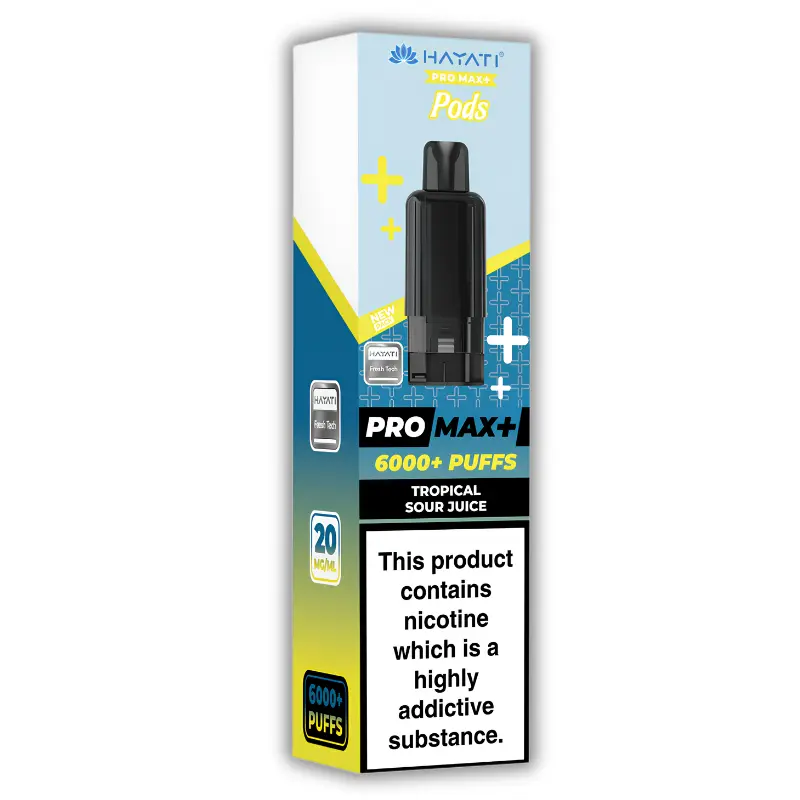
Hayati · Pro Max Plus
Tropical Sour Juice Hayati Pro Max Plus Pods
£5.49
✔ In stock — ready to ship
Genuine Hayati
Free over £20
Same-day dispatch
Secure checkout
£5.49 buys one Tropical Sour Juice pod for the Hayati Pro Max Plus: 12ml of liquid at 20mg, filled and closed at the factory, with no device travelling alongside it. If there is no Pro Max Plus body in the house already, nothing in this packet can be drawn on, and the Tropical Sour Juice kit at £7.99 is the listing that arrives usable. The liquid in the two is the same liquid. The gap between the prices is one body, bought once.
That similarity is the reason this page does not re-describe the flavour. The kit listing already works through what each of the three words in the name is doing, why a declared Sour marker is a different proposition from fruit that happens to arrive tart, how a single draw is shaped front to back, and why the sharpness quietly recedes over the course of a long unbroken session. All of that is settled there and repeating it here would produce a worse copy of it.
What is not settled anywhere, and what somebody buying this pod for the second or fifth time is uniquely placed to use, is a narrower question: what does a second identical pod tell you that the first one could not?
On most products the honest answer is not very much. Buy a second pod of a sweet mango liquid and you learn that it is still a sweet mango liquid. Sour is the exception, and it is a large exception. Acidity is the least stable thing your palate measures. It moves with what you last ate, with how much saliva you happen to be producing, with where in a session the draw falls, and with how warm the device is, and unlike a fruit aroma it leaves behind no category you can file it under and retrieve later. You can remember that Tropical Sour Juice was sour. You cannot remember how sour, and neither can anybody else.
The consequence is worth stating bluntly at the top, because it is the whole argument of this page. Your first pod of this liquid did not measure the liquid. It measured a fortnight of your life with the liquid in it, and a fair amount of what you concluded from it was about the fortnight. The second pod, if you go at it deliberately, is the first opportunity you have had to separate the two.
Why one pod of a sour liquid is a weak measurement
Nothing here is a criticism of the product or of the reader. It is a property of the attribute being judged. Sweetness is fairly robust to circumstance. Aroma is robust enough that people identify a blend correctly across widely different conditions. Acidity is neither, and a liquid that puts Sour in its name is asking to be judged precisely on the one axis that refuses to hold still.
The mouth you tasted it with was not a neutral instrument
Sour perception is threshold-based, and the threshold is set by whatever was in your mouth before. That is not a metaphor. Anything acidic taken shortly beforehand raises the bar the pod has to clear: a coffee, a fizzy drink, a glass of orange juice, a dressed salad, a tomato-heavy meal. Draw on this pod within twenty minutes of any of those and it will read noticeably flatter than it is, because the tongue has already been given a larger dose and is comparing against that.
The reverse happens too and is less obvious. A mouth that has just had something sweet reads the acid harder than it would otherwise. So does a dry mouth, because saliva is the thing standing between the acid and the receptors, and a mouth that is short of it has less buffering in place. Hydration, the hour of the day and whether you have eaten at all in the last few hours therefore all shift the answer, in directions that are predictable once named and invisible if they are not.
Toothpaste deserves its own sentence, because it is the confound most people have already noticed without connecting it to this. The detergent in most toothpastes suppresses sweetness and lets acid through unopposed for roughly half an hour afterwards. Somebody whose first draw of pod one happened shortly after brushing did not taste this liquid. They tasted a version of it with the sugar turned down and the acid left where it was, and formed a first impression from it.
The reference point moves, and so does the memory of it
Aroma memory is categorical and surprisingly durable. Given a fruit accord, most people can say mango or pineapple or blackcurrant a year later and be right. Intensity memory is dimensional, and dimensional memories degrade fast and then re-anchor themselves to whatever you have tasted most recently. A month after finishing a pod, what survives is a label, not a magnitude.
There is also no vocabulary doing any work. Cooling at least has markers attached to it across the range: Ice, Frozen and Cooler are three rough tiers, and a buyer who has had Lychee Ice and then Blackberry Ice has two points on a scale and can place a third. Sourness has one word and no tiers. Tropical Sour Juice, Cherry Sour Raspberry and Blue Sour Raspberry all carry the identical marker and nothing published distinguishes their intensities. You cannot look the answer up, which leaves your own palate as the only instrument, and the instrument has no printed scale on it.
The pod you remember is an average of a declining curve
This one is specific to the format and it is the strongest of the three. A pod holds 12ml and runs on one coil for all of it. The kit page explains why acid is the first casualty of a coil accumulating residue, and there is no need to derive it again: the sharp front end of the draw softens well before anything tastes tired, and on a declared-sour liquid the loss is conspicuous.
Now think about what that does to a memory. Your impression of pod one is not a snapshot of the liquid. It is an average over a curve that starts high and ends low, weighted towards the beginning and the end by the ordinary quirks of memory, and the end of a sour pod is the least sour part of its life. Whatever number you carry in your head for how sharp this flavour is, it is almost certainly lower than the liquid actually is, and it is lower by an amount nobody can tell you.
Stack the three together and the position is this. A first pod gives you one sample, taken with an instrument of unknown calibration, over a period during which the thing being measured was itself changing, and stored afterwards as a label rather than a value. It is enough to tell you whether you broadly liked it. It is not enough to tell you what it is.
What the second pod makes possible
A second identical pod is not merely more of the same thing. It is a repeat of an experiment, and repeating an experiment is how anybody separates a constant from a variable. The liquid is the constant. You, the day, the device state and possibly the batch are the variables. Anything that differs between pod one and pod two is coming from the second list, because the first list did not move.
A first draw you can compare against another first draw
The single most informative moment in a pod's life is the first properly wetted draw off a fresh coil, and on pod one that moment was worthless as data, because you had nothing to hold it against. You could only say it was sour. On pod two the same moment becomes a comparison, and a comparison is a measurement where a bare impression is not.
The comparison is easy to get wrong in one specific way, so it is worth naming. Compare first draw against first draw, not first draw against last week. Almost everybody does the second thing without intending to, because last week is what is freshest in mind, and last week was the bottom of a declining curve. A new pod that follows a worn one will always seem dramatically sharper, and that difference is mostly the coil you just retired, not the pod you just fitted. Hold pod two's opening against pod one's opening, not against pod one's ending, and the number means something.
A direction of error, which is more useful than a value
Suppose pod two opens noticeably sharper than you remember pod one opening. That is not a disappointment about pod one or a surprise about pod two. It is information about the conditions of your original trial, and you can usually name them. Was pod one opened at a party, or on the second morning of a holiday, or straight after a coffee, or in the middle of a cold that had your nose blocked? Any of those explains a low first reading, and it makes the verdict you formed at the time unreliable in a knowable direction.
The same logic runs the other way. Somebody whose first encounter with this pod happened on an empty morning palate, with a dry mouth and a properly saturated coil, met this liquid at its absolute sharpest and encoded that as normal. Pod two will seem milder, and they may conclude the recipe has been softened when nothing of the sort has happened. Knowing which of those two people you are is worth more than any adjective on a product page, and only a second pod can tell you.
Deliberately breaking one condition at a time
Once you have two instances, you can start changing one thing on purpose and watching what it costs. This is where a repeat buyer stops being a consumer of descriptions and starts producing their own.
Take the opening days of pod two on the cleanest conditions you can arrange: a neutral palate, unhurried draws with real gaps between them, the same time of day on two consecutive mornings. Then, at a point of your choosing, deliberately break one condition. Have it after a coffee. Have it in the middle of a long run of draws. Have it in the evening after a large meal. Each of those tells you the size of one confound, and the sizes are the numbers you actually want, because they are what determine whether this pod suits how you personally vape rather than whether it suits a bench test.
Most people will find the session effect is the biggest of them by a distance, which is exactly what the kit page predicts. What people do not expect is how large the food effect is, and it is worth discovering with your own mouth rather than taking anybody's word for it. If it turns out that the way you vape reliably puts this liquid in its flattened state, that is not a fault in the pod. It is a mismatch, and a mismatch is a reason to buy something else rather than to keep buying this and being mildly let down.
Two pods at once, which is the only clean side-by-side
There is one comparison that sequential pods cannot give you, and it needs two bodies. Running the tail end of a tired pod on one device and the opening of a fresh pod on another, alternating within the same ten minutes, is the only way to observe the decline directly rather than reconstructing it from a memory this page has already spent several hundred words undermining.
That is the one genuine argument for buying a second complete kit rather than a bare pod, and it is a narrow argument that applies to few people. Most will be better served comparing across days and accepting a little imprecision. Anyone who does want the direct comparison should note that the two devices need to be in similar condition themselves, or the coil age difference is confounded with the body.
Four things your first pod probably told you wrongly
These are the four verdicts people most commonly bring to a repeat purchase of a declared-sour liquid, along with what a second pod tends to reveal about them. Not all of them will apply. At least one usually does.
"It was less sour than I expected." This is the most common and the least reliable. It is the verdict of somebody who sampled mostly mid-session, or after food, or during a period when they were vaping heavily. The pod's sharpest presentation is a single unhurried draw on a rested palate, and a lot of people never once took one of those during an entire 12ml. Before concluding that the marker on the name is overstated, take one draw in the morning, before anything else, on the second day of pod two. That is the liquid at full strength, and a fair number of people meet it properly for the first time on their second pod.
"It faded about halfway through." Partly true and partly not, and the proportions matter. The coil part is real and is documented on the kit page. The other part is attentional: a flavour you are meeting for the first time gets scrutinised, and a flavour you have been running for a week stops being scrutinised, so the sensation genuinely does become quieter without the liquid changing at all. A second pod disentangles them, because you can put the two halves of pod two under the same attention by making a point of taking one deliberate draw a day and comparing those rather than comparing general impressions.
"It is sweeter than the name suggests." Frequently an artefact of draw style and device warmth. Long slow draws move more liquid and bring the fruit weight forward, and a warm device pushes perceived sweetness up while doing very little for perceived acidity, so the ratio moves twice in the same direction. Somebody who takes long draws will get a sweeter pod than somebody who takes short ones, from identical liquid. If pod one was drawn long throughout, the sweetness verdict is a verdict about a habit.
"It is one-note." Almost always formed during an extended run, which is precisely the condition under which the acid stops registering and the pod collapses into its sweet component. It may also be correct. This is not a complex liquid and the kit page says so plainly. The point is that a judgement of simplicity formed in hour three of a session is not evidence, because the liquid presents a different structure in the first minute of a session than it does in the fortieth. Form the verdict on a fresh palate, then it means something.
Where this stops being worth the effort
Two pods is a sample of two, and there are limits to what a sample of two supports. It cannot separate a batch difference from a personal-condition difference, because you would need several pods from each batch and Hayati publish no batch reference, no fill date and no manufacture date against this listing, so you would not know which batch you had anyway. It cannot tell you whether the recipe has been adjusted. It cannot give you a number anybody else could use, since your threshold is yours.
What it can do is answer the only question a repeat buyer actually faces, which is whether to keep buying this. That question does not need an absolute value. It needs to know whether the verdict you formed on pod one survives a second look under better conditions. Most of the time it does. When it does not, the correction is usually large enough to change the decision, which is why the exercise is worth an afternoon of mild attention and not a spreadsheet.
The pod itself, briefly
The packet contains one pod and nothing else. It is prefilled and closed at the factory, it fits a Hayati Pro Max Plus body, and it will not work on its own. The Hayati Pro Max Plus Pods shelf carries the full set of flavours in this fitment, and the wider Hayati Prefilled Pods and Refills shelf covers the same idea across Hayati's other devices.
One specification matters more than the rest for this particular liquid, and it is the 12ml. Not the volume as such, but the fact that all 12ml passes through a single coil that is part of the pod and cannot be changed partway. A liquid whose defining attribute is the first thing a loaded coil stops rendering has to carry that attribute across the whole distance on one component. That is the mechanical reason a repeat buyer's comparison has to be pinned to a fixed point in the pod's life, because any two draws taken at different points are draws from what is effectively a slowly changing product.
Everything else about the platform, the body, the fitment across the range and how the format behaves generally, is written up at length elsewhere and adds nothing here. The Hayati Pods shelf is the place to start for anyone comparing formats rather than flavours, and the New Products shelf is where recent additions sit before they settle onto the permanent listings.
This listing in numbers
The table below separates what Hayati publish from what they leave unstated, and on a repeat purchase the unstated rows are the more interesting half, because they are the reason your own record of previous pods is the only evidence available to you.
| Listing | Tropical Sour Juice Hayati Pro Max Plus Pods |
| Price | £5.49 |
| What arrives | One prefilled pod, no device |
| Device required | A compatible Hayati Pro Max Plus body, bought separately |
| Volume held | 12ml |
| Nicotine | 20mg, the only strength on this listing |
| Acidity | Declared in the name, with no intensity figure behind it |
| Coolant | No cold marker in the name, none indicated in the data |
| Puff rating | Rated by the manufacturer at up to 6,000 puffs for a full pod, a laboratory estimate |
| Base ratio | Unstated for this listing |
| Coil resistance | Unstated for this listing |
| Fill or batch date | Unstated, and not printed on the packet |
| Brand | Hayati |
Three rows are worth a sentence each in the context of a repeat purchase. The missing fill date is the one that bites hardest, because it means a pod that has sat in storage for a long stretch is indistinguishable on paper from one filled last month, and an acid dose is not a permanent fixture in a bottle. If pod two seems softer than pod one from its very first draw, storage age is a candidate explanation and you have no way to check it. That is a limitation of the information available rather than a criticism of anybody, but it does mean the only date you can rely on is the date you bought it.
The unstated base ratio matters at one remove. The balance between the two carrier liquids affects how quickly the aerosol wets the tongue, and a taste that arrives on a faster-wetting base registers more abruptly than the same taste on a thicker one. Hayati do not publish the ratio for this pod, so nothing can be inferred, and any figure quoted for it is somebody's invention. The unstated coil resistance sits in the same position, since resistance governs how hot the coil runs and warmth moves the sweet-to-sour balance towards sweet.
On the puff figure: it is a bench number produced by a machine drawing at fixed intervals, useful for putting listings in an order and close to worthless as a forecast of how long a given person's pod will run. The 20mg is a plain fact about the contents, and nicotine is an addictive substance regardless of what flavour is wrapped around it. A zero nicotine Pro Max Plus pod exists as a separate listing at the same price for anyone who wants that instead.
What a repeat buyer should weigh it against
The comparison set changes once you are restocking rather than choosing for the first time. A first-time buyer is asking what this tastes like. A repeat buyer already knows roughly, and is asking a different question: given what I now know about how this liquid behaves for me, is there something on the shelf that fits my actual pattern of use better?
The two other declared-sour listings, as instruments rather than alternatives
The most useful thing a repeat buyer can do with Cherry Sour Raspberry and Blue Sour Raspberry is not to replace this pod with one of them, but to use one to put a second point on a scale that currently has one point. All three carry the same marker and none publishes an intensity, so the only way to know where Tropical Sour Juice sits relative to its siblings is to own two of them at once and alternate. That is a genuinely different purpose from buying a new flavour, and it produces a piece of knowledge nothing on this site can give you.
Be aware of the trap, though. Two acid-forward liquids run back to back blunt each other, for the same reason a long session blunts a single one. Alternate across days rather than across draws, and take each opening draw on a rested palate, or you will conclude that both are mild.
The same territory with the acid taken out
Somebody whose second pod confirms that the sharpness is the problem rather than the appeal has a clear set of options in the same fruit family. Caribb Crush occupies broadly the same warm tropical ground with the sour dose absent, which makes it rounder, considerably easier to run for long stretches and less interesting on a first draw. Triple Mango pushes further the same way, concentrating on the heaviest and least acidic fruit in the tropical set. Mango Banana adds a soft, creamy-textured partner to the same base and lands softer again, and Strawberry Guava keeps one tropical component while pairing it with a berry that brings no sharpness of its own.
The honest note attached to all four is that they do not decline the way this one does. A pod whose appeal is sweetness and body arrives at the far end of 12ml recognisably itself, because sweetness is not the component a loaded coil drops first. If the thing that annoyed you about pod one was that it changed character partway, that annoyance is a property of building a flavour on acid, and it follows the acid rather than the product.
Tartness from the fruit instead of from a dose
A different reading of a disappointing first pod is that the sharpness was fine but its shape was wrong: a spike at the front rather than something running through the whole draw. If that is the diagnosis, the answer is fruit that brings its own acidity. Guava Kiwi Passion Fruit is the clearest example on the shelf, with three named fruits that are all inherently tart and no declaration anywhere in the name. Dragon Berries sits milder and between the two camps, and Blueberry Pomegranate brings a drier, more astringent kind of tartness that lasts into the finish instead of vanishing at the exhale. Strawberry Kiwi is the gentlest of the group, with the kiwi supplying a small amount of lift under a sweet berry.
Fruit-borne acidity has one practical advantage worth knowing about on a repeat purchase: it is more stable across a pod's life, because it is carried in the same material as the flavour rather than dosed separately, so it does not disappear on its own schedule. It is also harder to notice, which is the corresponding cost.
Sharpness by temperature rather than by acid
A proportion of people reaching for a sour liquid actually want something that cuts through sweetness, and cooling does that by a completely different route. It also holds up far better across 12ml, which makes it the more sensible choice for anyone whose chief complaint about pod one was the drift. Lychee Ice keeps you in tropical territory, Blackberry Ice moves to a darker fruit with the same treatment, and Banana Ice puts cold over something soft and heavy, which is about as far from this pod's structure as the shelf goes while still being fruit.
The drink treatments, which handle acid differently
Juice and Lemonade are both processing markers, and the difference between them is where the sharpness comes from. A lemonade accord carries its own citric bite as part of the drink character, so the acid and the treatment arrive together rather than being bolted on separately. Berry Lemonade and Blue Razz Lemonade both work that way. Blue Razz Mojito is a third arrangement, where herbal lift does the job that acid does here, and Cola Ice uses sharpness as a stand-in for carbonation rather than for fruit.
Confectionery sweetness, for contrast
At the other end of the shelf sit the liquids with no sharpness at all, and they are worth naming because they make good rotation partners for this one rather than good replacements. Hubba Bubba and Blueberry B'Gum are both sweet and soft throughout, and Blue Razz Fruit Twist is sweet with a confected fruit edge rather than a real one. Coming back to Tropical Sour Juice after any of the three produces the sharpest opening draw you will get from it, which is exactly the condition you want for a comparison. Juicy Peach is a quieter version of the same idea, with a single soft fruit and no edge anywhere.
The listings that name nothing
Several pods on this shelf are named for a mood rather than an ingredient, and they are the one category a repeat buyer should approach differently from a first-time one. Galaxy Aura and Sunset Aura publish nothing that would let you predict whether there is acid in them, which means buying one is a genuine unknown rather than a calculated move. That is fine if you enjoy the unknown. It is a poor idea if you are in the middle of trying to fix a scale with only one point on it, because an unknown pod cannot serve as a comparison for anything.
The full tropical and warm-fruit selection sits on the Exotic Vapes shelf, which is the right place to browse if you are comparing this against the rest of its family rather than against the rest of the device range. The full Hayati catalogue is there if none of the shelves narrows it usefully.
Handling a restock so that pod three is comparable
The practical advice on this page is aimed at one outcome, which is making successive pods comparable to each other. That is a narrower goal than getting the most out of a single pod, and it changes what matters.
Let a new pod settle before judging anything. A pod that has just travelled has liquid where it should not be, and a few minutes upright with the mouthpiece uppermost lets the wick take up what it needs. The reason this matters for a comparison rather than for enjoyment is that an underfed coil runs hot, a hot coil favours sweetness, and a first draw taken too early therefore lands in the wrong place on exactly the axis you are trying to measure. Give it the same settling time every time and the variable is removed.
Keep spare pods in one place, at one temperature, away from sunlight and away from anything that gets warm. Consistency of storage is the point here rather than preservation as such: two pods kept in the same drawer for the same length of time are comparable to each other, whereas one kept in a cool cupboard and one left in a car are not, and you will spend the comparison wondering which difference you are looking at. If a pod has been somewhere warm, give it a night indoors and a handful of ordinary draws before you form any view of it.
Fix the moment you judge from and keep using it. The opening of a pod is the obvious candidate, because it is the only moment guaranteed to exist in every pod's life and the only one where the coil condition is known. Make it the second morning rather than the first hour, on a palate that has had nothing acidic and nothing minty, with unhurried draws spaced far enough apart that the session effect does not get a chance to start. It takes no extra time. It only takes doing it on purpose.
Recognising a spent pod is harder on this liquid than on most, and the kit page explains why: the worn state of this one is a perfectly coherent sweet tropical pod rather than an obvious fault, so there is no unpleasant signal telling you to stop. What a repeat buyer gains is the ability to put a date on it. If you know from two previous pods that the front of the draw tends to go quiet somewhere around a particular point, you can plan the changeover rather than discovering it. That is a small thing, and it is the sort of small thing that only a second identical purchase makes available.
One habit to avoid: do not judge a new pod immediately after finishing an old one. The contrast will be enormous, it will be almost entirely about the coil you just took out, and it will reset your sense of what normal looks like to something unrealistically high. Leave an hour, or better, start the new pod the next morning.
Questions repeat buyers ask
Is the liquid in this pod the same as in the kit?
Yes. The kit is this pod plus a rechargeable body in one box at £7.99, and this listing is the pod on its own at £5.49. There is no difference in the liquid, the volume or the strength, so anyone who already owns a compatible device has no reason to buy the kit again unless they specifically want a second body.
My second pod tastes less sour than the first. Is something wrong with it?
Probably not, and the likeliest explanations are all about the circumstances of the comparison rather than the pod. Check whether you are comparing its opening against the previous pod's opening or against your general memory of it, whether you have eaten or drunk anything acidic recently, and whether the draws you are judging by fell in the middle of a long run. If it still reads soft after a morning draw on a rested palate on the second day, storage age becomes a plausible candidate, and there is no printed date to check it against.
Can I tell whether two pods came from different batches?
Not reliably, and it is better to say so than to pretend otherwise. Hayati publish no batch code, fill date or manufacture date against this listing, so there is nothing to read off the packet. A difference you notice from the very first draw of a properly settled pod is more likely to be a real difference than one that emerges gradually, since gradual change is what coil wear looks like, but even that is a weak signal from a sample of two.
Why does it seem sharper in the morning?
Saliva production is lower after a night's sleep, and saliva is what stands between the acid and the receptors that detect it. A drier mouth reads a given dose harder. The same effect turns up after exercise or a long stretch without drinking anything, which is worth knowing if you are trying to compare two pods fairly.
Should I buy several pods at once?
That depends on how quickly you get through them, and an acid-carrying liquid is not the one to stockpile deepest, since sourness tends to drift downwards over a long stay in a drawer rather than upwards. For the purposes of comparing pods against each other, buying two at a time and keeping them together is more useful than buying one at a time, because pods bought and stored together have had the same history.
Does the flavour actually change over the life of one pod?
The liquid does not, but what reaches you does. The sharp front end of the draw softens as the coil accumulates residue, while the sweetness carries on largely unaffected, so the balance shifts over 12ml. The kit listing sets out the mechanism in full. The practical consequence for a repeat buyer is that any two draws compared across different points in a pod's life are not comparing like with like.
How does it compare with the other sour pods on this shelf?
Nothing published answers that, because the Sour marker appears on all of them with no intensity attached. The only way to find out is to have two of them running and alternate across days, taking the opening draw of each on a rested palate. Cherry Sour Raspberry and Blue Sour Raspberry are the two to look at, and they sit in a different fruit family, which makes the acid easier rather than harder to isolate.
Is there any cooling in it?
None of the cold markers Hayati use in their naming appear here, and nothing in the product data indicates a coolant. What you can feel is acid acting on the tongue during the inhale rather than a temperature sensation in the throat. Anyone who wants cold instead should look at the iced listings on the same shelf.
How long will one pod last?
That varies too much between people for any honest answer. The pod is rated by the manufacturer at up to 6,000 puffs, which is a laboratory estimate generated by a machine drawing at fixed intervals, and it is best treated as a way of ranking listings rather than as a prediction. Draw length and frequency differ more between two individuals than most published figures do.
I have decided I like it. Do I need to do any of this?
No. All of the above is optional, and it is aimed at somebody who is uncertain whether their first impression was fair. A person who enjoyed pod one and wants pod two should simply buy pod two. The measuring is for the undecided, and the honest position is that most repeat buyers do not need it.
What goes well alongside it?
Something with no acid in it, because two sharp liquids in sequence flatten each other. A sweet confectionery pod or a soft single fruit gives the palate a complete change and makes the next opening draw on this one properly sharp. Running this as the only flavour for a week is the arrangement least likely to show it at its best.
The short version
This is the Tropical Sour Juice pod on its own, 12ml at 20mg for £5.49, for a Pro Max Plus body you already have. The flavour argument lives on the kit listing and is better made there. What this page adds is a point about repeat purchasing that happens to be unusually true of this particular liquid: your first pod measured a fortnight rather than a flavour, and on a declared-sour product the difference between those two things is large.
A second identical pod gives you a repeat of the same experiment with the same constant in it, which lets you hold an opening draw against an opening draw, work out which direction your original verdict erred in, and find out for yourself how much a coffee or a long session or a warm device actually costs you. Some of what you concluded the first time will survive that. Some of it will not, and the parts that do not are usually the parts that were about the day rather than the pod. Nobody has to do any of this to enjoy a restock. It is simply the case that with a sour liquid, the second pod is the first one that can tell you the truth.
Strictly for adults aged 18 and over. Nicotine is an addictive substance.
You might also like