
Home / Hayati Pro Max Plus Pods / Summer Dream Hayati Pro Max Plus Pods
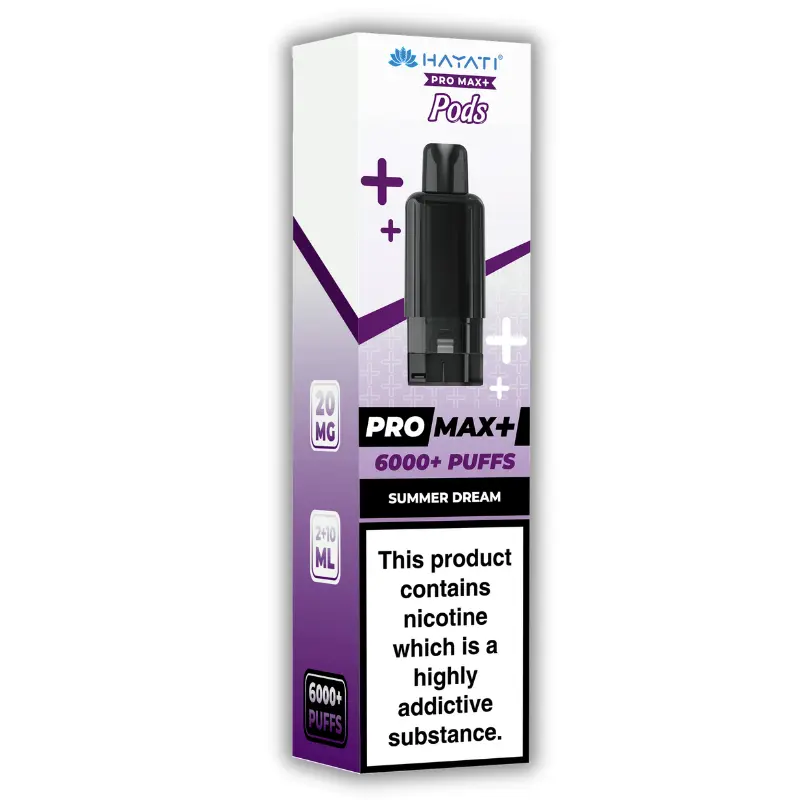
Hayati · Pro Max Plus
Summer Dream Hayati Pro Max Plus Pods
£5.49
✔ In stock — ready to ship
Genuine Hayati
Free over £20
Same-day dispatch
Secure checkout
£5.49 buys one prefilled Hayati Pro Max Plus pod holding 12ml of liquid at 20mg nicotine salt, with the element built into the pod and nothing else in the pack. One flavour, no selector, no body, nothing to charge. Hayati rate a full pod at up to 6,000 puffs, a figure produced on laboratory equipment drawing to a timer rather than a forecast of how long it will last anybody. If there is no Pro Max Plus in a drawer already, this listing contains nothing that can be made to work, and the Summer Dream Hayati Pro Max Plus Pod Kit at £7.99 is the one that arrives usable.
That specification is the same specification carried by most of the Hayati Pro Max Plus Pods shelf, all 89 of them, and it is not why this page exists. Nor is the flavour name, which has been taken apart properly on five separate listings and does not need a sixth treatment. Summer Dream is one of the most heavily distributed names Hayati print. It appears on thirteen listings in this catalogue, and by now a reader arriving here has probably already been told, on one of those thirteen, that the name identifies no fruit and that the honest position is to say so.
What has not been written anywhere is the thing that follows from buying this particular object twice. This is a refill. Almost everybody who orders it has emptied one before, which means almost everybody who orders it is carrying an impression of the liquid in their head and using that impression to justify the order. The question nobody has asked is whether that impression is worth anything, and the answer turns out to be that it depends entirely on how many pods deep you are. Pod one settles less than it feels like it settles. Pod two settles considerably more. Pod three is the first point at which a verdict deserves the name.
That sequence matters more on this listing than on any of its 88 neighbours, and the reason is structural rather than a matter of taste. A label that names a fruit hands the buyer a standard from outside the transaction. This one hands over nothing, so the only yardstick available is a memory of the previous pod, and the previous pod was spent constructing a guess rather than holding a measurement. The rest of this page works out what each successive pod can genuinely settle, corrects one thing a sibling page got slightly wrong about whether sealed pods can be measured at all, and counts the claim it was built on before building on it.
What five earlier Summer Dream pages have already settled
None of the following is rebuilt here, and it is worth knowing where each piece lives so that the parts of the argument this page skips can be read somewhere.
The Summer Dream Hayati Rubik Prefilled Pod Kit page counted the distribution. It established how many listings carry this name, how far across the hardware families they run, and it ran the listing diff: lining up every description Hayati have written for this liquid and asking which properties all of them assert, which only some do, and which one asserts alone. That work is the strongest evidence anybody outside the factory holds about what is in the pod, and repeating it would be pointless.
The Summer Dream Hayati Pro Ultra Plus Pods page priced every one of the thirteen listings by the millilitre in a single table and worked out what it costs to meet an undescribed liquid at 22ml. It concluded that almost nobody should start there, and set out a ranked order of cheaper ways in. Every price comparison in the Summer Dream family belongs to that page. There is no table of that kind below and no attempt at one.
The Summer Dream Hayati Pro Max Nic Salt page took the recommendation those pages kept making and wrote it from the point of view of the bottle. It is the working protocol for testing an unnamed flavour on hardware you already own, and it is honest about the two things that stop a reading taken on a bottle transferring cleanly to a sealed pod: the nicotine concentration differs, and the heating element is yours rather than the factory's. It also summarised what the listing diff closed and what it left open, which is the short version worth carrying into this page. Closed: no fruit is named on any listing, no cooling is declared on any of them, every prefilled listing calls the liquid sweet, nothing anywhere attaches a sour or tart word to it, and several describe a blend in which nothing is meant to lead. Open: which fruits, in what proportions, and whether the result reads as one undifferentiated impression or as components you could separate.
The two dual listings, the Lemon & Lime/Summer Dream Hayati Pro Ultra Plus 25K Pods and the Lemon Lime / Summer Dream Hayati Pro Ultra Plus 25000 Prefilled Pod Kit, own the asymmetry between a named half and an unnamed one, what a label on one side does to the buyability of the other, and what happens to a shared liquid budget when the two sides are not used at the same rate. Both of those listings state in their own text that the flavours are held apart and that a rotating mouthpiece decides which reaches the element, so the arrangement is published there rather than inferred. It is worth one note below and no more.
The silence on cooling is worth one extra line, because it is silence that carries information rather than silence that carries nothing. The Blue Frozen Hayati Pro Max Plus Pods page counted the whole catalogue's cooling vocabulary and found that Hayati put a cold word in a title whenever a coolant is present. On a range that behaves that way, a title with no cold word in it is evidence of no declared coolant, not an omission. That census is done and this page cites it rather than running it again.
Counting the claim this page was built on
The argument arrived in a strong form: that a repeat buyer of this pod is the only person who ever holds a usable reference for this liquid. This catalogue has a habit of producing claims like that which do not survive being counted, so it was counted first, and it does not survive either. The corrected version is narrower and it is more useful, because the narrowing points at something specific rather than at something sweeping.
Start with the thirteen listings. Five of them are complete kits, which are device purchases. Eight are consumables that can be reordered on their own: five bare replacement pods and three bottles. So eight listings, not one, put a buyer in a position to hold a second sample of this liquid. The sweeping version of the claim is simply wrong and it is wrong by a factor of eight.
Narrow it once and it improves. Of those eight, the three bottles are a different instrument. Two of them are 120ml at 0mg, which is a different transaction entirely, and the third is the 10ml bottle whose own page sets out at length why a reading taken through hardware you chose yourself does not transfer to a sealed pod at a different concentration. Take the bottles out and five bare pods remain. Narrow again: one of those five is the dual 22ml pod, where Summer Dream shares one element and one airway with a citrus that is turned to and away from throughout a session. Whatever a reading taken there is, it is not an isolated reading of Summer Dream, and the dual pod page describes the carryover in its own terms. That leaves four.
Four single-flavour sealed refills carry this liquid at 20mg: this 12ml pod at £5.49, the 22ml Pro Ultra Plus pod, the 12ml Rubik pod and the 4ml Mini Ultra pod. Each of the four can be bought a second time to the same published specification, and a buyer of any of the four therefore has the same method available. So the honest form of the claim is not "the only person". It is this: four listings out of thirteen put a buyer in the position this page describes, and this listing is one of the four rather than the exception among them.
There is one thing that is true of this listing alone, and it is worth stating because it is the part that survived. Summer Dream appears twice on the Pro Max Plus platform: as this pod and as the kit. The kit is bought once, because it contains a body. This pod is the only Summer Dream listing on this platform that is a pure consumable, so for anybody holding a Pro Max Plus, every repeat sample of this liquid necessarily comes through this listing and no other. That is a much smaller claim than the one handed over and it is the one the page is built on.
A second count was run because the argument leans on it. How unusual is it, on this shelf, to be given nothing to measure against? Taking every one of the 89 listings filed under Pro Max Plus pods, which are themselves part of the 201 on the Hayati Prefilled Pods & Refills shelf, and reading both the title and Hayati's own description for each, five name no fruit, no fruit family, no confection and no drink anywhere: Midnight Dream, Galaxy Aura, Sunset Aura, Black Mamba and this one. Five out of 89. Everything else on the shelf gives you something you could have tasted before, even when the title does not. Blue Fusion names no fruit in its title and its description names two. Caribb Crush gives a region in the title and the description says tropical fruit. Ice Pop names a confection. The four Pro Max Plus listings sold by nicotine strength rather than by flavour look like exceptions and are not, because their descriptions state the flavour outright; they are all Banana Ice, which is also sold under its own name as Banana Ice Hayati Pro Max Plus Pods.
Five in 89 is roughly one listing in eighteen. That is unusual enough to be worth a page and common enough that nobody should call it unique. Four of the five, including this one, do offer a direction in the description: darker and sweeter, or lighter and sweeter, or bolder. A direction is not a standard. It tells you which way to look and gives you nothing to hold the result against.
The label gives you nothing to measure against
Consider what a named flavour actually does for a buyer, because it is easy to assume it does nothing more than describe. Lychee Ice Hayati Pro Max Plus Pods puts a fruit on the front that most adults have eaten. Whatever the pod does on arrival, the buyer brings a prior expectation of lychee into the first draw, formed years earlier and formed outside this transaction entirely. That expectation is independent of the pod, of the element, of the day and of the order in which things were tasted. It is a fixed point, and a fixed point is what turns an impression into a measurement.
The same applies with more force to a compound name. Cherry Peach Lemon Hayati Pro Max Plus Pods lists three things, so a buyer has three independent fixed points and can ask which of them is arriving, in what order, and at what strength. If the lemon is not there on day nine, that is a finding, because lemon was promised and lemon is a thing the buyer knows. Blueberry Raspberry Cherry Hayati Pro Max Plus Pods works the same way. So does Blackcurrant Mango Hayati Pro Max Plus Pods, with two.
Now take the promise away. Hayati say this liquid is sweet, light and relaxed, and they say nothing else that a palate could check. There is no component that can go missing, because no component was ever named. There is no ordering that can be wrong, because no order was ever given. There is nothing a draw can fail to deliver. Which means the entire class of observation that a named pod supports, namely "the thing on the label is not arriving", is unavailable here, and it is unavailable permanently rather than until you work it out.
That is the real content of the information gap, and it is a different point from the ones the five earlier pages made. They were concerned with the decision before purchase: what a buyer can reasonably predict about an undescribed liquid, whether the mood word means anything, and how much money to put at risk before finding out. This page is concerned with what happens afterwards, once the liquid is known and the buying has become routine. At that stage the gap stops being a problem about prediction and becomes a problem about calibration, and calibration problems have a shape of their own.
The shape is this. Every sensory reading you take of any liquid is a reading of three things at once: the liquid, the state of the element it passed through, and the state of you. On a named flavour those three can be partly separated, because the label supplies an expected value for the first. On an unnamed one they cannot be separated at all from a single reading, because there is no expected value for anything. A thin, flat, simple mouthful might be a thin, flat, simple liquid, exactly as advertised by a description that promises mellow and undemanding. It might equally be a rich liquid read through an element with 10ml already behind it. The two possibilities are indistinguishable from the inside, and no amount of attention paid during that single pod will separate them.
Anyone who has worked with an unlabelled sample in any context will recognise the position. You cannot validate an instrument against an unknown. You need either a known sample or a repeat, and on this product the known sample does not exist, which leaves the repeat. That is the whole argument, and the rest of this page is the working out of it.
It is also worth being explicit about what this argument is not. It is not a claim that the recipe differs between the thirteen listings, or that any pod contains anything other than what the others contain. Hayati publish nothing about the formulation, no ingredient breakdown, no batch information and no statement that the liquid is identical across formats, so nobody can say either way and this page does not try. The claim here is about method: about what a buyer can and cannot conclude from a given number of observations. It would hold in exactly the same form if every pod ever made were chemically identical, because the uncertainty being described is in the reading, not in the product.
Pod one is a hypothesis
Somebody buying this flavour for the first time, in whichever format, gets exactly one thing out of it: a hypothesis about what Summer Dream is. Not a weak result, not a provisional finding. A hypothesis, in the strict sense of a statement that the evidence so far is consistent with and has not tested.
Here is why it cannot be more than that, stated in the order the problems arrive. The first draws on a fresh pod are not a reading at all, because cotton that has not fully wetted delivers a muted and slightly strange version of whatever is in it, and a blend built so that nothing leads is precisely the kind of liquid that reads as almost nothing when it is under-delivering. So the opening of pod one is discarded, and whoever formed a view during it formed it on bad data.
Then the pod runs. Twelve millilitres is a fortnight for a lot of people and considerably longer for some, and across that period the element does not stay in one condition. It accumulates residue, and residue does not degrade a flavour evenly. The lighter and more volatile part of a blend suffers first, which on a multi-component liquid means the top of the profile thins while the base stays put, so the same liquid read late reads simpler and heavier than it did early. The Summer Dream Rubik page makes that point for a 12ml pod and there is no need to labour it again.
What that does to pod one is specific. The impression the buyer ends up carrying is not a reading taken at a moment. It is a smear across the whole life of one element, weighted towards whenever they happened to be paying attention, which for most people is somewhere in the middle or the end rather than the beginning. If the liquid genuinely is undifferentiated and restful, that is what they will remember. If the liquid separates into parts early and stops separating as the element fouls, they will also remember something undifferentiated, because the undifferentiated version is what occupied most of the pod. Two quite different liquids produce the same memory.
Add the third variable and the hypothesis gets weaker still. A palate is not constant. Coffee, a cold, the time of day, what was eaten an hour earlier and what was vaped immediately before all shift a reading, and on a liquid whose declared character is gentle rather than assertive, those shifts are large relative to the signal. A gentle liquid is harder to read than a sharp one for the same reason a quiet sound is harder to identify than a loud one. Cherry Sour Raspberry Hayati Pro Max Plus Pods declares an acid edge, and an acid edge is loud; it will still be recognisable through a head cold. Nothing on this listing is loud by its own account.
None of that makes pod one worthless. It generates the hypothesis, and generating the hypothesis is the hard part. It also settles some genuinely coarse questions on the first day, which are worth naming because they are the only things a single pod does settle with confidence. Whether the liquid is sweet: yes, and Hayati say so on every prefilled listing. Whether it is cooled: there is no declared coolant, and a first pod will confirm the absence or the presence of a cold finish immediately, because that is not a subtle property. Whether it is sour: nothing in any of the thirteen descriptions says so, and a single pod will confirm that too. What a single pod cannot settle is everything in the middle, which is where the actual purchase decision lives.
Pod two, and the correction that makes it possible
The Summer Dream nic salt page argues, correctly and at length, that a single reading of an unfamiliar blend is not a result, and that what you need is the same reading taken more than once with the instrument in a comparable condition each time. It then says that a sealed pod cannot deliver that, because the element changes underneath the measurement, and that this is why a refillable device with a replaceable element is the better instrument for the job.
That is right about one pod and it is not right about two, and the distinction has not been drawn anywhere in this catalogue. It is worth drawing, because it is the difference between "this format cannot be measured" and "this format can only be measured at one point in its cycle".
Work through what actually changes when a second identical pod is opened. The element is new. It is the same manufactured part, made to the same specification, in the same condition it was in on the first day of pod one. The liquid is the same declared formulation at the same declared strength. The airway is the same geometry. Nothing in the pod has been chosen by the buyer, which on a bottle is the largest confound of all and here is absent entirely, because the whole assembly arrives configured. And critically, the buyer is no longer in the same epistemic position: they are not meeting an unknown, they are checking a claim.
So the opening of pod two is a genuine replicate of the opening of pod one. Not of the whole of pod one, which is unrepeatable, but of its first hundred draws, and those are the most comparable measurement points the format offers. The instrument does not change underneath a measurement if the measurement is taken before the instrument has had time to change. A sealed pod does not prevent replication. It rations it, at one replicate per pod, and it charges £5.49 for each one.
That charge is not trivial and it should be stated rather than glossed. Running a two-pod comparison costs the price of a second pod, and the second pod is bought anyway by anybody restocking, so the marginal cost of the method is zero for a repeat buyer and the price of a pod for somebody who would otherwise have stopped. That asymmetry is the practical heart of it. The restocker is already paying for the experiment. They are simply not running it, because nobody has told them that the first hour of a new pod is the only hour that is comparable with anything.
What does the second reading buy? Less than people expect from a repeat, and it buys it asymmetrically, which is the part worth understanding. If the two openings agree, that is weak evidence. Two readings can agree and both be wrong in the same direction, and there are obvious mechanisms for that: both taken in the evening, both taken by someone who had already decided what the liquid was, both taken in the same season with the same background diet. Agreement at two observations rules out only the crudest kinds of error, such as one pod having arrived in poor condition.
Disagreement is much more informative. If the opening of pod two does not match the memory of pod one, something real has been learned, although not yet which of three things it is. Either the memory of pod one was formed late and is therefore a reading of a tired element rather than of the liquid, which is the single likeliest explanation and the one this page would bet on. Or the two pods genuinely differ, which happens with manufactured goods and which Hayati publish nothing about either way. Or the reader has changed. Three candidates, and two observations cannot choose between them. But knowing that one of the three is in play is itself a result, and it is a result that the first pod could not produce at any price.
There is a particular version of that disagreement worth flagging, because it is the one most likely to occur on this product and the one most likely to be misread. Suppose pod two, at the opening, reads as more separated than the remembered version: several things arriving rather than one thing. The natural interpretation is that this pod is different. The far more likely interpretation is that pod one was mostly experienced through a partly fouled element, which flattens a blend towards its heaviest component, and that the separated version is what the liquid does when the element is working. On a named flavour the buyer would have caught this, because a named component going missing is a recognisable event. Here there was nothing to notice going missing, so the flattening passed as the flavour.
Which is, in one sentence, the whole reason this argument attaches to this listing and not to Lemon Lime Hayati Pro Max Plus Pods or to Blackcurrant Lemonade Hayati Pro Max Plus Pods. Both of those tell you what should be in the pod, so the buyer has a checklist and the checklist does the calibration for free. Here there is no checklist, so the calibration has to be done by repetition, and repetition costs £5.49 a go.
Pod three is the first honest verdict
Three observations is the smallest number that can distinguish a pattern from a pair, and the reasoning is not arithmetic dressed up. It is about which explanations survive.
With two readings you have, at best, a consistent impression, and the trouble with a consistent impression is that systematic error produces one just as reliably as truth does. If both pods were read in the evening after the same routine, the consistency is a property of the evenings. If both were read by someone who had already settled what the liquid was, the consistency is a property of expectation, which is a considerably stronger force on a gentle blend than most people credit. Two agreeing readings are compatible with the liquid being what you think it is and equally compatible with your reading process being reliably biased in one direction.
A third reading can be taken deliberately unlike the other two, and that is where its value is. Opened at a different time of day, on a different part of the week, following something else in the rotation rather than following nothing, read before anything else has gone through the mouth rather than after. If the impression survives being read under conditions chosen to break it, the remaining explanations shrink hard. It is no longer plausibly an artefact of the time of day, or of the order in the rotation, or of a single odd pod. What is left is the liquid, plus whatever bias is common to all three readings, which by pod three is usually just the settled expectation, and that one can be partly defeated by writing the impression down after pod one and not rereading it until after pod three.
That is why the honest verdict arrives at three rather than two, and it is why the answer is three rather than six. There is no benefit in continuing past the point where the alternative explanations have been eliminated, and on a liquid whose declared range of behaviour is narrow, they are largely eliminated by the third deliberately varied reading. Anybody running this to five pods is no longer testing anything. They have found a flavour they like and have started buying it, which is a fine place to end up and does not need a protocol.
The three pods also settle a second question that the first pod cannot even pose, and it is the question that decides whether this liquid works as a daily one. A blend can be restful or it can be monotonous, and the distinction is not visible on first meeting because everything is interesting on first meeting. It only shows up as a rate of decay in attention. Whether Summer Dream holds up across three consecutive pods, or whether the third one is being finished out of stubbornness, is a fact about the liquid interacting with a particular person and there is no way to read it off a label. It is also the fact that determines whether the next order is placed. Berry Lemonade Hayati Pro Max Plus Pods and Grape Berry Hayati Pro Max Plus Pods face the same question, but their buyers at least know what they are getting bored of.
To be clear about the confidence attached to each part of this. That the opening of a fresh pod is more comparable across pods than any two points within one pod: reasonably confident, and it follows from how residue accumulates rather than from anything Hayati publish. That two agreeing readings are weak and a disagreement is informative: reasonably confident, since it is a general property of small samples rather than a claim about this product. That three is the practical stopping point: probable, and it is a judgement about diminishing returns rather than a rule. That any two pods of this liquid contain the same mixture: unknown, not published, and not something this page will assert in either direction.
What this means if you are restocking
The practical upshot is short enough to state in one paragraph and then qualify. If you are ordering this pod for the second time, open it and pay attention for the first day, because that day is the only part of the pod that can be compared with anything you already know. Do not form the comparison at the end of the pod, where the element is in a different condition and the comparison is meaningless. If the opening matches what you remember, you have confirmed the crude version of your impression. If it does not, the most probable explanation is that your memory of the last pod was taken late rather than that this pod is different, and the way to find out is the next one.
The qualification is that this is worth doing for exactly as long as you are still deciding. A buyer on their fourth or fifth pod of the same liquid has made the decision, and paying close attention to the opening of each one has stopped being information gathering and become a habit. The point of the protocol is to get to a verdict, not to keep running.
There is a second, less obvious consequence, and it is about which listing a Pro Max Plus owner should use for the second sample. It is tempting, having liked this, to try the liquid in another format. The count above says why that does not work as a check: a reading taken on the 4ml Mini Ultra pod, the 12ml Rubik pod or the 22ml Pro Ultra Plus pod is taken through different hardware, and although all three are factory configurations rather than something you assembled, none of them is this configuration. A cross-format comparison tells you about the formats. Only another pod of this listing tells you about the reading. That is the narrow sense in which this listing is the one that matters for a Pro Max Plus owner, and it is the version of the original claim that survived counting.
The third consequence is about what a disappointing pod should and should not trigger. Somebody who opens a replacement pod, finds it flat, and concludes the liquid is not for them has run one uncontrolled observation and acted on it. On a named flavour that would be defensible, because a named component being absent is a legitimate negative. Here it is not defensible, because flat is also exactly what a description promising mellow and undemanding would predict, and the two cannot be told apart without a second opening. A negative verdict on this listing is worth much less than a positive one, which is an odd property and a real one.
Worth saying plainly at the end of this: none of the above is a reason to buy more pods than you were going to. It is a description of what the pods you were buying anyway are capable of telling you, which is more than most people ask of them.
The pod itself, briefly
There is not much to say about the hardware that has not been said across the rest of this shelf, so this section is short on purpose and the length has gone into the argument above.
The pack holds one prefilled pod and nothing else. No body, no charging accessory, no spare. The element sits inside the pod and is not a separate part, so it is replaced when the pod is replaced and there is no maintenance to do in between. Hayati publish no resistance figure for it and no airflow figure, which every pod page on this site records as a gap in the specification rather than as something to estimate. The pod cannot be refilled once empty, and the liquid, the wick and the element finish together as one item.
The one specification that actually matters for this particular liquid is the 12ml volume, and it matters for the reason the argument above depends on. Twelve millilitres is a long enough run that the element will be in a noticeably different condition at the end than at the start, which is what makes a within-pod comparison unreliable and a between-pod comparison worth setting up. On a 4ml pod the drift across the pod's life is smaller and the problem is milder; on a 22ml one it is worse. Twelve sits in the middle, which is the awkward place, because the drift is large enough to distort a reading and slow enough that nobody notices it happening.
Check the range name printed on your device against the range name in this title before ordering, since Hayati sell several pod systems and they are not interchangeable. The rest of the shelf, including the complete kits, sits on the Hayati Pods shelf if you want to see the whole set in one place.
Specifications
| What arrives in the pack | One prefilled pod, nothing else |
| Hardware you must already own | A Hayati Pro Max Plus device, bought separately |
| Liquid held | 12ml |
| Nicotine content | 20mg/ml, salt preparation |
| Manufacturer's puff rating | Up to 6,000, a laboratory estimate |
| Element | Built into the pod, not separable, no resistance published |
| Carrier base ratio | Not published for this pod |
| Flavour components Hayati name | None |
| Cooling declared | None |
| Price | £5.49 |
| Listings of this flavour in the catalogue | 13 |
| Listings on this shelf naming no flavour at all | 5 of 89, including this one |
Two rows in that table are blanks printed deliberately rather than gaps in the research. The element resistance and the carrier ratio are not published by Hayati for any prefilled pod in this range, so a reader who assumes the numbers exist somewhere they have not looked will keep looking for a while. They do not exist outside the factory. A page that offered figures for either would be inventing them.
The two rows at the bottom are not conventional specification and they are the two that decide how this pod should be bought, which is why they are there. Thirteen listings means the liquid is widely distributed and that the distribution has already been counted properly elsewhere. Five in 89 is the figure that makes the method argument worth the space it takes: on eighty-four of the pods on this shelf the label does part of the calibration for you, and on five of them it does none of it.
The strength is 20mg/ml, which is the maximum permitted for nicotine-containing e-liquid sold in the United Kingdom, and it is the figure carried by almost every prefilled pod Hayati list. It is stated here as a fact about the contents. Nicotine is an addictive substance, and nothing on this page recommends a strength or suggests moving between them.
The puff figure needs the usual qualification and it needs it particularly on this listing. Six thousand is a manufacturer's laboratory estimate produced by a machine drawing at a fixed rate, and real use varies by draw length and by how often the device is picked up. On this page the number matters less as a measure of duration than as a rough indication of how much work one element is being asked to do before it is thrown away, since that is what drives the drift the argument above is built on.
How it sits against its neighbours
Comparing an undescribed liquid to described ones on taste is not possible, and any page that tries is writing fiction. What can be compared is the position a buyer is put in, which is a real difference and a practical one.
Against the four other unnamed listings on this shelf, the differences are in direction rather than in kind. Midnight Dream and Galaxy Aura are both pointed darker and sweeter by their descriptions. Black Mamba is pointed dark and intense. Sunset Aura is pointed warm, soft and mellow, which is the closest neighbour to this one in stated direction, and the difference between "warm and golden" and "bright and summery" is a difference in copywriting that may or may not correspond to a difference in liquid. All five share the calibration problem described above, and a buyer restocking any of them is in the same position. If that position is unappealing, the answer is not a different unnamed pod.
Against the named shelf, the trade is legible. Blackcurrant Juice Hayati Pro Max Plus Pods tells you the fruit and the form, so a buyer arrives with a prior and can check it on the first draw. Fizzy Cherry Hayati Pro Max Plus Pods adds a texture claim to a named fruit, which is two things to check. Cola Lime Hayati Pro Max Plus Pods names a drink and a citrus. In each case the label is doing work that here has to be done by repetition. What you give up in exchange is the thing the five earlier Summer Dream pages kept circling: a named flavour is a flavour you can predict, and some people want a pod they cannot predict. That is a legitimate preference and this listing serves it.
Anyone who wants the opposite of the position this page describes should look at the declared-cooling listings, because a declared coolant is the loudest and most checkable property on the shelf. Blackberry Ice Hayati Pro Max Plus Pods tells you a fruit and a temperature. Double Menthol Hayati Pro Max Plus Pods is almost entirely a declared property with very little left to interpret. Neither of those needs three pods to characterise, because there is barely anything to characterise that the title has not already said.
Within the Summer Dream family itself the comparison is about format rather than taste, and the full priced version of it lives on the Pro Ultra Plus pods page. In outline: this pod is the mid-sized sealed unit of the liquid, the Mini Ultra pod is the smallest, the Rubik pod holds the same 12ml on different hardware, and the Pro Ultra Plus pod is the largest single commitment available. The whole set can be seen together on the Summer Dream Vapes shelf, which lists all thirteen. If you want this liquid with a device attached, that is the Summer Dream Hayati Pro Max Plus Pod Kit, and the two dual pods pair it with a citrus behind a rotating mouthpiece for anyone who wants a labelled half alongside the unlabelled one.
One comparison that is sometimes made and should not be is between this and a mixed-fruit listing on the grounds that both are blends. A blend that names its components is not the same object as a blend that does not, even if the liquids turned out to be similar, because the buyer's relationship with it is different from the first draw onwards. That is the distinction this whole page rests on and it is worth not collapsing.
For anybody who has concluded that an unnamed liquid is not worth the arrangements described here, the rest of the Pro Max Plus pod shelf is 88 other options and the majority of them tell you what is in them. The New Products listing and the full Hayati catalogue are the wider views.
Handling, and the signals that matter on an unnamed blend
Most of the standard advice for prefilled pods applies here unchanged and is not worth restating at length. What follows is the part that changes because of the argument above.
Let a new pod stand for a couple of minutes after fitting before drawing on it properly. On this listing that instruction carries extra weight, because the opening draws are the ones the whole comparison depends on, and a reading taken through cotton that has not fully wetted is not a reading of the liquid. Take the first few pulls gently and start paying attention somewhere around the fifth or sixth. A rushed opening does not merely give a poor first impression here, it destroys the one measurement the pod was going to provide.
Draw length is the main variable a user controls, and it is worth holding it constant across the openings of successive pods for the same reason a laboratory holds anything constant. A long slow draw and a short sharp one deliver different proportions of a blend, and on a liquid where nothing is declared to lead, that difference is large enough to look like a difference between pods. If you are comparing pod two against pod one, draw the same way you drew before.
Storage is worth one paragraph because it bears on the same thing. A pod kept somewhere warm or in direct sunlight will not present the same as one kept cool, so a spare that has sat on a windowsill for a month is not a clean replicate of one opened the week it arrived. Keep spares somewhere dark and at a steady temperature, upright, still in the wrapper, and away from children and animals. If you are deliberately running the comparison, buy the pods together and store them the same way.
On knowing when a pod is finished, the usual signals apply: the flavour thins, the draw feels different, and eventually there is a scorched note that means the wick is running short of liquid. The complication specific to this listing is that thinning is hard to detect when you never knew what the full version was, which is the calibration problem arriving one last time. The practical workaround is to note, in the first day or two of a pod, roughly how much is arriving, and treat a clear drop from that as the signal rather than waiting for the scorched note. That works even when you cannot name what dropped.
When it is empty, the pod contains an element and a little residual liquid, so it is electrical waste rather than ordinary rubbish. Vape retailers and larger shops selling this kind of product are obliged to accept them back, and household waste services list where they can be handed in.
A last practical note. If you are running the three-pod comparison described above, write down the first impression after the first day of pod one and do not reread it until after pod three. Memory reconstructs itself towards whatever you have since decided, and on a liquid with no external reference there is nothing to stop it. A written note is the only fixed point available.
Questions buyers actually ask
Is there a device in this pack?
No. This listing is the prefilled pod on its own. It needs a Hayati Pro Max Plus device that you already own, and if you do not own one the kit listing at £7.99 includes the body.
What fruits are in Summer Dream?
Hayati do not say, on this listing or on any of the other twelve carrying the name. The listing diff run on the Rubik kit page checked all of them and found no fruit named anywhere. Anything you read that states the fruits is an inference rather than a published fact.
Does it have any cooling in it?
Nothing is declared. Hayati put a cold word in the title whenever a coolant is present, a convention established by counting the whole catalogue on the Blue Frozen pods page, so a title without one is reasonable evidence of no added coolant. It is evidence rather than a statement from the manufacturer.
Is the liquid the same as in the Rubik or Mini Ultra version?
The name is shared and the descriptions run along the same lines, but Hayati publish no formulation for any of them and no statement that they match. Nobody outside the factory can settle it, and this page does not assert it in either direction.
Why would my second pod taste different from my first?
Three explanations are in play and two observations cannot separate them. Your memory of the first pod may have been formed late in its life, when the element was no longer fresh, which is the most likely of the three. The pods may genuinely differ. Or your own palate was in a different state. Comparing the opening of each pod rather than the whole of each pod removes most of the first explanation.
How many puffs will I get?
Hayati rate a full pod at up to 6,000, measured on laboratory equipment drawing at a fixed rate. Real use depends on draw length and frequency, so treat it as an indication of the workload one element is built for rather than a count you can plan around.
Can I refill it when it runs out?
No. The liquid, the wick and the element are one manufactured item, and the pod is replaced as a unit. There is no fill port and nothing to service.
What strength is it, and is there a choice?
20mg/ml as a nicotine salt, which is the maximum permitted in the United Kingdom, and this listing offers no alternatives. Nicotine is an addictive substance. A small number of Pro Max Plus pod listings carry lower strengths, but they are filled with a named flavour rather than this one.
I have only had one pod and I am not sure about it. Should I reorder?
That depends on how the first pod went rather than on anything anybody can tell you, but the argument above is that a single uncertain pod is genuinely uninformative on a liquid with no named components, and a clear dislike is worth more than a vague one. If the impression is vague, a second pod read at its opening will settle more than another three weeks of the first one would have.
Is this the same as the Summer Dream in the dual pod?
It carries the same name, and the dual listing pairs it with a lemon and lime side selected by a rotating mouthpiece. The two share one element and one airway in that pod, so a reading of the Summer Dream side there is not an isolated reading of it. Those listings are worth reading for the pairing argument rather than for a clean impression of this liquid.
How does it compare to Sunset Aura?
Both name no fruit, and the descriptions point in slightly different directions: Sunset Aura towards warm and mellow, this one towards bright and light. Whether that corresponds to a real difference in liquid or only to a difference in the copy is not something anybody can tell you from the listings, and it is the kind of question the three-pod method above exists to answer for yourself.
Should I buy several at once?
Buying two or three together makes the comparison described above tighter, because they will have been stored the same way and are more likely to be from the same production run. Beyond that there is no advantage, and pods stored for a long time in poor conditions are not a clean reference for anything.
In short
£5.49 for 12ml of a liquid at 20mg nicotine salt in a sealed Pro Max Plus pod, rated by Hayati at up to 6,000 puffs on laboratory equipment, with no device included and no flavour component named by the manufacturer. The flavour question has been worked over on five earlier Summer Dream listings and none of it is repeated here.
What this page adds is a method rather than a description. Because the label names nothing, the only reference a buyer can hold is a memory of the previous pod, and that memory is less reliable than it feels: it is smeared across the life of one element that changed condition while it was being read. Pod one produces a hypothesis. Pod two, read at its opening against the opening of pod one, is the first real replication and the first chance to tell the liquid apart from a tired element. Pod three, read deliberately under different conditions, is the first point at which a verdict is worth holding. That is available to anybody restocking, it costs nothing extra because the pods were being bought anyway, and it is worth more here than on any of the 84 listings on this shelf whose own text names what is in them.
The claim handed to this page, that a repeat buyer of this pod is the only person who holds a usable reference for this liquid, did not survive counting and has been narrowed. Eight of the thirteen Summer Dream listings can be reordered as consumables, and four of them are single-flavour sealed pods at the same strength. What is true is smaller: this is the only Summer Dream listing on the Pro Max Plus platform that is a consumable rather than a device purchase, so for a Pro Max Plus owner every repeat sample necessarily comes through here.
Strictly for adults aged 18 and over. Nicotine is an addictive substance.
You might also like


